
Rubber Tree and Natural Rubber — Traditional Latex Extraction in the Amazon
Instructions
Getting to Know the Rubber Tree (Hevea brasiliensis)
Getting to Know the Rubber Tree (Hevea brasiliensis)
The rubber tree (Hevea brasiliensis) is a tree of the family Euphorbiaceae, native to the Amazon basin. It reaches 25-30 meters in height, with a straight trunk 30-60 cm in diameter and a broad crown. The bark is smooth and grayish, with leaf scar marks. The leaves are compound trifoliate (three leaflets) with smooth margins, arranged alternately. The tree produces capsular fruits with three seeds that explode when mature, launching the seeds several meters away — hence the name of the family (Euphorbiaceae, from the Greek 'euphorbia'). The latex is produced in the laticifer vessels (laticifer vessels) located in the inner bark (secondary phloem). Fresh latex is a white milky emulsion containing 30-40% rubber particles (cis-1,4-polyisoprene) suspended in water, as well as proteins, sugars, minerals, and lipids.
Understanding the history of the rubber cycle
Understanding the history of the rubber cycle
The first rubber cycle (1879-1912) transformed the Brazilian Amazon. The worldwide demand for rubber for bicycle and automobile tires attracted thousands of rubber tappers, mainly northeasterners fleeing the droughts. Manaus became one of the richest cities in the world — the Teatro Amazonas (1896) was built with materials imported from Europe. Brazil held the world monopoly on rubber until 1876, when Henry Wickham smuggled 70,000 Hevea seeds to the Royal Botanic Gardens, Kew, in England. The seedlings were sent to Ceylon (Sri Lanka) and Malaya, where organized plantations surpassed Amazonian extractive production. By 1913 plantation rubber from Asia already dominated the world market, and the Amazonian cycle collapsed. Today, Thailand and Indonesia are the largest producers in the world. In Brazil, rubber tappers such as Chico Mendes (1944-1988) fought for the creation of Extractive Reserves to preserve the traditional way of life and the forest.
Identifying rubber trees in the forest
Identifying rubber trees in the forest
In the native Amazon forest, rubber trees grow scattered — typically 5-10 productive trees per hectare, never in dense clusters. The rubber tapper must know their 'seringa trail' — a circular path through the forest that connects 100-200 rubber trees, walked daily. Identifying Hevea brasiliensis: straight trunk, smooth grayish bark with horizontal lenticels (pores), trifoliate leaves with long petioles, and scars from previous tappings on already-worked trees. In plantations (cultivated rubber groves), the trees are planted in rows spaced 7x3 meters (approximately 470 trees per hectare). A tree is ready for tapping when it reaches 50 cm in circumference at 1 meter above the ground — generally at 5-7 years of age. Younger trees should not be tapped because the bark is too thin.
Tools needed:
 Machete (facão)
Prepare the tapping knife and equipment
Prepare the tapping knife and equipment
The tapping knife (sangria knife) is the essential tool of the rubber tapper. It is a specialized instrument with a short curved blade, designed to cut the bark to the exact depth without reaching the cambium (growth tissue). The blade must always be sharp — a dull knife tears the bark unevenly, damages the cambium and reduces future production. Sharpen the knife with a whetstone before each shift. The traditional Amazonian knife has a natural depth limiter in the shape of the blade, which prevents cuts deeper than 2 mm into the bark. In addition to the knife, prepare: collection cups (clay, aluminum or plastic cups with a capacity of 200-500 ml), metal spouts (gutters) to direct the latex flow, wire to fix the cups, and a poronga (kerosene lamp worn on the head) for lighting in the early morning.
Materials for this step:
 Latex Collection Cup (tigela 300ml)20 pieces
Tools needed:
 Rubber Tapping Knife (faca de seringa)
 Sharpening Stone (pedra de amolar)
 Kerosene Headlamp
 Metal Spout (bica/calha)
 Fixing Wire
Walking the rubber tapping trail in the early morning
Walking the rubber tapping trail in the early morning
The rubber tapper wakes up around 3-4 in the morning and sets out along the rubber trail while it is still dark, lighting the way with the poronga. Tapping should be done in the early morning because the turgor pressure in the rubber tree cells is at its maximum during the night and the first hours of the morning, when leaf transpiration is at its minimum — resulting in a latex flow 30-50% higher than during the day. The high humidity of the Amazonian early morning (90-100%) also slows the natural coagulation of the latex at the cut. A typical trail has 100-200 trees and takes 3-5 hours to walk completely. The rubber tapper taps each tree (cut + installation of the cup) and moves on to the next. After finishing the last tree, he returns to the first to collect the latex accumulated in the cups.
Tools needed:
Kerosene HeadlampRubber Tapping Knife (faca de seringa)Make the tapping cut on the bark
Make the tapping cut on the bark
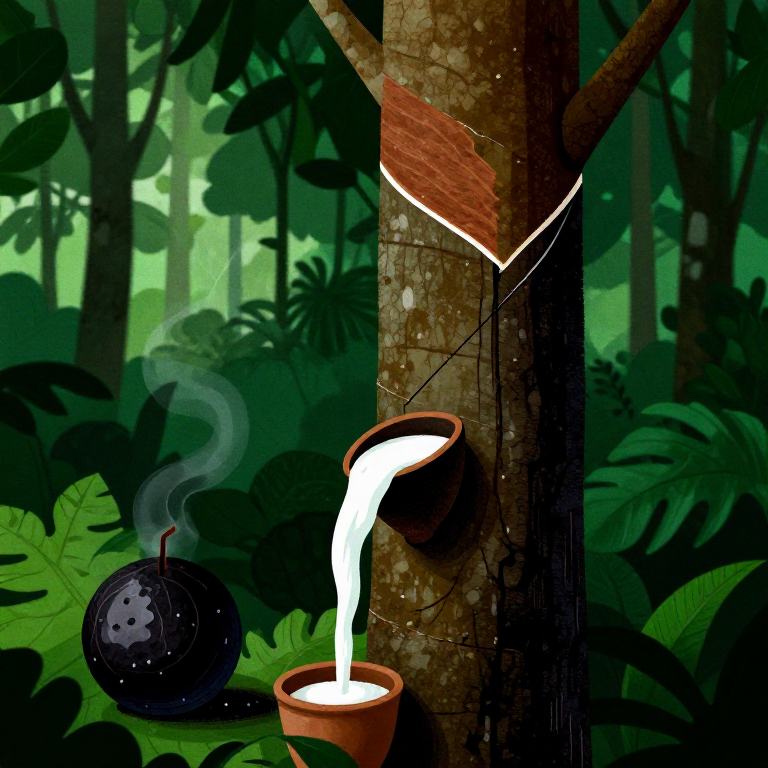
The standard cut is the half-spiral (half-spiral, S/2): a diagonal cut that runs across half the circumference of the trunk, inclined at 30 degrees to the horizontal, descending from left to right (for right-handed tappers). Start the first cut at a height of 1.50 m from the ground. The 30-degree inclination is essential because the laticifer vessels in the Hevea bark are arranged helically from right to left — a cut at 30 degrees intercepts the maximum number of vessels. Cut only the outer bark until reaching the laticifer vessels, at a depth of 1.5-2 mm. The cambium (living growth tissue) lies just below — NUNCA cut into the cambium, as it permanently damages the bark's regeneration capacity. At each tapping, shave a thin slice of bark (1-2 mm) along the previous cut, opening new vessels. The white latex will begin to flow immediately, running down the inclination of the cut into the spout and the cup.
Tools needed:
Rubber Tapping Knife (faca de seringa)Install the spout and collection cup
Install the spout and collection cup
At the lower end of the cut (lowest point of the diagonal, right side), install a metal spout (gutter) by driving it into the bark. The spout directs the latex flow into the cup. Fix the collection cup just below the spout, attached to the trunk with wire. The cup must be clean and dry — latex contaminated with rainwater or dirt coagulates prematurely and produces lower-quality rubber. A mature rubber tree typically produces 30-50 ml of latex per tapping (equivalent to 10-15 grams of dry rubber). Exceptionally productive trees can yield up to 80-100 ml. Tapping is done every 2-3 days (d/2 or d/3 system), never daily — the tree needs time to regenerate the bark and replenish the latex in the laticifer vessels.
Materials for this step:
Latex Collection Cup (tigela 300ml)1 pieceTools needed:
 Wire Cup HolderMetal Spout (bica/calha)
Collect the latex from the cups
Collect the latex from the cups
The latex flows continuously for 2-4 hours after tapping, until natural coagulation at the cut stops the flow. The rubber tapper returns along the tapping path 3-5 hours after the first tapping to collect the latex accumulated in the cups. Pour the latex from each cup into a larger collection bucket. Fresh latex is milky white, fluid, with a slightly sweet odor. Also collect the 'cernambi de tigela' — the latex that coagulated inside the cup (white/yellowish disc). Cernambi is lower-quality rubber, sold separately. Also remove the 'cernambi de fita' — the thin layer of coagulated latex on the cut, which will be scraped off at the next tapping. Clean the cups after each collection. The total collected from a path of 150 trees is typically 5-8 liters of liquid latex per tapping day.
Tools needed:
 Latex Collection Bucket (balde 20L)
Strain the latex
Strain the latex
The collected latex may contain impurities: fragments of bark, leaves, insects, and forest debris. Strain the latex through a fine stainless steel sieve (mesh 40-60) or a clean cotton cloth, pouring it into a clean container. The filtered latex should be homogeneous, milky white, without lumps or visible particles. Organic impurities degrade the quality of the final rubber — they cause dark spots, unpleasant odor and fragility in the smoked product. In the Amazonian tradition, the rubber tapper filters the latex with cotton cloth stretched over the mouth of the bucket. To preserve liquid latex for longer before smoking, 2-3 ml of ammonia solution per liter can be added — the ammonia raises the pH and prevents natural coagulation. However, in the traditional technique of immediate smoking, ammonia is generally not necessary.
Tools needed:
 Stainless Steel Strainer (40-60 mesh)
 Clean Cotton Cloth (for filtering)
Prepare the fire for smoking
Prepare the fire for smoking
Smoking (traditional smoking) is the historical method used by rubber tappers to coagulate and preserve latex. Build a small fire on the ground or in a clay oven (smokehouse), using fruits and oil-bearing seeds from the forest that produce dense white smoke. Traditionally, babaçu coconuts (Attalea speciosa), tucumã seeds (Astrocaryum aculeatum), or Brazil nut husks (Bertholletia excelsa) are used. These oil-bearing seeds produce smoke rich in acetic acid, formaldehyde, and phenolic compounds that coagulate the latex and act as antifungal and antibacterial agents, preserving the rubber. Avoid resinous wood (pine), which gives a dark color and undesirable odor. The smoke should be dense and white; light, hot smoke indicates excessive combustion. The smokehouse should have an upper opening directed where the rubber tapper positions the spit with the forming rubber ball.
Materials for this step:
 Babassu Palm Nuts5 kilogram
Tools needed:
 Clay Smokehouse
 Fire Starter
Smoking the latex to form the rubber ball
Smoking the latex to form the rubber ball
Smoking is done by rotating a wooden spit (smoking stick) horizontally over the dense smoke and gradually pouring latex over it. The spit is a straight stick of hardwood 1-1.5 m long and 3-4 cm in diameter. Wet the spit with water before starting to make later removal easier. Dip a ladle (gourd) into the latex bucket and pour a thin layer over the spit while slowly rotating it in the smoke. The smoke coagulates and dries each thin layer in 1-2 minutes. Apply the next layer over the previous one and keep rotating. The process is repeated dozens of times — layer by layer — until a spherical or oblong ball called a 'rubber ball' or 'pela' is formed. A typical ball weighs 40-60 kg when complete and requires several days of work with latex from multiple collections. Smoked rubber is dark amber to brown, is elastic, and has a characteristic smoky odor. Each layer must dry completely before the next one — layers that are too thick result in raw rubber inside.
Materials for this step:
 Filtered Latex5 liters
Tools needed:
 Wooden Smoking Paddle (pau de defumação, 1.2m)
 LadleClay Smokehouse
Remove the ball from the spit and inspect
Remove the ball from the spit and inspect
When the ball reaches the desired size (typically 20-60 kg), cut it along the spit with a sharp knife to remove it. The ball should be uniform in color (dark amber to brown), elastic to the touch, with no pockets of raw latex inside. Cut a thin slice to inspect: the interior should be homogeneous, without white layers (uncoagulated latex) or air bubbles. Good quality smoked rubber (fine rubber) is translucent when cut into a thin slice against the light. Rubber with raw layers or contamination is classified as 'sernambi' — inferior quality. The traditional classification goes from 'fina' (best) to 'entrefina' and 'sernambi' (worst). Well-smoked fine rubber can be stored for months without degradation thanks to the antifungal properties of the smoke.
Tools needed:
 Knife
Caring for the Health of Rubber Trees
Caring for the Health of Rubber Trees
Sustainable management of rubber trees is essential for long-term productivity. Each tree should rest at least 2 days between tappings (d/3 system: tapping every 3 days). Daily tapping exhausts the laticifer vessels and can kill the tree within a few years. The tapping panel (the area of bark where the cuts are made) must be renewed systematically: start at a height of 1.50 m and move down 2-3 cm per month of tapping. When the front panel descends to within 30 cm of the ground, a new panel is opened on the opposite side of the trunk. The bark regenerates in 7-10 years, allowing a return to the original panel. Watch for signs of disease: 'panel dryness' (bark dryness, brown bast disease) — areas of bark that do not exude latex — indicates stress. Reduce the tapping frequency or let the tree rest for 6-12 months. Avoid tapping during natural leaf fall (leaf change), a period when the tree is most vulnerable to the fungus Microcyclus ulei (South American leaf blight). A well-managed rubber tree produces latex for 25-30 years.
Storing and transporting rubber
Storing and transporting rubber
Smoked rubber balls should be stored in a dry, covered place with good ventilation, away from direct sunlight. Smoked rubber is hygroscopic — it absorbs moisture in humid environments, which favors the growth of fungi on the surface. In Amazonian tradition, the balls were transported by canoe along rivers and igarapés to the rubber tappers' bosses' warehouses (barracões) of the seringalistas (patrões), where they were weighed and exchanged for supplies under the aviamento system — a debt system that tied the seringueiro to the land. The balls were then sent downriver to Belém or Manaus for export. Today, natural Amazonian rubber is valued by programs such as the 'Selo de Borracha Nativa' of the Chico Mendes Extractive Reserve. Native Amazonian rubber, although it represents a small fraction of world production, has invaluable cultural and environmental value — each smoked rubber ball represents the preservation of the standing forest and the ancestral knowledge of the seringueiros.
Tools needed:
 Weighing Scale
 Covered Storage Area
Materials
3- 21 piecesPlaceholder
- 5 kilogramPlaceholder
- 5 litersPlaceholder
Tools Required
17- Placeholder
- Placeholder
- Placeholder
- Placeholder
- Placeholder
- Placeholder
- Placeholder
- Placeholder
- Placeholder
- Placeholder
- Placeholder
- Placeholder
- Placeholder
- Placeholder
- Placeholder
- Placeholder
This blueprint makes
CC0 Public Domain
This blueprint is released under CC0. You are free to copy, modify, distribute, and use this work for any purpose, without asking permission.
Support the Maker by purchasing products through their Blueprint where they earn a Maker Commission set by Vendors, or create a new iteration of this Blueprint and include it as a connection in your own Blueprint to share revenue.