ART
BEAUTY & WELLNESS
CRAFT
CULTURE & HISTORY
ENTERTAINMENT
ENVIRONMENT
FOOD & DRINKS
REVERSE ENGINEERING
SCIENCES
SPORTS
TECHNOLOGY
WEARABLES



Setting Out a Right Angle on the Ground
A carpenter's square is 300 millimetres long. A building is twenty metres long. Put the square on a corner and extend the line, and an error of half a degree you cannot even see becomes 170 millimetres of skew at the far end.
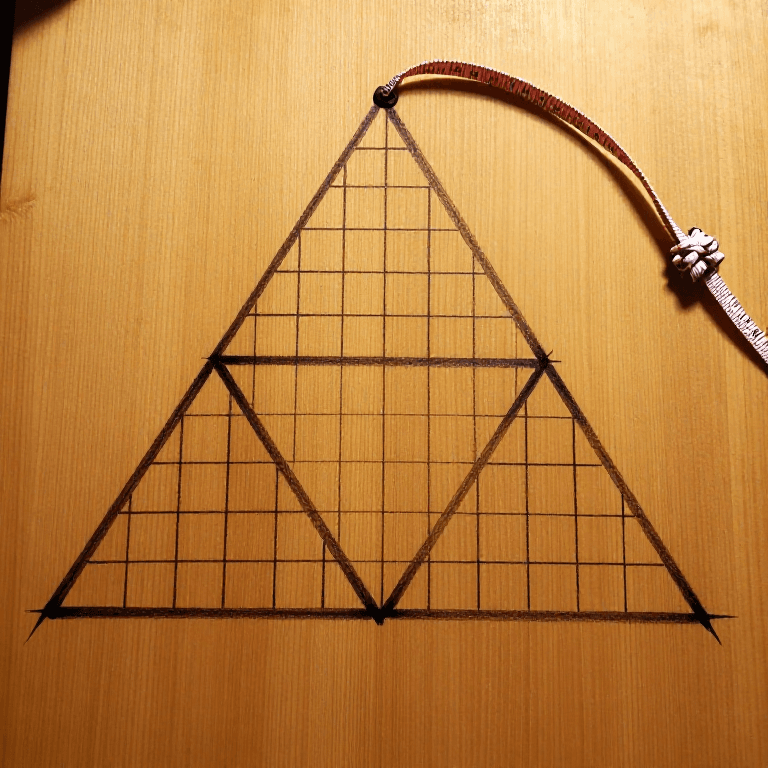
So a right angle on the ground is never set with a square. It is set with a measurement, using the 3-4-5 triangle the Egyptian rope-stretchers used and Pythagoras later explained — and the longer you make the triangle, the more accurate the corner.
This rung is short, it uses only a tape and some pegs, and getting it wrong is the reason a great many sheds have a trapezoid floor. It is also the foundation the setting-out and traverse rungs later in this batch both stand on.
Beginner
3 hours
Instructions
1
1
Set the base line first, and make it the long one
Set the base line first, and make it the long one
Drive two pegs and stretch a taut line between them. This is your base, and everything else is measured from it.
Choose the LONGEST edge of your layout as the base, because every angular error you make will be amplified by whatever you build off it. Tap a nail into the top of each peg and work to the nail, not the peg — a peg is 40 millimetres across and 'the middle of the peg' is a 40-millimetre uncertainty at the very start of the job.
Materials for this step:
 Wooden Pegs8 pieces
 Galvanized Nails20 pieces
Tools needed:
 Claw Hammer
 Measuring Tape
 String Line
2
2
Lay out 3-4-5 as large as the site allows
Lay out 3-4-5 as large as the site allows
From the corner, measure 3 units along the base and 4 units along the line you want at right angles. Adjust the second until the diagonal between the two marks reads exactly 5 units.
Use metres, not the tape's own numbers: 3-4-5 metres is good, 6-8-10 is better, 9-12-15 better still. The triangle's accuracy depends on how large it is relative to your measuring error, and a 30-metre tape costs nothing to use fully. This is the single highest-leverage choice in the whole layout.
Materials for this step:
Wooden Pegs8 piecesTools needed:
Measuring TapeClaw Hammer3
3
Check the diagonals, always
Check the diagonals, always
Once all four corners are pegged, measure both diagonals of the rectangle. They must be equal.
Equal diagonals with equal opposite sides is the definitive test that a quadrilateral is a rectangle — it checks all four corners at once, including errors that individual corner checks can hide. If they differ, move two adjacent corners by half the difference each, in opposite directions along their own lines, and re-measure. Two iterations usually converge.
Tools needed:
Measuring Tape4
4
Deal with the tape itself
Deal with the tape itself
Pull the tape with a consistent, firm tension, keep it horizontal, and do not let it sag or drag through grass.
A steel tape stretches measurably under hand tension and sags into a catenary under its own weight, both of which make the distance you read LONGER than the straight line you wanted. Over 30 metres, careless sag is easily 30 millimetres. Consistency matters more than correctness: if you pull the same way every time, the error cancels in the diagonal comparison.
Tools needed:
Measuring Tape5
5
How big to make the triangle
How big to make the triangle
Loading Jupyter Notebook...
Tools needed:
Measuring Tape6
6
Make a large fixed square for repeat work
Make a large fixed square for repeat work
If you are setting out many corners, build a permanent 3-4-5 frame from three light battens, braced and screwed, with the hypotenuse checked before every session.
A 1.5-2-2.5 metre frame is portable and five times more accurate than a carpenter's square. Check it by flipping it over and comparing the line it gives against the line it gave the other way up: any error DOUBLES between the two, which makes it easy to see and easy to halve out.
Materials for this step:
 Douglas Fir Timber Beam3 lengthGalvanized Nails20 pieces
Tools needed:
 Hand SawMeasuring TapeClaw Hammer
Materials
3- 8 piecesPlaceholder
- 40 piecesPlaceholder
- 3 lengthPlaceholder
Related Blueprints
These blueprints share knowledge with this one — techniques, materials, or principles that connect them in the learning graph.


CC0 Public Domain
This blueprint is released under CC0. You are free to copy, modify, distribute, and use this work for any purpose, without asking permission.
Support the Maker by purchasing products through their Blueprint where they earn a Maker Commission set by Vendors, or create a new iteration of this Blueprint and include it as a connection in your own Blueprint to share revenue.