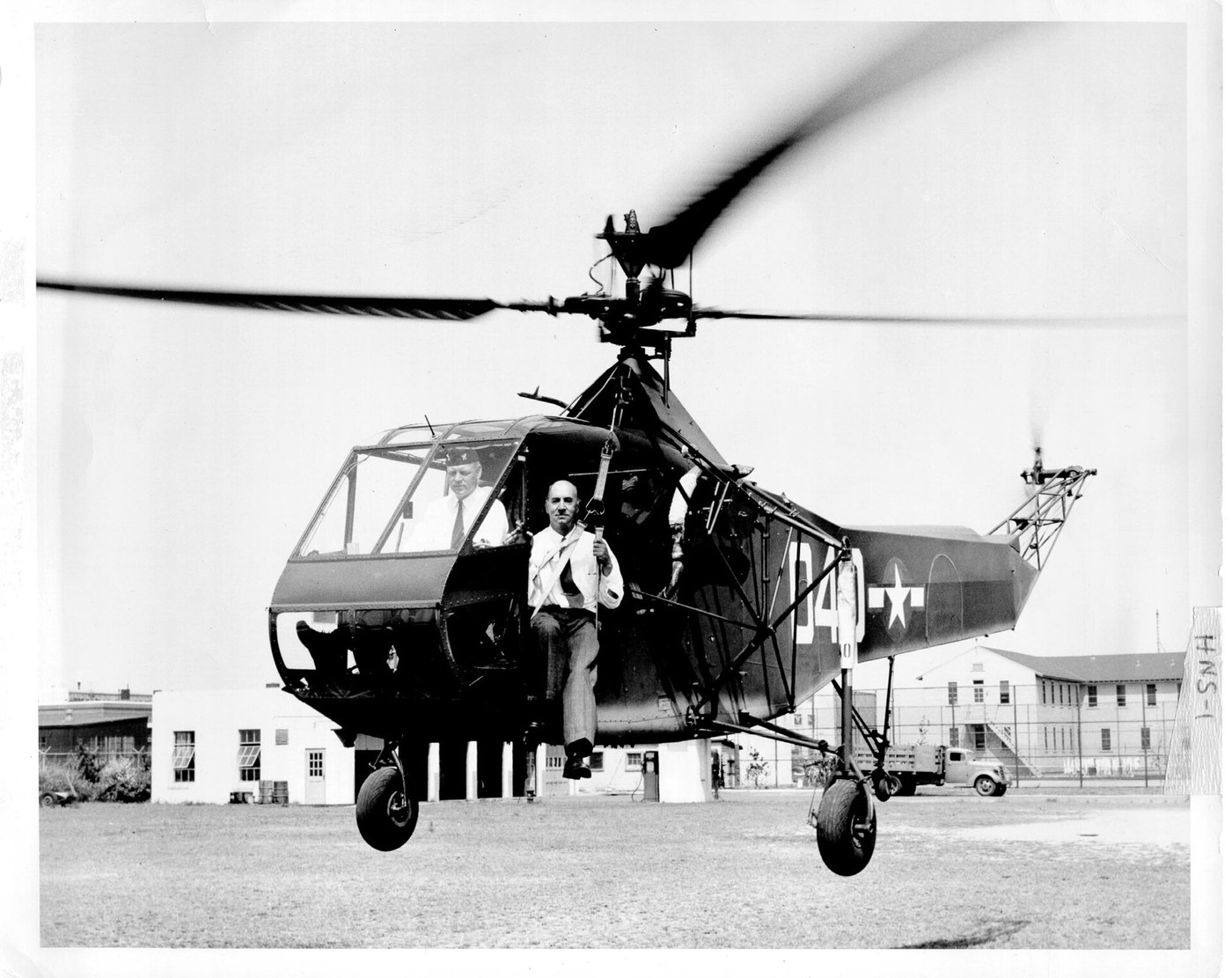

Sikorsky Helicopter
Lifting a machine vertically is not the hard part: a rotor with enough thrust will do it. The difficulty is elsewhere — by Newton's third law the fuselage begins to rotate in the opposite direction to the rotor. The craft lifts off and immediately becomes an uncontrollable carousel.
Sikorsky's answer is a small rotor on a tail boom, mounted sideways. It provides no lift at all. It produces a horizontal thrust on a long lever arm which balances the reaction torque of the main rotor. By varying its pitch the pilot yaws the machine — the same rotor serves as both compensator and rudder.
The patent is titled “Direct lift aircraft” — US 1,994,488, granted 19 March 1935 to Igor Ivanovich Sikorsky. The single main rotor plus tail rotor layout became the world standard.
Instructions
Model only, and only with guarded rotors
Model only, and only with guarded rotors
This is a bench model. Spinning blades are dangerous even at small scale: shield them with mesh, test on a tether, and never run it near people.
Read patent US 1,994,488
Read patent US 1,994,488
Sikorsky claims a lift rotor connected to a torque-compensating rotor. Not “a helicopter” in general, but specifically the pairing of two rotors.
Show the problem with a hanging motor
Show the problem with a hanging motor
Suspend a motor and propeller on a thread and switch it on. The body spins the other way. That is the reaction torque which kept helicopters on the ground for decades.
Build the frame and main rotor shaft
Build the frame and main rotor shaft
Make a light, rigid frame with a vertical shaft on bearings. All the load passes through this joint, and any play will turn into vibration.
Materials for this step:
 Plywood Sheet1 sheet
Tools needed:
 Hand Saw
Make blades with an aerofoil section and twist
Make blades with an aerofoil section and twist
Each blade is a wing. Tip speed is higher than root speed, so the pitch angle must decrease towards the tip or the thrust distribution will be badly uneven.
Balance the rotor carefully
Balance the rotor carefully
Weigh the blades and match them to a fraction of a gram. Imbalance at speed produces vibration that destroys bearings and frame within minutes.
Tools needed:
 Measuring Ruler
Extend the tail boom well back
Extend the tail boom well back
The longer the boom, the less thrust is needed: moment equals force times lever arm. A long tail is how you get away with a small tail rotor.
Materials for this step:
 Hardwood Dowel Rods 1/4"1 piece
Mount the tail rotor vertically
Mount the tail rotor vertically
The tail rotor's axis is horizontal and its disc vertical. It pushes the tail sideways and contributes nothing to lift.
Trim the thrust until the body holds still
Trim the thrust until the body holds still
Run it on the tether and vary tail rotor pitch until the fuselage stops rotating. That balance point is a working helicopter.
Confirm the tail rotor is also the rudder
Confirm the tail rotor is also the rudder
Give slightly more or less thrust: the machine yaws. One assembly solves two problems — compensation and control.
Add collective pitch
Add collective pitch
Link the blades so their angle changes together. Rotor speed is held constant and height is controlled by pitch — faster and more precise than changing rpm.
Materials for this step:
 Mild Steel Rod (6mm)1 piece
Understand why cyclic pitch is needed
Understand why cyclic pitch is needed
In forward flight the advancing blade has a higher airspeed than the retreating one, so lift becomes asymmetric. Varying pitch cyclically around the disc evens it out.
Add flapping hinges
Add flapping hinges
Let the blades flap freely up and down. This removes the bending moment at the root — Juan de la Cierva's solution, without which the rotor breaks.
Measure how much power goes to the tail
Measure how much power goes to the tail
Compare consumption with and without the tail rotor. A noticeable fraction of engine power goes to compensation — the price of the single-rotor layout's simplicity.
Compendium — the small rotor that solved everything
Compendium — the small rotor that solved everything
The patent. US 1,994,488, “Direct lift aircraft”, granted 19 March 1935 to Igor Ivanovich Sikorsky. Sikorsky was born in Kyiv in the Russian Empire, where he built the world's first multi-engined aeroplanes — the Russky Vityaz and the Ilya Muromets — emigrated after the revolution, and founded his company in the United States. The first controlled flight of his VS-300 was on 14 September 1939.
Reaction torque, not lift. Lifting by rotor was well understood: Juan de la Cierva's autogyro flew from 1923, and the German Focke-Wulf Fw 61 flew in 1936 on two counter-rotating rotors. What remained unsolved was the reaction: the engine turns the rotor, and the rotor turns the fuselage with equal force. Coaxial and side-by-side layouts balance the torque with a second lifting rotor — which works, but doubles the transmission. Sikorsky used a small rotor on a long lever arm: moment equals force times distance, so the tail rotor can be weak if the boom is long enough.
One assembly, two functions. The tail rotor compensates torque and simultaneously acts as a rudder: changing its pitch yaws the machine. The price is that a share of engine power goes to the tail and produces no lift, and the boom itself is vulnerable. That is why alternatives such as NOTAR and Kamov's coaxial designs exist — and why the classic layout still dominates anyway: it is simpler and lighter than any of them.
What is not in this patent. The swashplate with cyclic pitch, and the flapping hinges, are other engineers' contributions, principally de la Cierva's. Without a flapping hinge a rotor tears itself apart in forward flight: the advancing blade generates more lift than the retreating one and the blade root works in bending. A modern helicopter is the sum of several inventions, and Sikorsky's patent covers exactly one of them — but the one that made the configuration practical.
Materials
3- 1 sheetPlaceholder
- 1 piecePlaceholder
- 1 piecePlaceholder
Related Blueprints
These blueprints share knowledge with this one — techniques, materials, or principles that connect them in the learning graph.


CC0 Public Domain
This blueprint is released under CC0. You are free to copy, modify, distribute, and use this work for any purpose, without asking permission.
Support the Maker by purchasing products through their Blueprint where they earn a Maker Commission set by Vendors, or create a new iteration of this Blueprint and include it as a connection in your own Blueprint to share revenue.