Collaboration
ART
BEAUTY & WELLNESS
CRAFT
CULTURE & HISTORY
ENTERTAINMENT
ENVIRONMENT
FOOD & DRINKS
REVERSE ENGINEERING
SCIENCES
SPORTS
TECHNOLOGY
WEARABLES
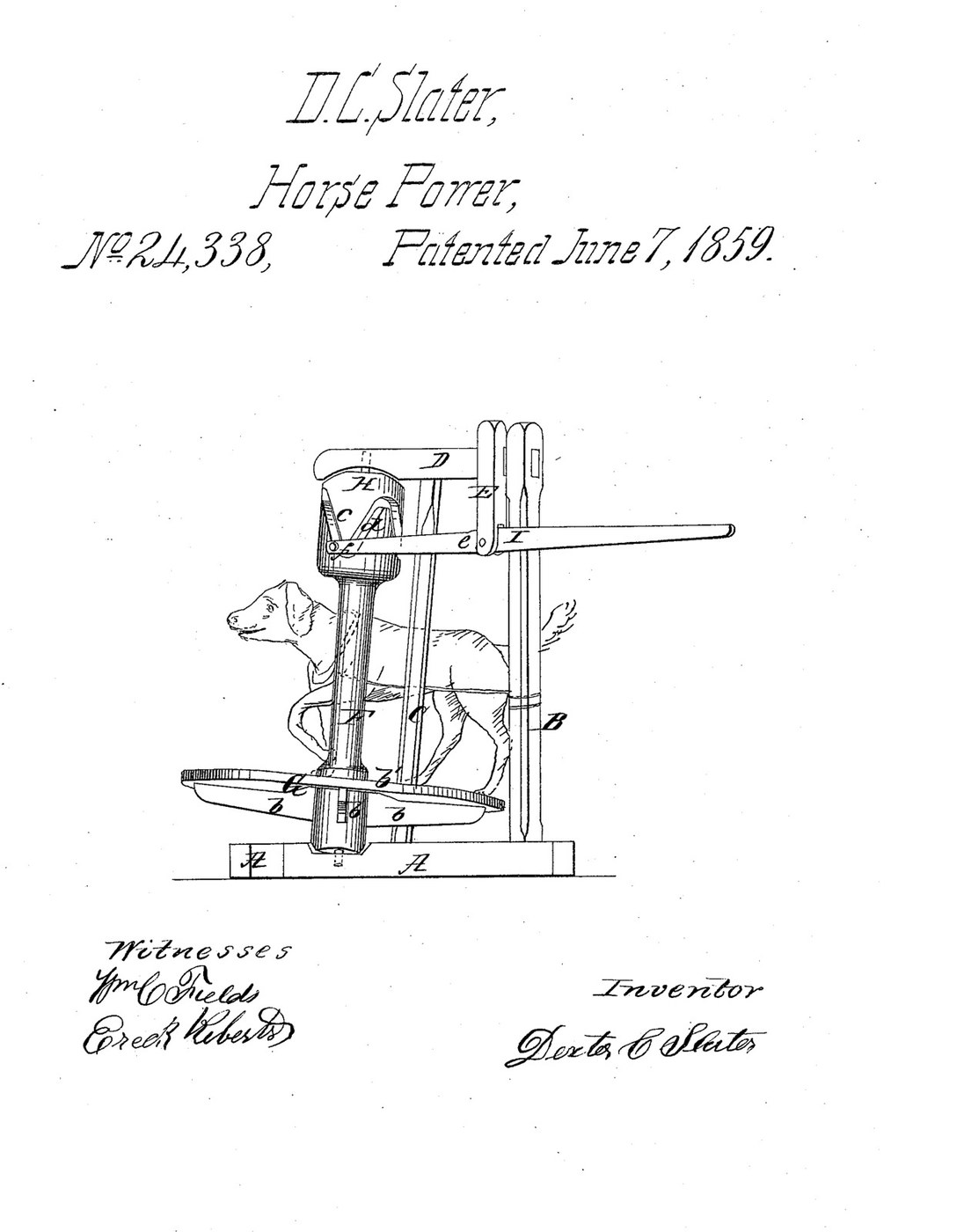


Inclined-Wheel Cam Dog Power: A Dog Turns a Tilted Platform; a Zig-Zag Cam Rocks the Churn Lever
Dexter C. Slater of Laurens, New York, received US 24,338, dated 7 June 1859, for a simple, portable dog power for light machinery such as churns. A tilted platform is fixed square to an inclined shaft; a dog walking on it turns it. On the shaft's upper part a cam has a zig-zag groove right round it; a roller on the end of a lever runs in the groove, so the lever rocks on its pin as the shaft turns, and the work is taken from the lever.
This rung builds it full size for a dog, working a bucket churn's dasher.
Advanced
About 3 days, plus printing
Instructions
1
1
Slope, strokes and stroke length
Slope, strokes and stroke length
Loading Jupyter Notebook...
2
2
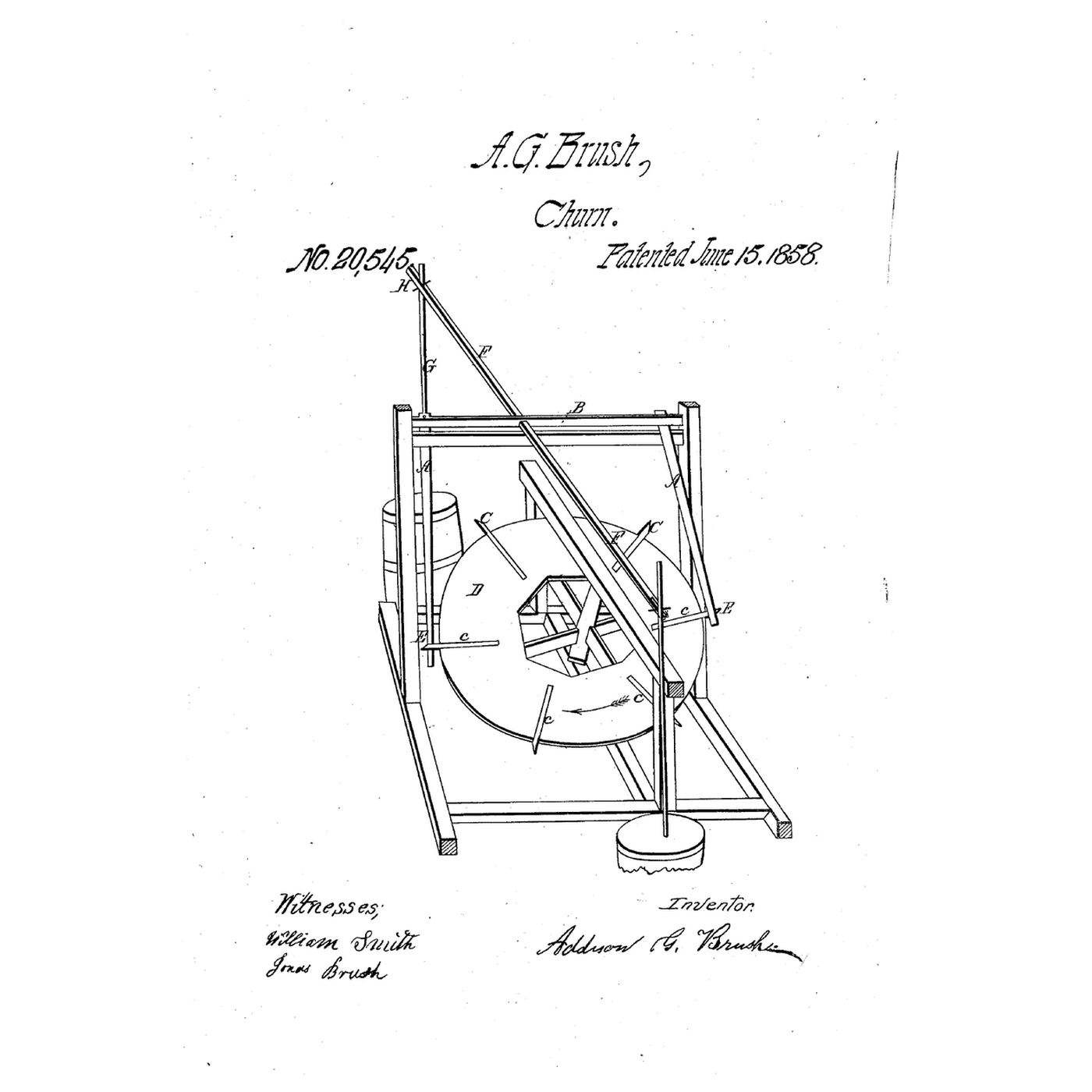
A dog's tread-wheel working a churn, before it
A dog's tread-wheel working a churn, before it
Brush rocked a shaft with tappets on the wheel's rim. Slater rocks a lever with a grooved cam on the wheel's own shaft.
3
3
Read US 24,338
Read US 24,338
"The dog is placed on the wheel G, and rotates it by the movement of his legs, and the cam H, as it rotates gives a vibrating motion to the lever I, from which the power is taken."
4
4
Print the cam segment
Print the cam segment
A quarter of cam H with its share of the zig-zag groove. Print four. PETG, 0.2 mm layers, 50 % infill, 5 walls.
5
5
Print the step block
Print the step block
The 15-degree block on the sill for the shaft's lower bearing. PETG, 0.2 mm layers, 50 % infill, 5 walls.
6
6
Sills, posts and bar D
Sills, posts and bar D
From 70 mm square timber lay sill A 1665 mm long and a front sill 1000 mm long across its end. Stand post B upright and post C beside it, 260 mm apart, on the front sill, and join their tops with bar D running back 660 mm over the shaft's top. Screw the printed step block on sill A 870 mm behind the front sill and bolt a flange bearing on it; bolt a second flange bearing under bar D so a line between the two leans 15 degrees toward the posts.
Materials for this step:
 Softwood Timber 70x70mm6 pieces
 #10 x 3" Wood Screw30 pieces
 PETG Filament1 piece
 Flange Bearing2 pieces
 Hex Bolt Set M104 pieces
Tools needed:
 FDM 3D Printer
 Hand Saw
 Cordless Drill
 Drill Bit Set
 Adjustable Spanner
 Spirit Level
 Protractor
 Tape Measure
7
7
Shaft F and wheel G
Shaft F and wheel G
Halve two 70 mm timbers 1300 mm long into a cross for arms b, bore the crossing 30 mm and glue and screw two layers of 18 mm plywood cut to a 1400 mm disc on them as platform b'. Screw pine cleats on top for the dog's grip. Pass a 30 mm steel shaft 1335 mm long through the lower bearing, the wheel and the top bearing, and cross-bolt the wheel to it 250 mm above the step. The platform is square to the shaft, so it tilts 15 degrees.
Materials for this step:
Softwood Timber 70x70mm2 pieces Plywood Sheet5 pieces
 Wood Glue1 piece
 #8 x 1" Wood Screw120 pieces
 Pine Board1 piece
 Steel Shaft 30mm1 pieceHex Bolt Set M101 piece
Tools needed:
 JigsawHand SawCordless Drill
 Spade Bit Set
 ClampsAdjustable Spanner
 Sandpaper
8
8
Cam H, pendant E and lever I
Cam H, pendant E and lever I
Bolt the four cam segments round a hardwood hub on the shaft, 990 to 1150 mm above the step, so the groove runs unbroken round them. Screw two hardwood cheeks down from bar D as pendant E, about 190 mm in front of the cam's face, and drill them 12.5 mm for the fulcrum pin e. Cut a hardwood lever I 30 x 20 mm, 815 mm long, drilled for the pin 174 mm from its inner end. Fit a 28 mm printed or hardwood roller f on a 10 mm stainless stub through the inner end, set it in the groove and bolt the lever between the cheeks.
Materials for this step:
PETG Filament1 piece Hardwood Board2 pieces
 Carriage Bolt8 pieces
 Flat Washer12 pieces
 Nylon Insert Lock Nut10 pieces
 Stainless Steel Rod1 piece#10 x 3" Wood Screw6 pieces
Tools needed:
FDM 3D PrinterHand SawCordless DrillDrill Bit Set HacksawAdjustable Spanner
9
9
The churn
The churn
Stand a food-grade 20-litre bucket under the lever's outer end, 600 mm beyond the pin. Hang a 12 mm stainless rod 900 mm long from the lever's end on a bolt, through a slot in the bucket's lid, with a 220 mm dasher of plywood screwed to its foot so it works between about 95 and 340 mm above the floor. Put an eye bolt in post B for the dog's lead.
Materials for this step:
 20-Liter Bucket1 pieceStainless Steel Rod1 piecePlywood Sheet1 piece#8 x 1" Wood Screw4 piecesHex Bolt Set M101 piece
 Eye Bolt1 piece
Tools needed:
JigsawCordless DrillDrill Bit SetAdjustable Spanner10
10
The build in 3D
The build in 3D
FreeCAD model of this build: the sills, posts B and C and bar D, the tilted shaft in its bearings, the platform on its arms with cleats, the zig-zag cam, the pendant with lever I and its roller in the groove, and the rod and dasher into the bucket. It was checked at eight cam angles.
11
11
Train the dog and churn
Train the dog and churn
Use a harness, never a collar, on a lead to the eye bolt in post B, the dog standing on the platform facing up the slope. Start with short sessions and treats until it walks calmly. Pour about 9 litres of heavy cream at about 15 °C into the bucket, checked with the thermometer, put the lid on and let the dog walk; time it. When the butter comes, pour off the buttermilk, wash the butter in cold water until it runs clear, work in a pinch of salt and weigh it.
Materials for this step:
 Dog Harness1 piece
 Water Bowl1 piece
 Heavy Cream9 l
 Coarse Sea Salt1 piece
 Water1 piece
Tools needed:
 Leave-In Probe Thermometer
 Stopwatch
 Digital Kitchen Scale
 Stainless Steel Mixing Bowl (Large)
12
12
Troubleshooting
Troubleshooting
Dog-power troubleshooting.
Flow
Loading...
13
13
History and honest limits
History and honest limits
**Dexter C. Slater** of Laurens, Otsego County, New York, US 24,338, 7 June 1859. He meant it to be simple, cheap and portable, almost wholly of wood, with metal strips only to face the groove, and claimed the wheel, shaft, cam and lever together. He gave no sizes: the tilt, the platform, the cam's two zig-zags and throw, the lever and the bucket churn are ours.
Materials
22- 6 piecesPlaceholder
- 36 piecesPlaceholder
- 2 piecesPlaceholder
- 2 piecesPlaceholder
- 6 piecesPlaceholder
- 5 piecesPlaceholder
- 1 piecePlaceholder
- 124 piecesPlaceholder
- 1 piecePlaceholder
- 1 piecePlaceholder
- 2 piecesPlaceholder
- 8 piecesPlaceholder
- 12 piecesPlaceholder
- 10 piecesPlaceholder
- 1 piecePlaceholder
- 1 piecePlaceholder
- 1 piecePlaceholder
- 1 piecePlaceholder
- 1 piecePlaceholder
- 9 lPlaceholder
- 1 piecePlaceholder
- 1 piecePlaceholder
Tools Required
17- Placeholder
- Placeholder
- 1 vendor sell this, none ship to you yetPlaceholder
- Placeholder
- Placeholder
- Placeholder
- Placeholder
- 1 vendor sell this, none ship to you yetPlaceholder
- 1 vendor sell this, none ship to you yetPlaceholder
- Placeholder
- Placeholder
- Placeholder
- Placeholder
- Placeholder
- Placeholder
- Placeholder
- Placeholder
Design Files
3This blueprint makes


Related Blueprints
These blueprints share knowledge with this one — techniques, materials, or principles that connect them in the learning graph.


CC0 Public Domain
This blueprint is released under CC0. You are free to copy, modify, distribute, and use this work for any purpose, without asking permission.
Support the Maker by purchasing products through their Blueprint where they earn a Maker Commission set by Vendors, or create a new iteration of this Blueprint and include it as a connection in your own Blueprint to share revenue.