Collaboration
ART
BEAUTY & WELLNESS
CRAFT
CULTURE & HISTORY
ENTERTAINMENT
ENVIRONMENT
FOOD & DRINKS
REVERSE ENGINEERING
SCIENCES
SPORTS
TECHNOLOGY
WEARABLES
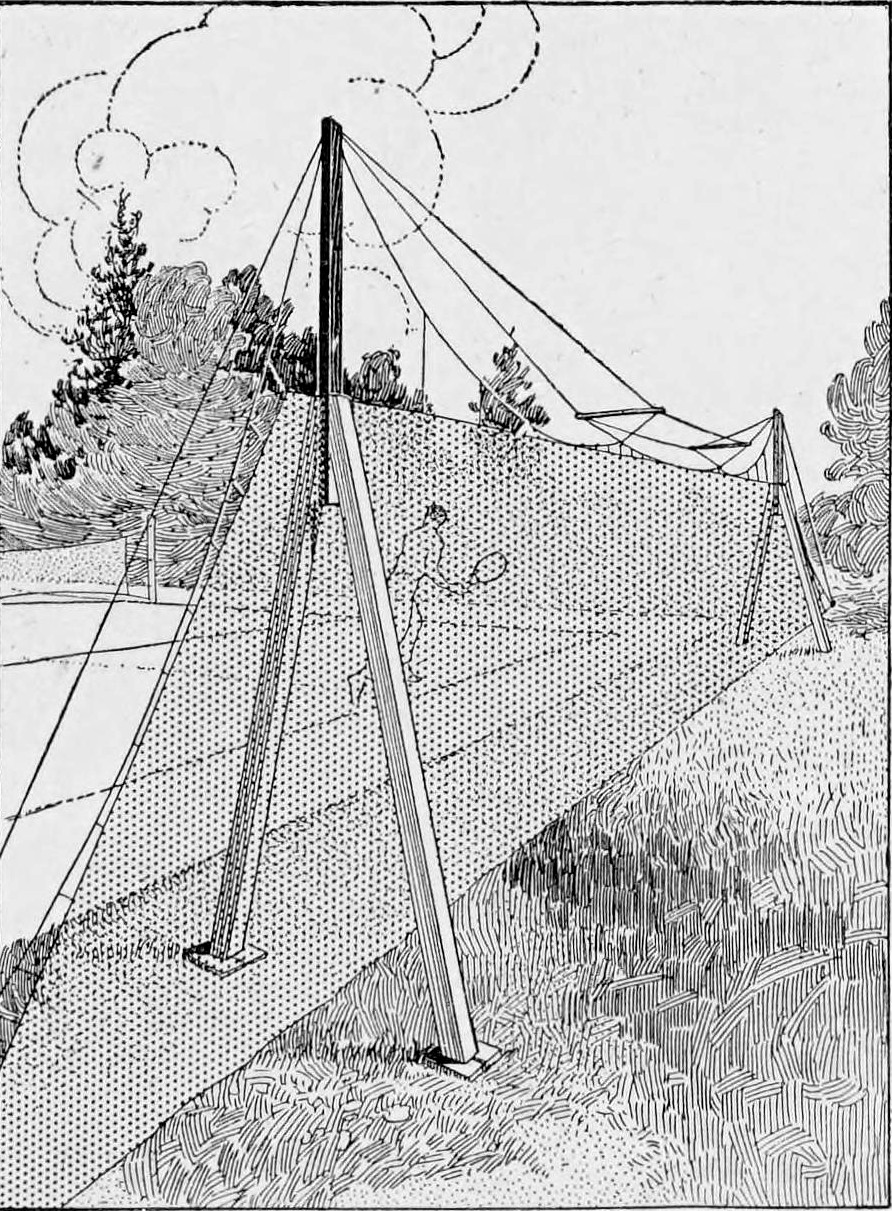


Knock-Down Tennis-Court Backstop: Guyed Yellow-Pine Towers on the Ground and Hooked-Down Netting (Boy Mechanic, 1919)
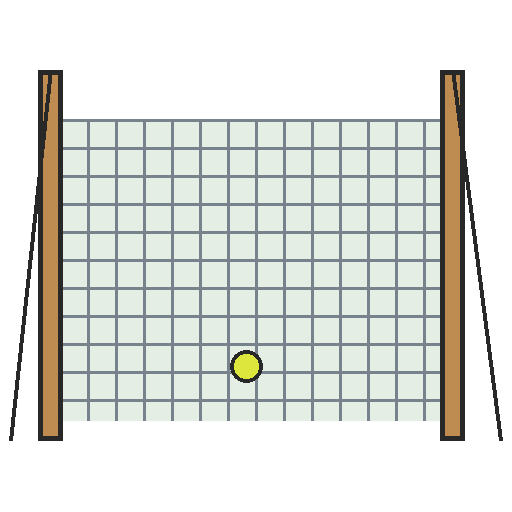
Edward R. Smith's take-down tennis backstop from The Boy Mechanic, Book 3 (1919): two towers about 14 ft high and 50 ft apart, of 4 x 4 and 2 x 4 in yellow pine, stand on brick footings and are guyed with heavy wire; the wire netting hangs from supporting wires on 2 ft crossarms and is hooked to tent stakes at the bottom, so the whole rig comes down between seasons.
Intermediate
About 2 days
Instructions
1
1
Sizes and wire gauges
Sizes and wire gauges
Loading Jupyter Notebook...
2
2
Read The Boy Mechanic, Book 3
Read The Boy Mechanic, Book 3
"Instead of setting the supports in the ground, they are set on the ground, and guyed by a system of wire braces."
3
3
Build the towers and footings
Build the towers and footings
Build two towers about 14 ft high from sound 4 by 4 in and 2 by 4 in yellow-pine timber, to stand 50 ft apart. Make brick foundations, anchored into the ground, for them to stand on, and sink anchors in the ground beyond each end.
Materials for this step:
 Pine Lumber6 pieces
 Nails1 piece
 Carriage Bolt4 pieces
 Brick20 pieces
Tools needed:
 Hand Saw
 Brace and Bit
 Hammer
 Shovel
 Tape Measure
4
4
Guy the towers
Guy the towers
Fasten end braces of heavy wire (No. 9) to the top of each tower and guy them to the sunken anchors; they carry the weight of the netting and let a ladder lean safely on the guyed end of a tower.
Materials for this step:
 Galvanised Steel Wire1 piece
Tools needed:
 Wooden Ladder
 Flat-Nose Pliers
5
5
Rig the supporting wires and hang the netting
Rig the supporting wires and hang the netting
Run the supporting wires (No. 20 gauge, as printed) between the towers on crossarms of 1 by 1 in wood, 2 ft long, which stop side motion at the top; wire them to the netting and draw them up so it is fairly taut. Add more supporting wires with vertical leaders to the netting to draw its whole length taut. Let the netting run under the towers, held there by wires, nearly to the end guys.
Materials for this step:
 Softwood Batten2 piecesGalvanised Steel Wire1 piece
 Galvanised Wire Mesh1 piece
Tools needed:
Wooden LadderFlat-Nose PliersHand Saw6
6
Hook down the bottom and mark the guys
Hook down the bottom and mark the guys
Hold the lower edge of the netting down with hooks pinned to the ground by tent stakes, so it can be unhooked to mow. Tie a white flag to each guy wire about 6 ft from the ground so players see it.
Materials for this step:
 Iron Wire1 piece
 Tent Stake12 pieces
 Flag2 pieces
Tools needed:
HammerFlat-Nose Pliers7
7
Season and troubleshooting
Season and troubleshooting
Backstop troubleshooting.
Flow
Loading...
8
8
History and honest limits
History and honest limits
From "A Knock-Down Tennis-Court Backstop" by Edward R. Smith, in **The Boy Mechanic, Book 3**, Popular Mechanics, 1919 (Project Gutenberg 71856; checked on the archive.org scan boymechanic0003unse, p. 189). He gives no netting height or mesh, no tower framing details and no anchor type, and No. 20 gauge for the supporting cables is as printed. The tools and metric figures are ours.
Materials
10- 6 piecesPlaceholder
- 1 piecePlaceholder
- 4 piecesPlaceholder
- 20 piecesPlaceholder
- 2 piecesPlaceholder
- 2 piecesPlaceholder
- 1 piecePlaceholder
- 1 piecePlaceholder
- 12 piecesPlaceholder
- 2 piecesPlaceholder
This blueprint makes
Related Blueprints
These blueprints share knowledge with this one — techniques, materials, or principles that connect them in the learning graph.
CC0 Public Domain
This blueprint is released under CC0. You are free to copy, modify, distribute, and use this work for any purpose, without asking permission.
Support the Maker by purchasing products through their Blueprint where they earn a Maker Commission set by Vendors, or create a new iteration of this Blueprint and include it as a connection in your own Blueprint to share revenue.