Collaboration
ART
BEAUTY & WELLNESS
CRAFT
CULTURE & HISTORY
ENTERTAINMENT
ENVIRONMENT
FOOD & DRINKS
REVERSE ENGINEERING
SCIENCES
SPORTS
TECHNOLOGY
WEARABLES
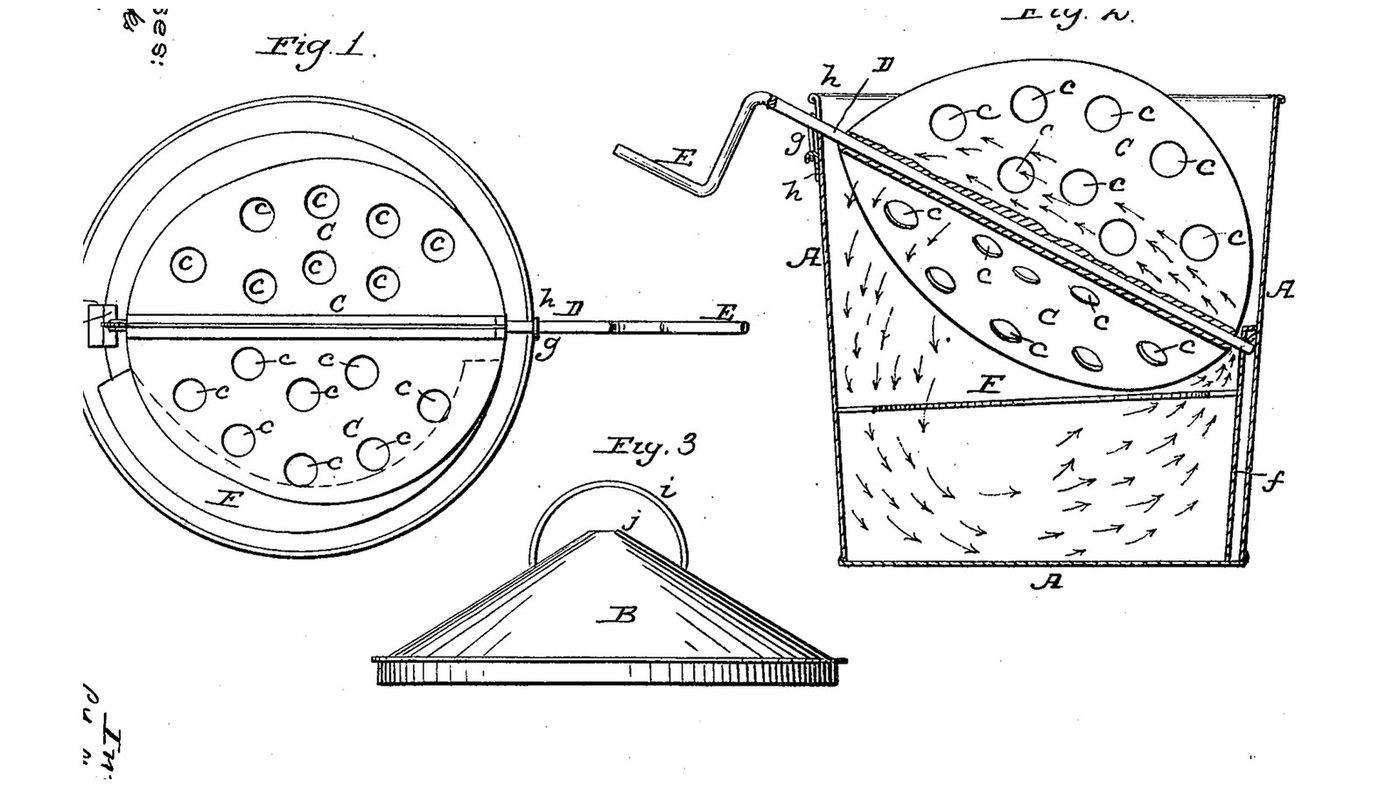

Oblique Perforated-Dasher Churn: A Slanted Spindle Drives the Cream Down and Sideways, a Guard Turns It Back
E. N. Sprinkle of Marion, Virginia, received US 25,985, dated 1 November 1859, for a churn. Three perforated dashers turn on a spindle set slantwise across the churn, from a standard low on one side to a slot in the rim on the other, and a crank on its end turns it fast. The cream is driven down and towards one side and cut by the holes' edges; a sloping guard under the dashers sends it back up to them, and the bottom stays clear for gathering the butter.
The patent gives no sizes; every size here is ours.
Beginner
About a day, plus printing
Instructions
1
1
The spindle's slope, and where the cream goes
The spindle's slope, and where the cream goes
Loading Jupyter Notebook...
2
2
A turning dasher with curved wings, seven weeks before
A turning dasher with curved wings, seven weeks before
Hassler's dasher stands upright. Sprinkle tilts his spindle so the dashers drive the cream sideways too.
3
3
Read US 25,985
Read US 25,985
"By reason of the dashers being operated in an oblique position, it will be seen that the cream will not only be forced down but will also be forced toward the side of the churn which supports the upper end of the dasher shaft, and is thus not only effectually agitated by the motion of the dashers, but is also cut and stirred by the edges of the perforations c, c, c, in the dashers"
4
4
Print the dashers C
Print the dashers C
Three perforated half-ellipse blades, 210 x 80 mm and 4 mm thick, round a 24 mm tube bored 12.6 mm, with a cross hole for a pin. Print with supports. PETG, 0.2 mm layers, 40 % infill, 4 walls.
5
5
Print the standard f
Print the standard f
A post 30 mm square and 178 mm tall on a 60 mm base with an M6 nut trap, its top bored 12.8 mm at 38 degrees for the spindle's lower end, e. PETG, 0.2 mm layers, 40 % infill, 4 walls.
6
6
Print the guard's leg
Print the guard's leg
A leg 24 mm across and 92 mm tall on a 50 mm foot, to hold the guard's low end. PETG, 0.2 mm layers, 40 % infill, 4 walls.
7
7
Standard f, guard F and slot h
Standard f, guard F and slot h
Drill a 6.5 mm hole in the bucket's floor 115 mm from its centre. Push an M6 nut into the standard's trap, lay an O-ring under its base and bolt it over the hole from underneath, its sloping bore facing across the bucket. Cut the guard F from 8 mm hardwood: a half-circle to fit the bucket 110 mm up, notched round the standard. Screw it to the standard's side 125 mm up and onto its leg, 95 mm up at the far end, on one side of the spindle's line. Cut a slot 13 mm wide and 12 mm deep in the rim opposite the standard, and screw an eye h' beside it.
Materials for this step:
 20-Liter Bucket1 piece
 Hex Bolt Assortment1 piece
 Hex Nut1 piece
 Flat Washer1 piece
 O-Ring1 piece
 Hardwood Board1 piece
 Wood Screws4 pieces
 Hook and Eye1 piece
 PETG Filament1 piece
Tools needed:
 FDM 3D Printer
 Cordless Drill
 Drill Bit Set
 Jigsaw
 Compass
 Hacksaw
 Files (Hand File)
 Adjustable Spanner
 Screwdriver Set
8
8
Spindle D and crank E
Spindle D and crank E
Cut 12 mm stainless rod 625 mm long. Heat 415 mm from one end with the torch and bend it at right angles, then 120 mm further on bend it back parallel to make the crank. Slide the dasher onto the straight part and pin it 70 mm from the end. Set the end into the standard's bore and lay the spindle in the slot, then hook the catch g over it into the eye.
Materials for this step:
 Stainless Steel Rod1 piece
Tools needed:
 Propane Torch
 Bench Vise
 Hammer
 Heat-Resistant GlovesHacksawFiles (Hand File)Cordless DrillDrill Bit Set
9
9
Cover B
Cover B
Cut a hardwood cover to sit on the rim, with a notch for the spindle at the slot, a 10 mm vent hole j, and a screw eye in the middle with a ring of stainless wire for lifting, i.
Materials for this step:
Hardwood Board1 piece Screw Eye1 piece
 Stainless Steel Wire1 piece
Tools needed:
JigsawCompassCordless DrillDrill Bit Set Sandpaper
10
10
The build in 3D
The build in 3D
FreeCAD model of this build, the bucket and cover cut through the middle: the standard, the slanting spindle with its crank, the three-bladed dasher, and the guard on its leg. The dasher was turned through 24 angles.
11
11
Churn
Churn
Pour about 6 litres of heavy cream at about 15 °C into the bucket, checked with the thermometer, and put the cover on. Turn the crank fast and steadily, timing it. When the butter comes, unhook the catch, lift the spindle and dasher out, gather the butter from the clear bottom, drain the buttermilk, wash the butter in cold water until it runs clear, salt and weigh it.
Materials for this step:
 Heavy Cream6 l
 Coarse Sea Salt1 piece
 Water1 piece
Tools needed:
 Leave-In Probe Thermometer
 Stopwatch
 Digital Kitchen Scale
 Stainless Steel Mixing Bowl (Large)
12
12
Troubleshooting
Troubleshooting
Oblique dasher churn troubleshooting.
Flow
Loading...
13
13
History and honest limits
History and honest limits
**E. N. Sprinkle** of Marion, Smyth County, Virginia, US 25,985, 1 November 1859, "Churn". He claimed, as an improvement on the churn patented to Hatfield and Goldsmith on 13 July 1858, "the combination of the perforated obliquely arranged dashers C, C, C, with the single inclined stationary guard F". The patent gives no sizes; every size here is ours. His cover is conical; ours is flat.
Materials
15- 1 piecePlaceholder
- 1 piecePlaceholder
- 1 piecePlaceholder
- 1 piecePlaceholder
- 1 piecePlaceholder
- 1 piecePlaceholder
- 4 piecesPlaceholder
- 1 piecePlaceholder
- 1 piecePlaceholder
- 1 piecePlaceholder
- 1 piecePlaceholder
- 1 piecePlaceholder
- 6 lPlaceholder
- 1 piecePlaceholder
- 1 piecePlaceholder
Tools Required
18- Placeholder
- 1 vendor sell this, none ship to you yetPlaceholder
- Placeholder
- 1 vendor sell this, none ship to you yetPlaceholder
- Placeholder
- Placeholder
- Placeholder
- Placeholder
- Placeholder
- Placeholder
- Placeholder
- Placeholder
- Placeholder
- Placeholder
- Placeholder
- Placeholder
- Placeholder
- Placeholder
Design Files
4This blueprint makes

Related Blueprints
These blueprints share knowledge with this one — techniques, materials, or principles that connect them in the learning graph.
Hinged-Leaf Wing Dasher Churn: Turn One Way to Churn, Reverse and a Leaf Opens to Gather the Butter
by Buttercup
Woodworking
1
0
0
0
0
0
Hooked Breaker-Frame Churn: Breakers Held Still From the Lid, Then Hooked to the Dasher to Gather
by Buttercup
FOOD & DRINKS
1
0
0
0
0
0

Churning Butter from Cream — The 5,000-Year-Old Fat Separation
by TheChef
CRAFT
60
0
0
0
0
0
CC0 Public Domain
This blueprint is released under CC0. You are free to copy, modify, distribute, and use this work for any purpose, without asking permission.
Support the Maker by purchasing products through their Blueprint where they earn a Maker Commission set by Vendors, or create a new iteration of this Blueprint and include it as a connection in your own Blueprint to share revenue.