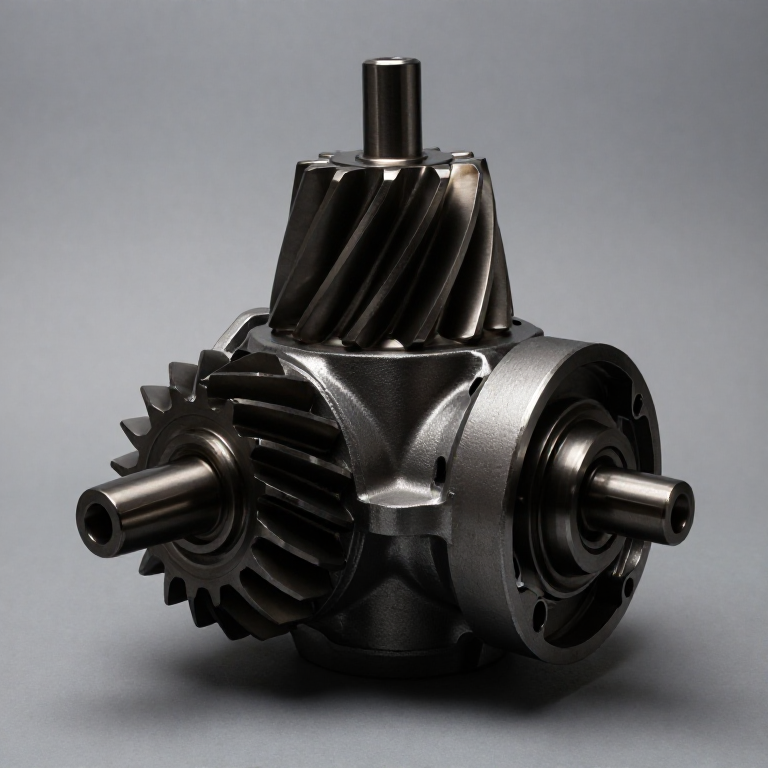


Differential Gear
Drive two wheels from one rigid axle and they must turn at the same speed. Go round a corner and they cannot — the outer wheel travels further than the inner one. Something has to give, and what gives is grip: one tyre scrubs sideways the whole way round the bend, wearing itself out, fighting the steering and loading the axle.
The differential lets one shaft drive two wheels that are free to turn at different speeds, while still splitting the torque between them. It does it with bevel gears: the drive turns a carrier, and small pinions inside that carrier can rotate on their own pins. If both wheels turn equally the pinions do not spin at all and the whole assembly revolves as one lump. If one wheel slows, the pinions roll, and exactly as much as one wheel loses the other gains.
The arithmetic is the elegant part and it is worth stating plainly: the two output speeds always average the carrier speed. Not approximately — exactly, at every instant, whatever the corner.
James Starley patented it as a balance gear, British patent 3388 of 1877, and fitted it to his Salvo tricycle. He was solving a tricycle problem. It went on to sit in the back axle of essentially every rear-wheel-drive car ever built.
Instructions
Measure the problem before you solve it
Measure the problem before you solve it
Draw a corner. Inner wheel radius 4 m, track width 1.4 m, so the outer wheel runs a radius of 5.4 m.
Arc length is proportional to radius, so over a quarter turn the outer wheel travels 5.4/4 = 1.35× as far. The outer wheel must turn 35% faster.
On a rigid axle it cannot. Write down what has to happen instead: one tyre must slide 35% of its rolling distance. That is the scrub the differential removes.
Build the carrier
Build the carrier
Mount two bevel gears facing each other on a common axis, each fixed to one output shaft, free to rotate.
Around them build a carrier — a frame that can rotate about the same axis, carrying two cross pins at right angles to the shafts.
Materials for this step:
 Bevel Gear Set (Steel, 1:1)2 pieces
 Steel Shaft 30mm2 pieces
Tools needed:
 Bench Vise
Add the pinions — the part that does the thinking
Add the pinions — the part that does the thinking
Fit two smaller bevel pinions on the cross pins so they mesh with both output gears at once.
Each pinion has two jobs simultaneously: it carries drive round with the carrier, and it can spin on its own pin. Those two motions superimpose, and that superposition is the entire mechanism.
Materials for this step:
 Bevel Pinion Gear (Steel)2 pieces
 Ball Bearings4 pieces
Test one: hold nothing
Test one: hold nothing
Turn the carrier one full revolution with both outputs free.
Expect both outputs to turn once, and the pinions not to rotate on their pins at all. Mark a pinion with tape and watch it — it orbits, it does not spin.
Straight-line driving. The differential is doing nothing, which is correct.
Test two: hold one output still
Test two: hold one output still
Now clamp one output shaft so it cannot turn, and rotate the carrier one full revolution.
Expect the free output to turn exactly twice.
That is the law in its starkest form: the two outputs average the carrier. One does 0, so the other must do 2 for the average to be 1. Count it out loud — it is exact, not approximate.
Find the flaw
Find the flaw
Hold one output with your fingers only, lightly, and turn the carrier.
The lightly-held shaft spins fast and the other barely moves. Torque follows the path of least resistance — an open differential sends equal torque to both sides, so the side with less grip sets the limit for both.
This is why a car with one wheel on ice goes nowhere while that wheel spins. Starley's mechanism is exactly right for cornering and exactly wrong for traction, and every limited-slip differential and traction-control system since exists to patch this one behaviour.
History & Context
History & Context
The patent. British patent 3388 of 1877, James Starley, for what he called a balance gear. He fitted it to the Salvo tricycle, sold as the Coventry Salvo — a machine with two closely-spaced wheels on one side, which made the cornering problem acute enough to be worth solving.
Starley did not invent the differential. Onésiphore Pecqueur is generally credited with it in 1827 for a steam carriage, and the principle appears far earlier still — the Chinese south-pointing chariot uses differential gearing, though how much its builders understood of the mechanism is genuinely unknown. What Starley did was make it small, cheap, reliable and manufactured in quantity. That is a different achievement, and it should be described as the one it is.
Why a bicycle man mattered to cars. The Coventry cycle trade of the 1870s–80s produced ball bearings, tangent-spoked wheels, chain drive and the differential as a practical package — and then the same workshops and the same people built the first British cars. The car did not invent its own transmission; it inherited the bicycle's.
Where the arithmetic still bites. The averaging law is why you must never jack up one driven wheel of a rear-wheel-drive car and run the engine in gear — the raised wheel spins at double speed while the car sits still. It is also why a limited-slip differential is not a repair but a deliberate compromise: it reintroduces some of the scrub Starley removed, in exchange for traction.
Materials
4- 2 piecesPlaceholder
- 2 piecesPlaceholder
- 2 piecesPlaceholder
- 4 piecesPlaceholder
Tools Required
1- Placeholder
CC0 Public Domain
This blueprint is released under CC0. You are free to copy, modify, distribute, and use this work for any purpose, without asking permission.
Support the Maker by purchasing products through their Blueprint where they earn a Maker Commission set by Vendors, or create a new iteration of this Blueprint and include it as a connection in your own Blueprint to share revenue.