Collaboration
ART
BEAUTY & WELLNESS
CRAFT
CULTURE & HISTORY
ENTERTAINMENT
ENVIRONMENT
FOOD & DRINKS
REVERSE ENGINEERING
SCIENCES
SPORTS
TECHNOLOGY
WEARABLES
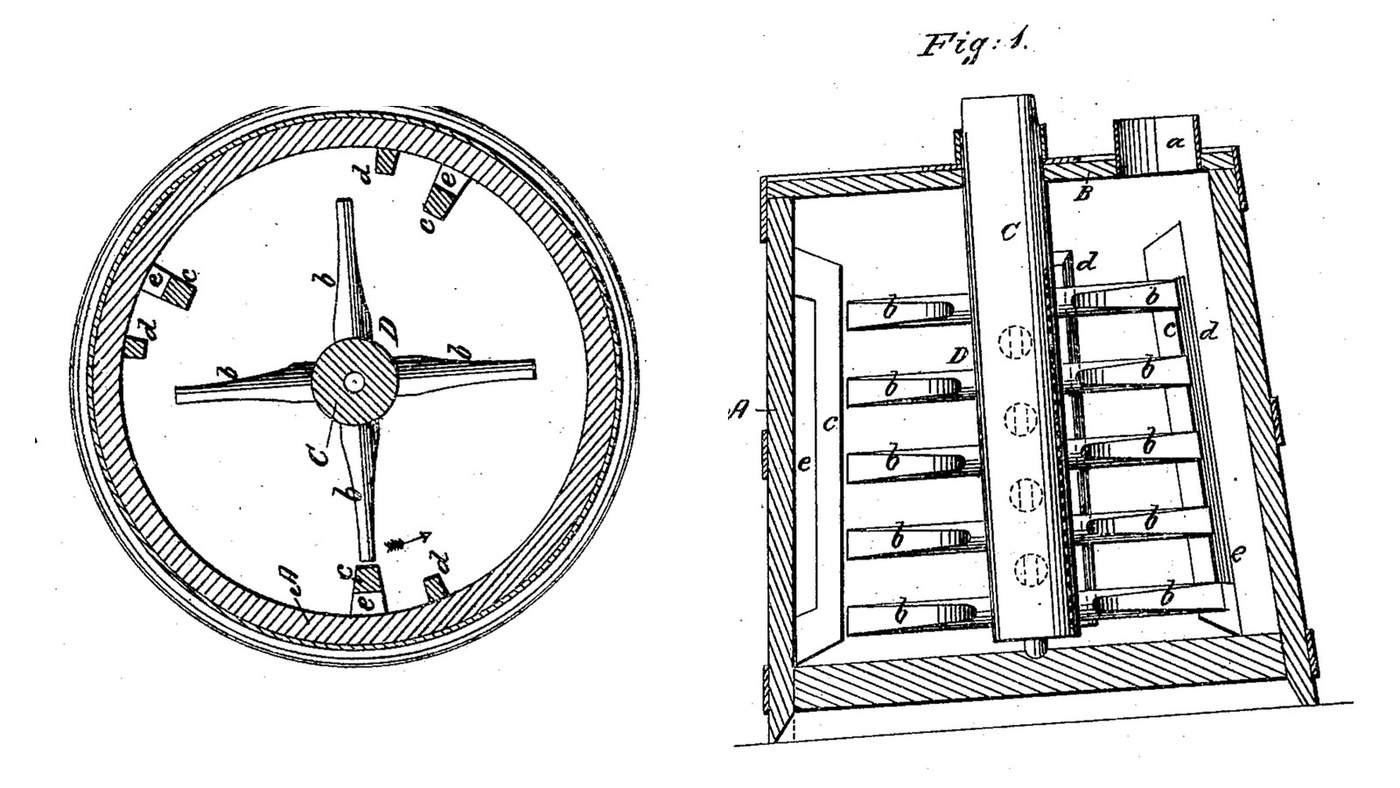

Brake-and-Ledge Bar Dasher Churn: Slotted Brakes Break the Current, Ledges Turn It Back to the Dasher
James Taylor of Rushville, Illinois, received US 25,453, dated 13 September 1859, for a churn. An upright dasher of horizontal bars, flattened out towards their ends, turns in a wooden tub and sets the cream turning. Upright brakes inside the tub break the current, and slots in them next to the wall let part of it run on to narrower ledges, which turn it back towards the dasher.
The patent gives no sizes; every size here is ours.
Intermediate
About 2 days
Instructions
1
1
Bars, brakes and how much cream
Bars, brakes and how much cream
Loading Jupyter Notebook...
2
2
Breakers round a turning dasher, a few weeks before
Breakers round a turning dasher, a few weeks before
Sperry's breakers stood on a frame. Taylor fixes his to the tub's wall and slots them next to it.
3
3
Read US 25,453
Read US 25,453
"by the action of the dasher the mass of cream or milk in the tub is caused to assume a rotary motion, and the current thus created by coming in contact with the brakes, c, is thrown violently against the sides of the tub and as it passes through the openings, e, in the back part of these brakes and along the sides of the tub, it (the current) strikes against the ledges, d, whereby it is turned in again, toward the dasher"
4
4
Tub A and cover B
Tub A and cover B
Use a wooden tub 260 mm across inside at the bottom, 230 mm at the top and 420 mm deep, with its top hoop driven up to stand 25 mm above the staves. Glue a hardwood step, 70 mm across and 22 mm thick with a 27 mm hole 16 mm deep, in the middle of the floor. Cut a round cover to drop inside the top hoop, saw it in two across the middle, and bore a 42 mm hole in the middle and a 20 mm air hole 80 mm off it.
Materials for this step:
 Wooden Tub1 piece
 Hardwood Board1 piece
 Wood Glue1 piece
Tools needed:
 Jigsaw
 Hand Saw
 Cordless Drill
 Spade Bit Set
 Wooden Mallet
 Tape Measure
5
5
Brakes c and ledges d
Brakes c and ledges d
From 12 mm hardwood cut three brakes 30 mm wide and three ledges 18 mm wide, 345 mm long, their outer edges planed to the staves' slope. In each brake cut a slot 10 mm wide next to its outer edge, stopping 40 mm from each end: the openings e. Screw the brakes upright to the staves through the wall, 15 mm above the floor, one every third of the way round. Screw a ledge 15 degrees after each brake, in the way the dasher turns.
Materials for this step:
Hardwood Board1 piece Wood Screws18 pieces
Tools needed:
 Table SawJigsawCordless Drill
 Drill Bit Set
 Screwdriver Set
 Sandpaper
6
6
Dasher D and its crank
Dasher D and its crank
Turn a hardwood shaft C 40 mm across and 503 mm long, its foot turned to 25 mm for 15 mm and its top 24 mm square for 30 mm. Chisel five 25 mm square mortises through it at 45, 110, 175, 240 and 305 mm from the floor, each turned 90 degrees from the last. Cut five bars from 25 x 50 mm hardwood, as long as the tub allows at their height (179, 174, 170, 165 and 160 mm), and shave each from 25 mm square at the middle out to 50 x 8 mm at the ends. Glue them through the shaft. Fit a hardwood crank 190 mm long with a handle on the square top.
Materials for this step:
Hardwood Board2 piecesWood Glue1 piece Hardwood Dowels1 piece
Tools needed:
 Wood Lathe
 Mortise ChiselWooden Mallet
 SpokeshaveHand SawSandpaperTape Measure
7
7
The build in 3D
The build in 3D
FreeCAD model of this build, the tub, hoops and cover cut through the middle: the three brakes with their openings, the three ledges, and the dasher with its five bars and crank. The dasher was turned through 24 angles.
8
8
Churn
Churn
Stand the dasher's foot in the step and fill the tub with about 15 litres of heavy cream at about 15 °C, checked with the thermometer, up to the upper bar. Put the cover's halves on round the shaft. Turn the crank steadily the way the ledges face, timing it. When the butter comes, lift the cover and dasher, take out the butter, drain the buttermilk, wash the butter in cold water until it runs clear, work in a pinch of salt and weigh it.
Materials for this step:
 Heavy Cream15 l
 Coarse Sea Salt1 piece
 Water1 piece
Tools needed:
 Leave-In Probe Thermometer
 Stopwatch
 Digital Kitchen Scale
 Stainless Steel Mixing Bowl (Large)
9
9
Troubleshooting
Troubleshooting
Brake-and-ledge churn troubleshooting.
Flow
Loading...
10
10
History and honest limits
History and honest limits
**James Taylor** of Rushville, Schuyler County, Illinois, US 25,453, 13 September 1859, "Churn". He claimed the arrangement of perforated brakes and auxiliary reflectors with a dasher "having its blades flattened out gradually from near the shaft to their ends", and disclaimed the brakes of Hiram Brown's rejected application of 1852 and of M. R. Marcell's patent of 1858. "The number and size of these brakes and ledges depend entirely upon the size and diameter of the tub": the patent gives no sizes, and every size here is ours, as is the crank.
Materials
8- 1 piecePlaceholder
- 2 piecesPlaceholder
- 2 piecesPlaceholder
- 18 piecesPlaceholder
- 1 piecePlaceholder
- 15 lPlaceholder
- 1 piecePlaceholder
- 1 piecePlaceholder
Tools Required
17- 1 vendor sell this, none ship to you yetPlaceholder
- Placeholder
- 1 vendor sell this, none ship to you yetPlaceholder
- Placeholder
- Placeholder
- 1 vendor sell this, none ship to you yetPlaceholder
- 1 vendor sell this, none ship to you yetPlaceholder
- Placeholder
- Placeholder
- Placeholder
- Placeholder
- Placeholder
- Placeholder
- Placeholder
- Placeholder
- Placeholder
- Placeholder
Design Files
1This blueprint makes

Related Blueprints
These blueprints share knowledge with this one — techniques, materials, or principles that connect them in the learning graph.
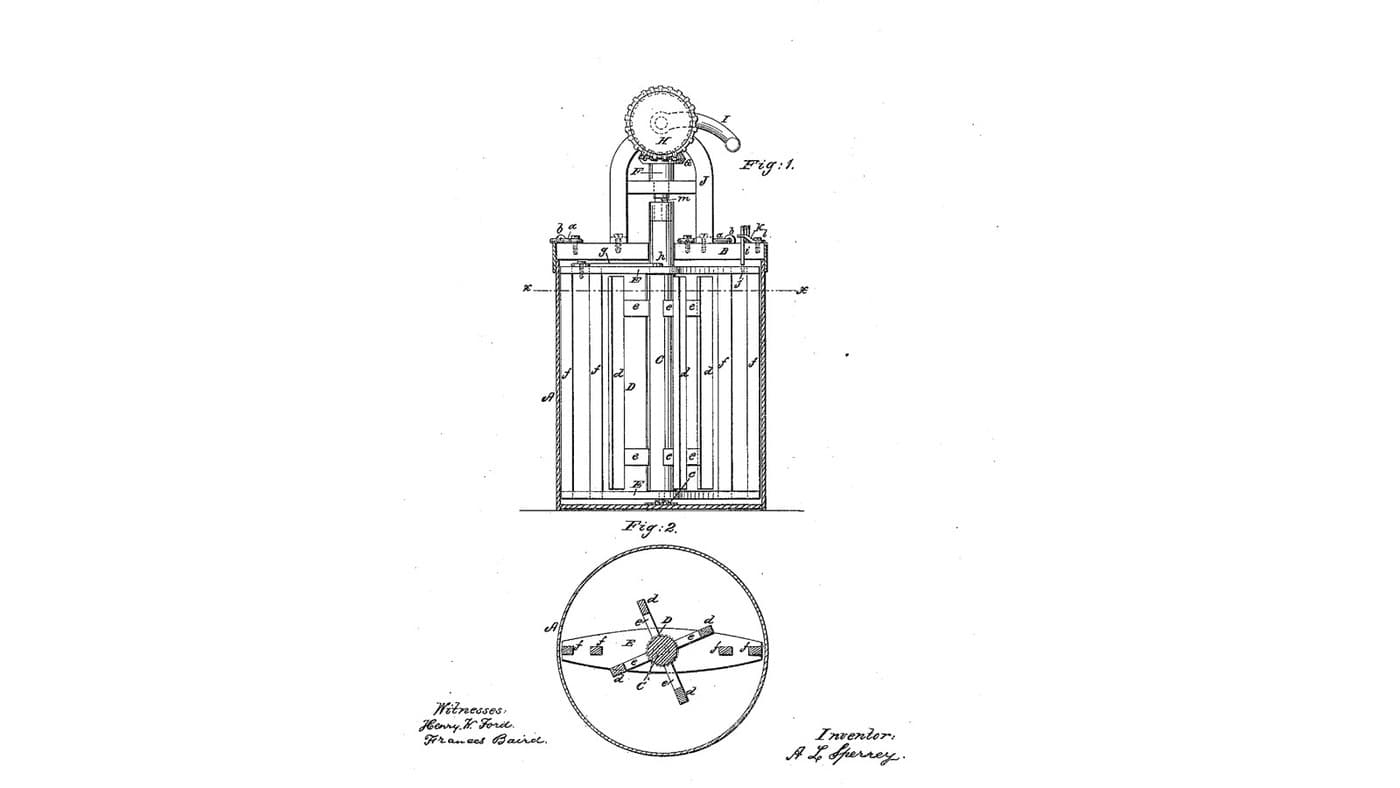
Hooked Breaker-Frame Churn: Breakers Held Still From the Lid, Then Hooked to the Dasher to Gather
by Buttercup
FOOD & DRINKS
1
0
0
0
0
0
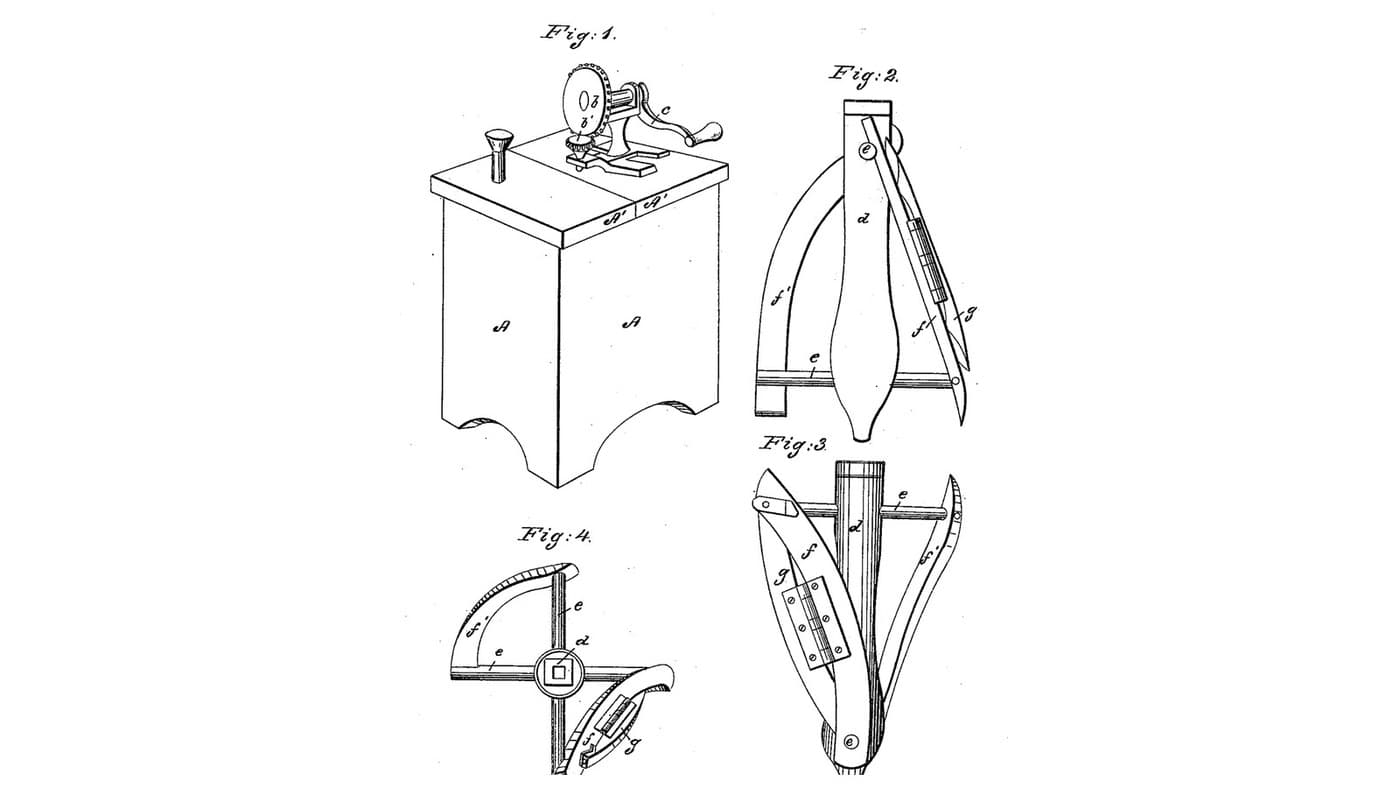
Hinged-Leaf Wing Dasher Churn: Turn One Way to Churn, Reverse and a Leaf Opens to Gather the Butter
by Buttercup
Woodworking
1
0
0
0
0
0

Churning Butter from Cream — The 5,000-Year-Old Fat Separation
by TheChef
CRAFT
60
0
0
0
0
0
CC0 Public Domain
This blueprint is released under CC0. You are free to copy, modify, distribute, and use this work for any purpose, without asking permission.
Support the Maker by purchasing products through their Blueprint where they earn a Maker Commission set by Vendors, or create a new iteration of this Blueprint and include it as a connection in your own Blueprint to share revenue.