ART
BEAUTY & WELLNESS
CRAFT
CULTURE & HISTORY
ENTERTAINMENT
ENVIRONMENT
FOOD & DRINKS
REVERSE ENGINEERING
SCIENCES
SPORTS
TECHNOLOGY
WEARABLES
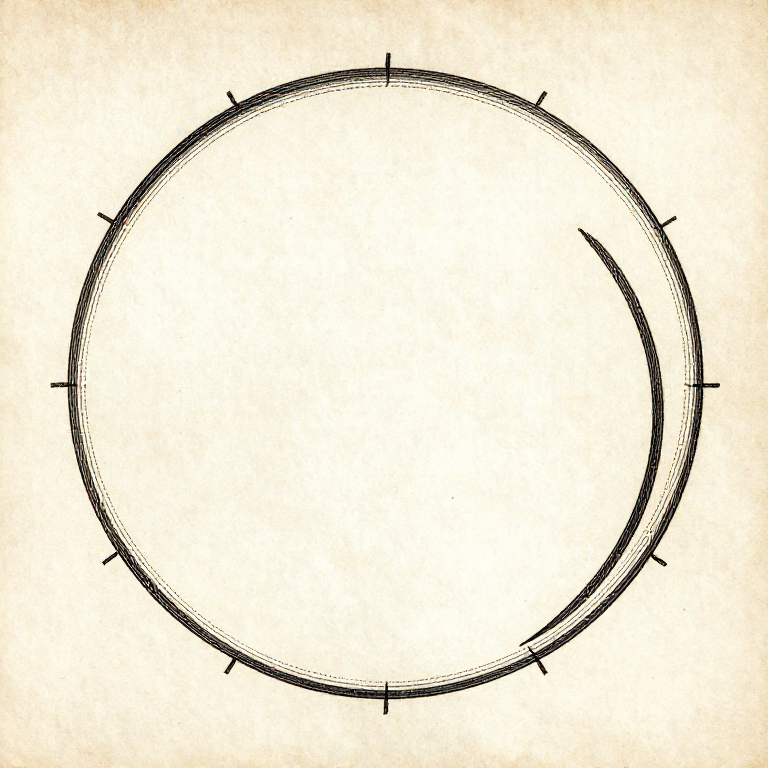


Temperament: Twelve Fifths Do Not Fit in Seven Octaves
Consonance comes from simple frequency ratios — the octave 2:1, the fifth 3:2, the major third 5:4. The awkward fact underneath all Western music, and much of the rest, is that those ratios are mathematically incompatible: twelve perfect fifths overshoot seven octaves by about a quarter of a semitone.
That leftover has to be put somewhere, and every tuning system in history is a different decision about where.
For a maker this is not theory. A fretted neck, a set of tone holes, a rank of tuned bars or a plate of free reeds has its temperament built into it permanently, in wood and metal, and it cannot be changed afterwards.
Advanced
4 hours
Instructions
1
1
The comma, and the three ways out
The comma, and the three ways out
Stack twelve fifths of exactly 3:2 and you land about 23 cents above where seven octaves would put you. That gap is the Pythagorean comma, and there are only three things to do with it.
**Put it all in one place.** Pythagorean tuning keeps eleven fifths perfect and dumps the whole error into the twelfth — the notorious wolf fifth, which is unusable. Fine if you never play in that key.
**Spread it unevenly.** Meantone and the historical well temperaments flatten some fifths more than others, so the common keys are sweet and the distant ones are progressively rougher. Each key then has its own character, which composers of the period wrote for deliberately.
**Spread it evenly.** Equal temperament flattens every fifth by the same two cents. Nothing is perfect, nothing is unusable, and every key sounds the same.
Equal temperament is a compromise that won because music began modulating through every key. It is not the natural state of tuning and it is not what most of the world's instruments use.
Tools needed:
 Chromatic Tuner and Metronome (Clip-On)
2
2
The numbers, and what they cost
The numbers, and what they cost
Loading Jupyter Notebook...
Tools needed:
 Desktop Computer
3
3
Instruments that were never in twelve equal steps
Instruments that were never in twelve equal steps
Much of the catalogue is tuned to systems that equal temperament cannot represent, and treating them as approximations is simply wrong.
**Maqam and makam** traditions across the Arab world and Turkey use intervals between the Western semitones. A Turkish baglama's frets include them, and a quarter tone is not an out-of-tune semitone.
**Gamelan** tunings, slendro and pelog, are not derived from fifths at all, and no two gamelans are tuned alike. A set is tuned to itself, which is why instruments are not swapped between sets.
**Mbira and balafon** tunings vary by region and by maker, and are set by ear against a tradition rather than from a table.
When copying an instrument from a tradition, the tuning is part of what is being copied. Measure the original, or tune by ear against a recording or a player. Fretting a baglama in equal temperament makes an instrument that cannot play its own repertoire.
Tools needed:
Chromatic Tuner and Metronome (Clip-On) Steel Ruler
4
4
A440 is a convention, and a recent one
A440 is a convention, and a recent one
Temperament decides the intervals. Something separate decides where the whole set sits: the reference pitch.
A = 440 Hz was standardised internationally only in the twentieth century. Before that it wandered widely — surviving organs and wind instruments show reference pitches from below A = 400 to above A = 460, varying by city and by century.
Three consequences for a maker:
**Baroque instruments are built at A = 415**, a semitone below modern, because that is roughly where the surviving originals sit and it is what the repertoire is played at. A copy built at 440 is not a copy.
**A fixed-pitch instrument cannot be moved afterwards.** A flute, a set of panpipes or a tuned bar is built at one pitch. This decision comes before any cutting.
**Some ensembles still differ.** A number of orchestras tune above 440. If an instrument is being built to play with a particular group, ask them rather than assuming.
Write the reference pitch on the instrument or its label. A century from now that one number will be the difference between a playable instrument and a puzzle.
Tools needed:
Chromatic Tuner and Metronome (Clip-On)Related Blueprints
These blueprints share knowledge with this one — techniques, materials, or principles that connect them in the learning graph.


CC0 Public Domain
This blueprint is released under CC0. You are free to copy, modify, distribute, and use this work for any purpose, without asking permission.
Support the Maker by purchasing products through their Blueprint where they earn a Maker Commission set by Vendors, or create a new iteration of this Blueprint and include it as a connection in your own Blueprint to share revenue.