ART
BEAUTY & WELLNESS
CRAFT
CULTURE & HISTORY
ENTERTAINMENT
ENVIRONMENT
FOOD & DRINKS
REVERSE ENGINEERING
SCIENCES
SPORTS
TECHNOLOGY
WEARABLES
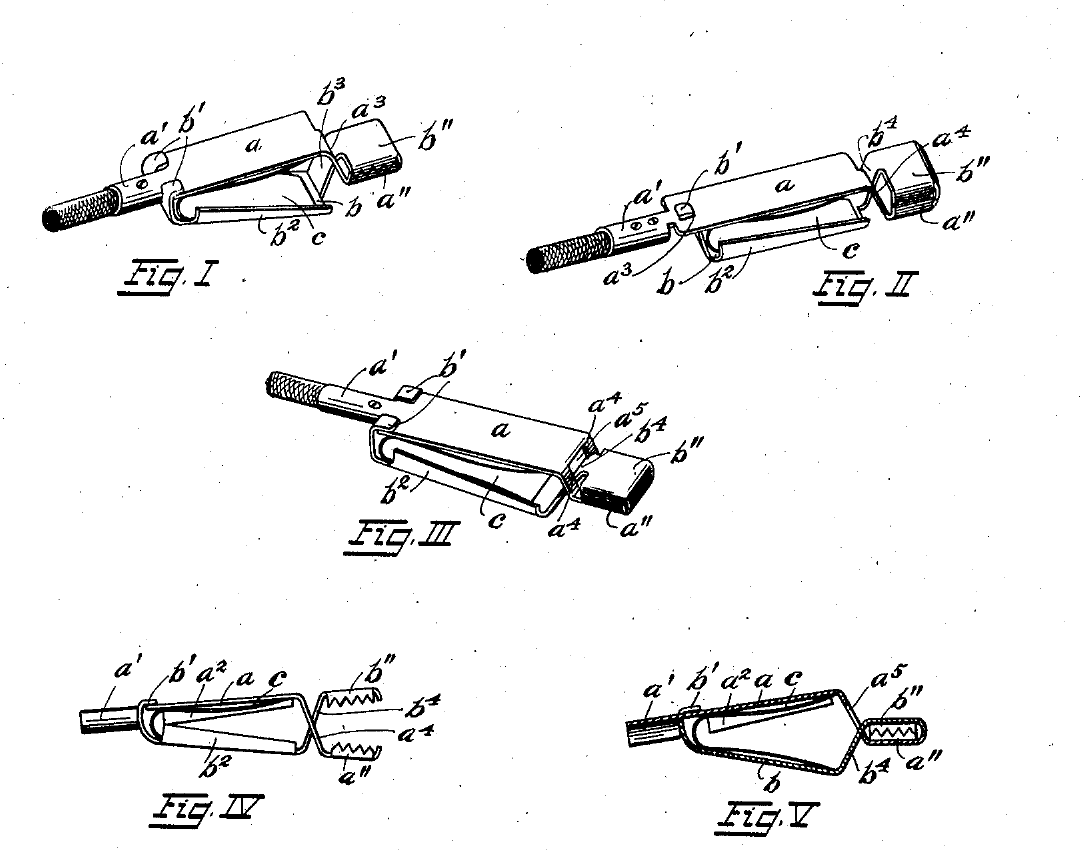

Test Leads with Sheet-Metal Spring Clips: Dusinberre, 1910
George Brown Dusinberre of Cleveland patented a testing clip for electric wires in 1910, US 963,425 (filed 1909). It is two sheet-metal members with crossed, serrated jaws, hinged on integral lugs at the back with no pivot pin. A U-shaped spring inside holds the jaws shut and is kept in place by flanges turned down at the sides. The upper member carries the sleeve that takes the wire. The jaws are serrated on the front edge and both sides, so a conductor can be gripped from any side, even in the crowded spaces of a switchboard. A length of insulated wire with a clip at each end makes a test lead.
Intermediate
1 hour
Instructions
1
1
Cut the blanks
Cut the blanks
Cut the two blanks from sheet metal: the upper one with the wire sleeve end and serrated jaw, the lower one with the terminal lugs and serrated jaw.
Materials for this step:
 Sheet Metal1 as required
Tools needed:
 Tin Snips
2
2
Shape and pair
Shape and pair
Bend the lugs of the lower member over to form the pivot between the two members, so the shanks of the jaws cross. Turn down the side flanges.
Tools needed:
 Combination Pliers
3
3
Spring
Spring
Fit the U-shaped spring between the members, held by the turned-down flanges; it keeps the crossed jaws closed.
Materials for this step:
 U-Shaped Clip Spring1 piece
Tools needed:
Combination Pliers4
4
Make the lead
Make the lead
Secure a length of insulated wire in the sleeve of one clip and its other end in a second clip.
Materials for this step:
 Hookup Wire1 as required
Tools needed:
 Wire StrippersCombination Pliers
Materials
3- 1 as requiredPlaceholder
- 1 piecePlaceholder
- 1 as requiredPlaceholder
This blueprint makes

Related Blueprints
These blueprints share knowledge with this one — techniques, materials, or principles that connect them in the learning graph.

CC0 Public Domain
This blueprint is released under CC0. You are free to copy, modify, distribute, and use this work for any purpose, without asking permission.
Support the Maker by purchasing products through their Blueprint where they earn a Maker Commission set by Vendors, or create a new iteration of this Blueprint and include it as a connection in your own Blueprint to share revenue.