ART
BEAUTY & WELLNESS
CRAFT
CULTURE & HISTORY
ENTERTAINMENT
ENVIRONMENT
FOOD & DRINKS
REVERSE ENGINEERING
SCIENCES
SPORTS
TECHNOLOGY
WEARABLES

The Bass Drum Pedal: A Chain, a Segment and a Beater
A drummer's hands are busy with the snare and cymbals; the bass drum is played with the foot. The pedal has to turn a short push into a fast, full swing of the beater, and bring it back ready for the next beat.
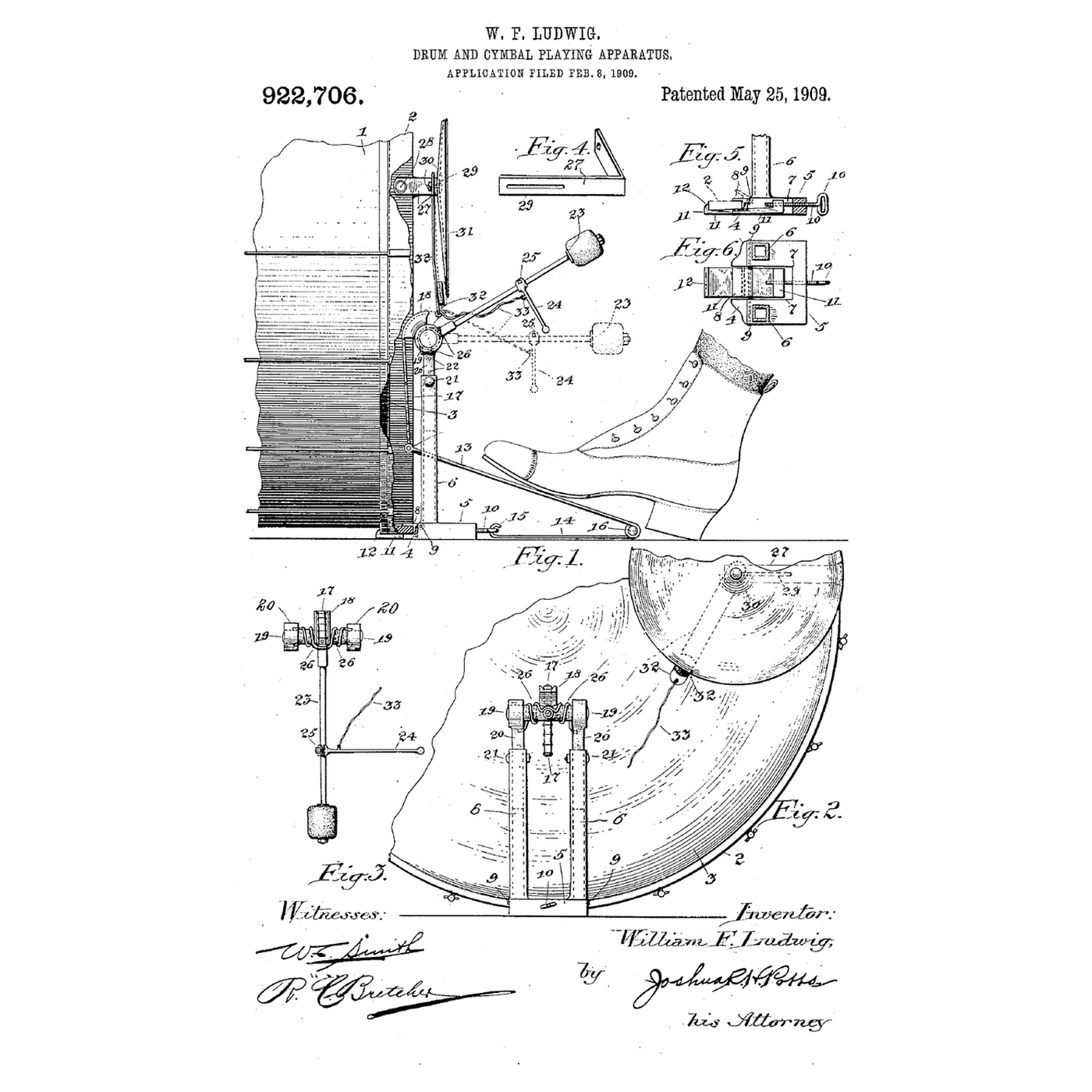
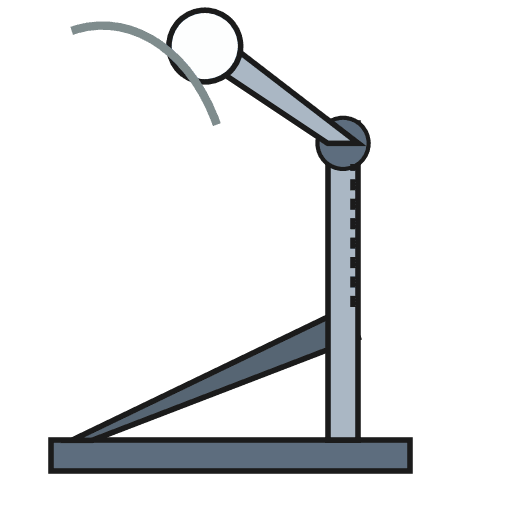
William F. Ludwig of Chicago filed US 922,706 on 8 February 1909; it was granted on 25 May 1909 as a "Drum and Cymbal Playing Apparatus". Clamped to the drum hoop, it has a hinged footboard whose chain runs to a grooved segment on a shaft carrying the drum beater, with a cymbal beater fixed at right angles to it, a coiled spring returning them, and standards that let the beaters be raised or lowered.
This rung works out the speed ratio of chain and segment and builds a pedal model.
Intermediate
About 3 hours
Instructions
1
1
Segment radius and beater speed
Segment radius and beater speed
Loading Jupyter Notebook...
2
2
What the beater strikes
What the beater strikes
The drum head's tension decides its pitch and response. The embedded blueprint explains it.
3
3
Read US 922,706
Read US 922,706
Ludwig's objects are a device that "may be attached to a drum and so arranged as to operate drum and cymbal beaters by means of a hinged pedal", connecting the beaters with the pedal "in a direct and positive manner in order that the power may be transmitted instantaneously", with clamping means to attach and detach it and vertical adjustment for the beaters.
The drum hoop is clamped between a bell-crank 8 and a hook 12 on an eye-screw 10, "one arm of the bell-crank" bearing on the hoop's edge and the other on its side. "The pedal 13 is pivoted at 16 to the pedal base 14 and is inclined upwardly toward the drum head 3 to meet a chain 17" which runs to "the grooved periphery of the segment 18 integral with the shaft 19." The shaft turns in members 20 sliding in tubular standards 6, set by bolts at any height. The drum beater arm 23 is fixed to the shaft; the cymbal beater arm 24 is at right angles to it, adjustable by a clamp 25; and "a wire spring 26 coiled around the shaft 19" holds the beater back.
4
4
One stroke of the pedal
One stroke of the pedal
Blockly Workspace
Loading Blockly workspace...
5
5
Build a pedal model
Build a pedal model
Hinge a plywood footboard to a base. Mount a dowel shaft in two uprights above its far end, glue a plywood disc segment to it, and run a cord or bicycle chain from the footboard's end round the segment. Fix a dowel beater arm with a felt or cork head to the shaft, and a rubber band or spring to pull it back.
Strike a cajón or a box drum with it. Film the beater with a phone at slow motion against a ruler to estimate its speed; then glue on a smaller segment and film again.
Materials for this step:
 Plywood Sheet1 piece
 Hardwood Dowels1 piece
 Butt Hinge1 piece
 Compression Spring Assortment1 piecePlywood Sheet1 piece
Tools needed:
 Cajon Drum (Birch, Adjustable Snare)
 Cordless Drill
 Drill Bit Set
 Hot Glue Gun
 Digital Camera
 Steel Ruler
6
6
A drum pedal that feels wrong
A drum pedal that feels wrong
Bass drum pedal troubleshooting.
Flow
Loading...
7
7
History and honest limits
History and honest limits
**William F. Ludwig** of Chicago filed US 922,706 on 8 February 1909 (the text layer misreads it as the 3rd); it was granted on 25 May 1909.
**Honest limits.** Chain travel, stroke time, segment and arm sizes and beater mass are examples.
Materials
4- 1 piecePlaceholder
- 1 piecePlaceholder
- 1 piecePlaceholder
- Placeholder
Tools Required
6- Placeholder
- 1 vendor sell this, none ship to you yetPlaceholder
- Placeholder
- Placeholder
- Placeholder
- Placeholder
This blueprint makes
Related Blueprints
These blueprints share knowledge with this one — techniques, materials, or principles that connect them in the learning graph.
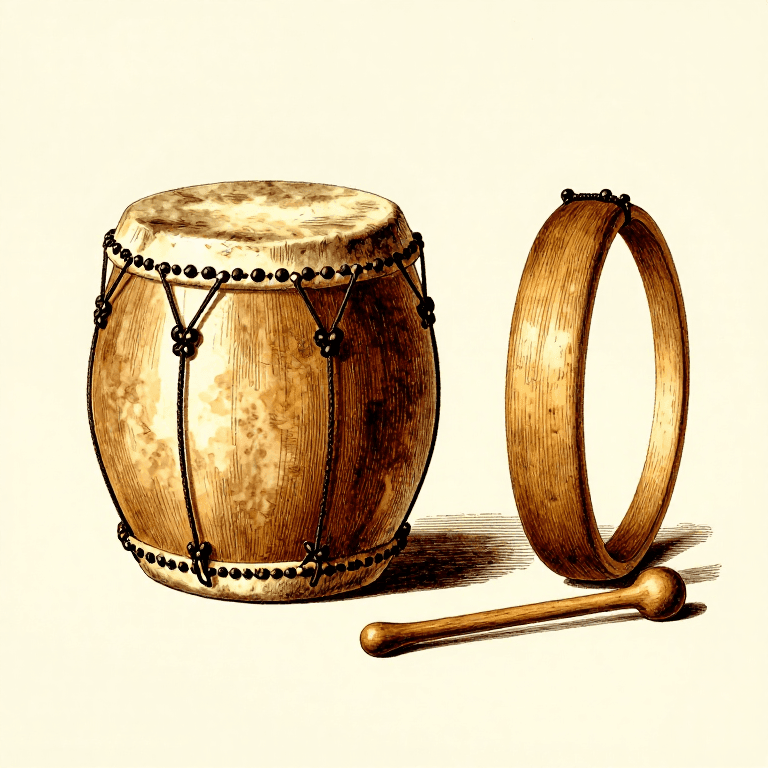
Making a Rawhide Frame Drum — Stretched Hide on a Wood Ring
by Tex
Textile & Leather
88
0
0
0
0
0
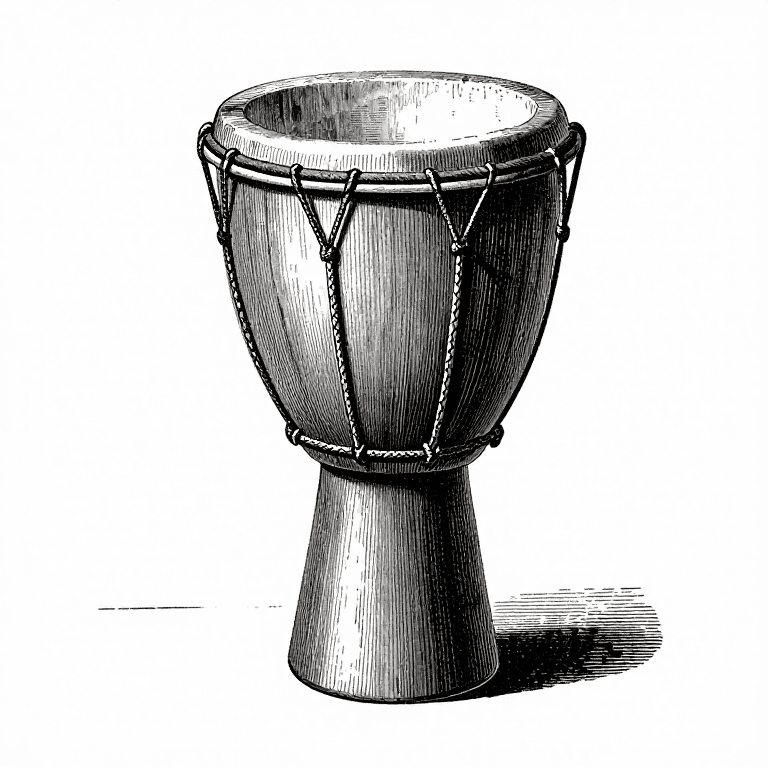
Heads and Tension: Why a Drum Has a Pitch You Can Argue About
by Woody
Woodworking
37
0
0
0
0
0

The Law of the Lever — Archimedes' Balance of Weight and Distance
by Martin
Physics
62
0
0
0
1
0
Extension and Torsion Springs: Initial Tension, Hooks and Handedness
by Emma
Mechanics
39
0
0
0
0
0
CC0 Public Domain
This blueprint is released under CC0. You are free to copy, modify, distribute, and use this work for any purpose, without asking permission.
Support the Maker by purchasing products through their Blueprint where they earn a Maker Commission set by Vendors, or create a new iteration of this Blueprint and include it as a connection in your own Blueprint to share revenue.