ART
BEAUTY & WELLNESS
CRAFT
CULTURE & HISTORY
ENTERTAINMENT
ENVIRONMENT
FOOD & DRINKS
REVERSE ENGINEERING
SCIENCES
SPORTS
TECHNOLOGY
WEARABLES
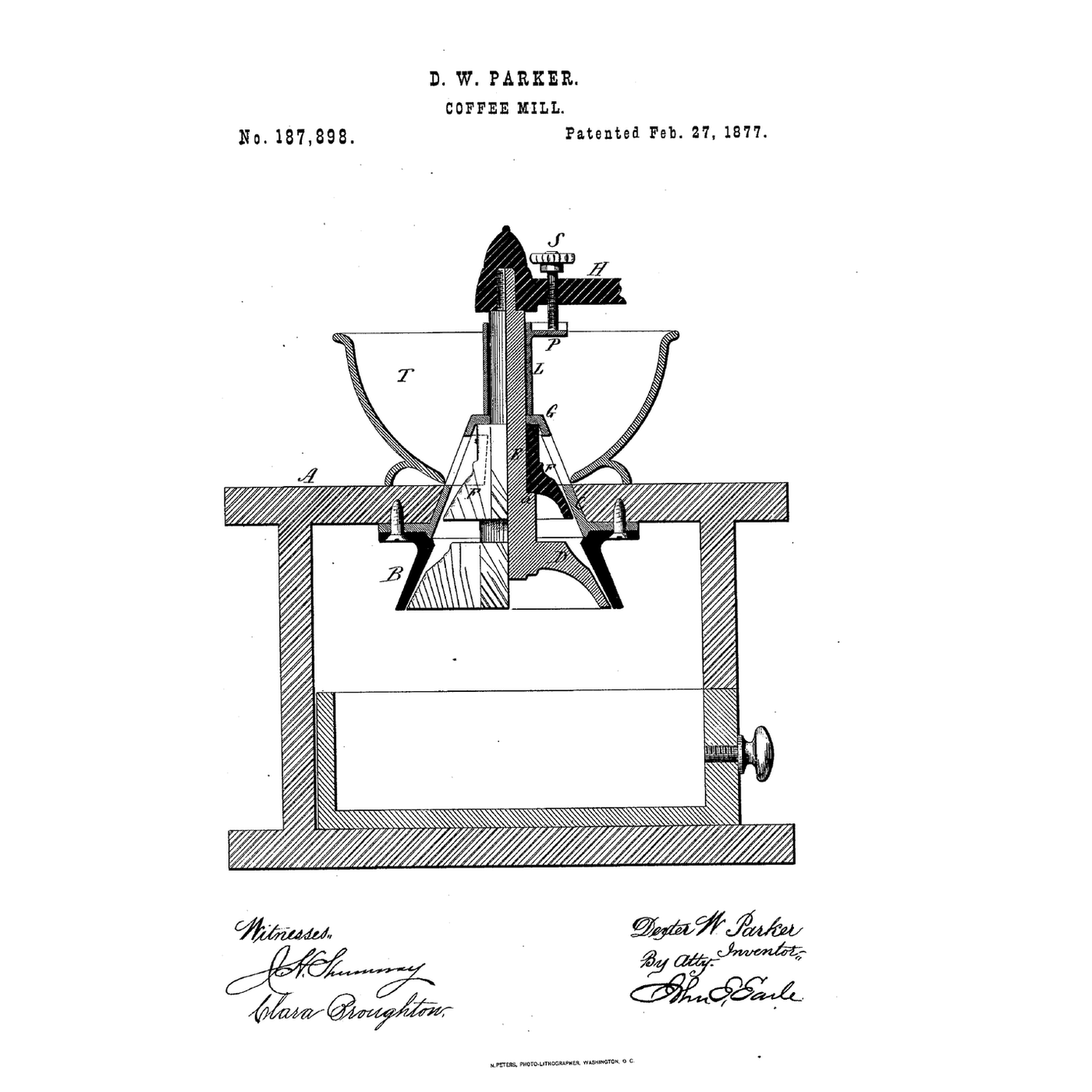
Dexter W. Parker, Meriden, Connecticut (assignor to Charles Parker) · Public domain (expired patent)


The Coffee Mill: A Cracker, a Grinder and One Screw to Set Them
Roasted coffee keeps as whole beans and goes stale once ground, so kitchens ground it a cupful at a time in a box mill: a wooden box, a hopper on top, a crank, and toothed iron inside.
Dexter W. Parker of Meriden, Connecticut, assignor to Charles Parker, received US 187,898, dated 27 February 1877 (filed 22 November 1876), for a "box or hand mill" with two runners, "the upper as a cracker and the lower as a grinder". He put both on "a single spindle" with an adjusting screw through the crank, so "the adjustment made at the upper end of the spindle" raises or lowers both runners at once.
This rung works out how the screw sets the gap and why fineness matters, then grinds at three settings and sieves the result.
Beginner
About 1 hour
Instructions
1
1
Gap, fineness and surface
Gap, fineness and surface
Loading Jupyter Notebook...
2
2
Grinding by hand before the mill
Grinding by hand before the mill
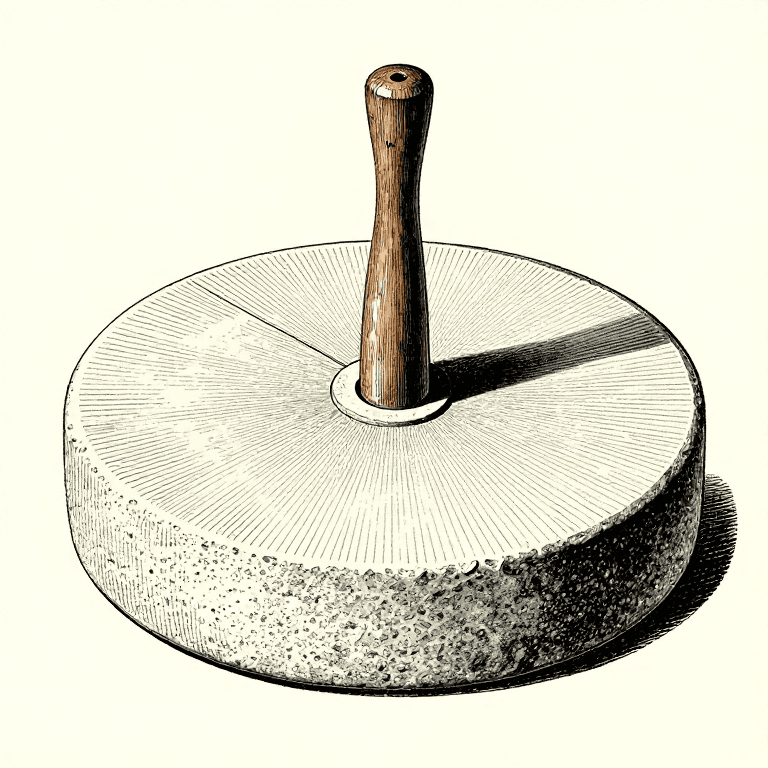
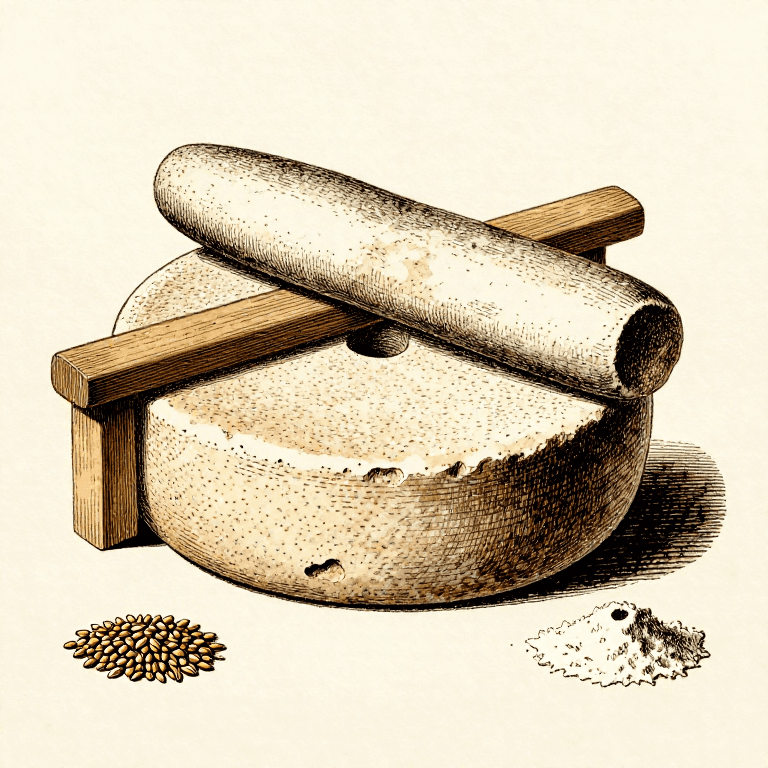
A quern grinds between two stones turned by hand; the mill puts the same idea in iron. The embedded blueprint carves a quern.
3
3
Read US 187,898
Read US 187,898
"This invention relates to an improvement in that class of grinding-mills commonly known as 'box or hand mills,' and in which the runners are mounted on a vertical spindle provided with a crank for turning in a horizontal plane, and specially to that class in which two runners are employed with the different shells, the upper as a cracker and the lower as a grinder."
"In this class of mills the runners have usually been formed upon independent spindles, the two spindles coupled together and supported upon a bridge below". "The object of this invention is to unite the two runners upon a single spindle, whereby the bridge may be dispensed with, and the adjustment made at the upper end of the spindle".
"By turning this screw in one direction or the other the crank is raised or lowered relatively to the upper end of the sleeve L, and accordingly raises or lowers both the runners. The usual hopper T is provided, through which the material to be ground passes, first to the cracker, and then to the runner, in the usual manner."
4
4
Grind at three settings and sieve
Grind at three settings and sieve
Weigh 20 g of whole beans three times. Grind the first at the mill's coarsest setting, timing the turns; move the adjuster half a turn finer and grind the second; half a turn finer again for the third.
Put each grind through the graded sieves, coarsest on top, shaking for one minute. Weigh what stays on each sieve and plot the three size spreads. Brew each the same way and note which tastes thin and which bitter: that is the notebook's surface area at work.
Materials for this step:
 Coffee Beans60 g
Tools needed:
 Coffee Grinder
 Digital Scale
 Sieve Set (Graded Mesh)
 Stopwatch
5
5
A mill that jams or grinds unevenly
A mill that jams or grinds unevenly
Coffee mill troubleshooting.
Flow
Loading...
6
6
History and honest limits
History and honest limits
**Dexter W. Parker** of Meriden, Connecticut, assignor to **Charles Parker**, filed US 187,898 on 22 November 1876; it is dated 27 February 1877.
**Honest limits.** The patent gives no pitch, angle or particle sizes. The screw pitch, runner angle, density and sizes in the notebook are examples; your sieve weights are the measurement.
Materials
1- 60 gPlaceholder
Tools Required
4- Placeholder
- Placeholder
- Placeholder
- Placeholder
Related Blueprints
These blueprints share knowledge with this one — techniques, materials, or principles that connect them in the learning graph.



CC0 Public Domain
This blueprint is released under CC0. You are free to copy, modify, distribute, and use this work for any purpose, without asking permission.
Support the Maker by purchasing products through their Blueprint where they earn a Maker Commission set by Vendors, or create a new iteration of this Blueprint and include it as a connection in your own Blueprint to share revenue.