ART
BEAUTY & WELLNESS
CRAFT
CULTURE & HISTORY
ENTERTAINMENT
ENVIRONMENT
FOOD & DRINKS
REVERSE ENGINEERING
SCIENCES
SPORTS
TECHNOLOGY
WEARABLES
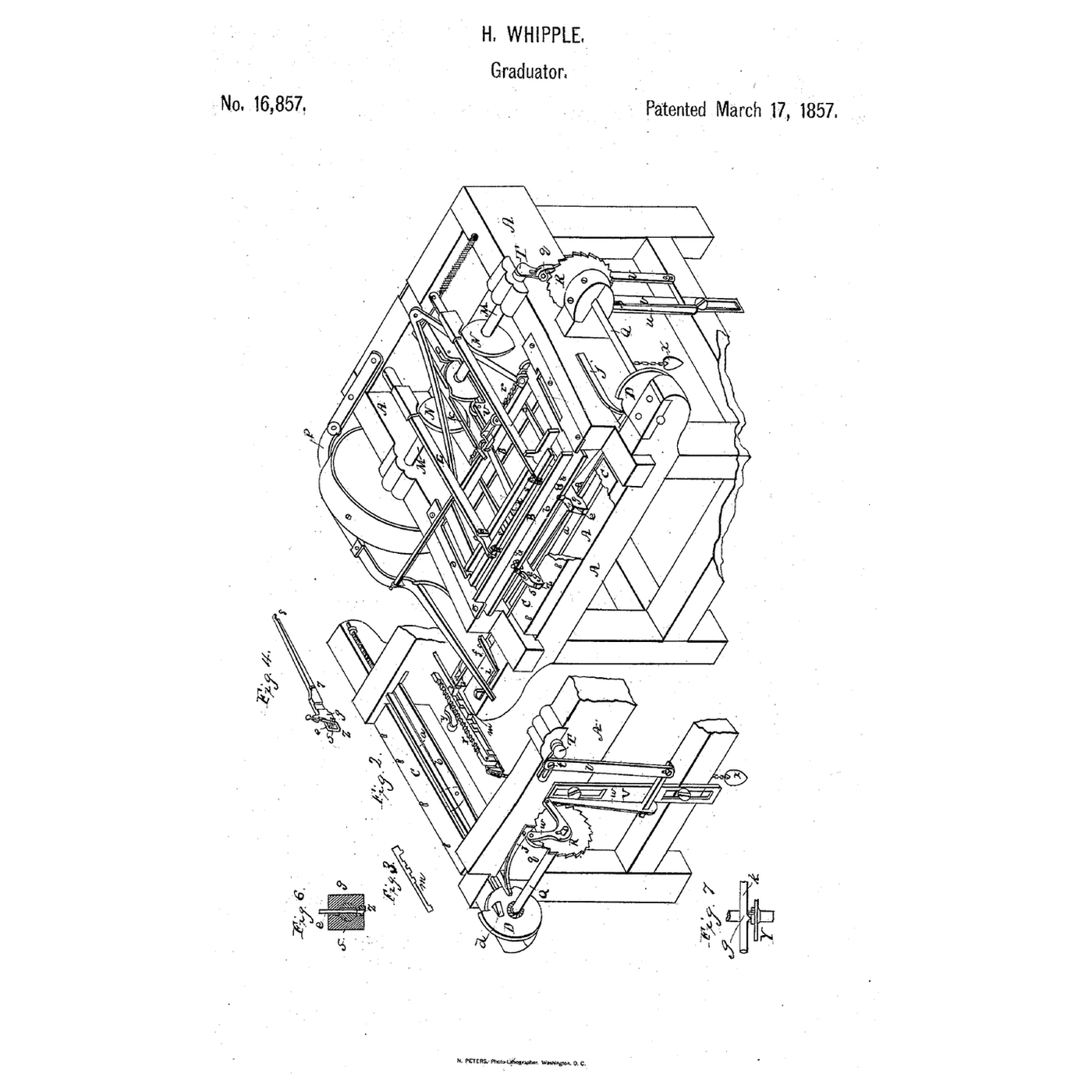


The Gang-Graver Graduator: Mark Every Inch at Once, One Fraction at a Time
A steel square has to carry hundreds of fine marks, each in the right place, and cutting them one by one along the blade lets small errors add up and takes a long time.
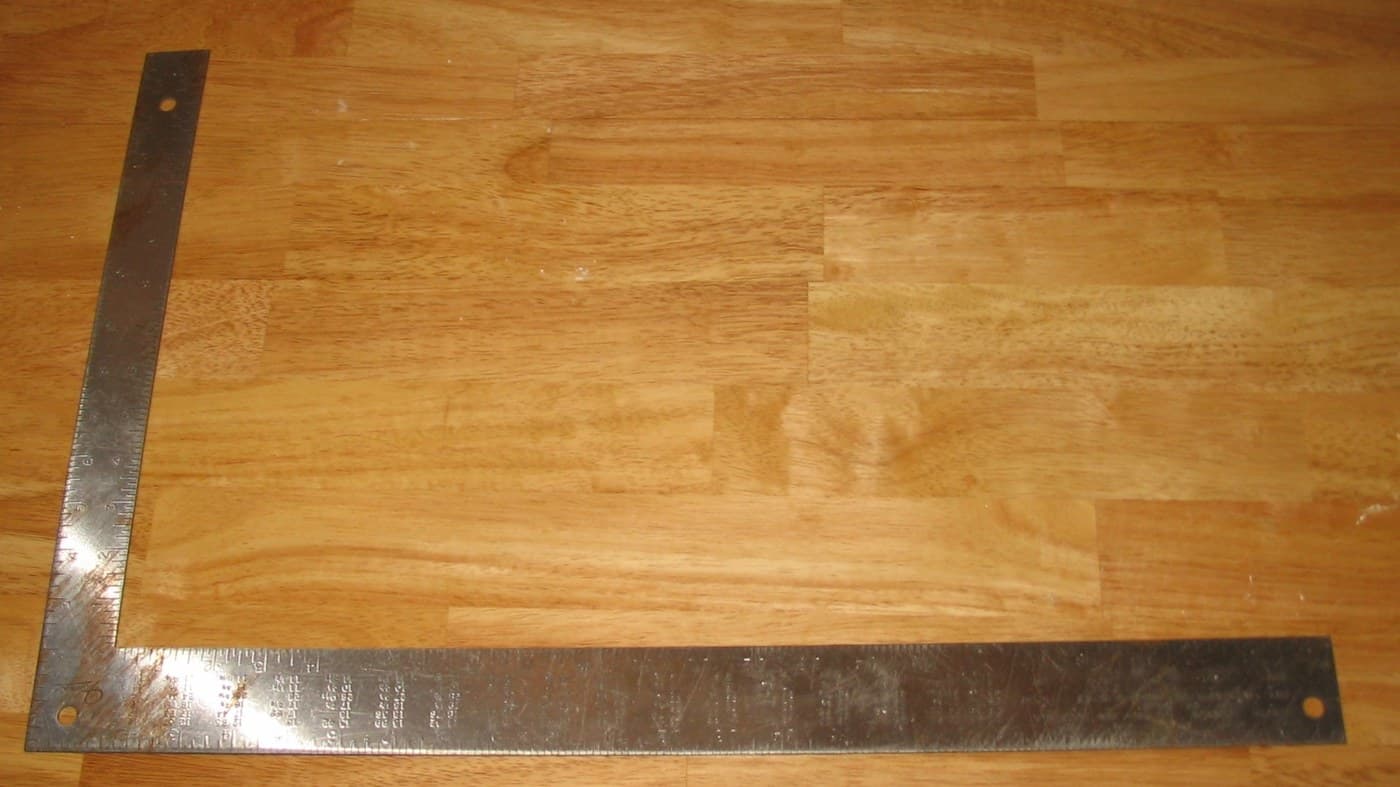
Heman Whipple of Shaftsbury, Vermont, received US 16,857, dated 17 March 1857, for a machine that provides "(for the common two foot square) twenty-four gravers set in stocks each about twenty inches long, which are confined to the bottom of a carriage, fitted to move back and forth far enough to make the longest crosswise mark on the square". The square, held on an anvil, is moved forward one fraction of an inch at a time by a scroll cam on a ratchet wheel, and a movable scale sets the length of each mark, so every inch is divided at the same strokes.
This rung works out why the gang keeps the error small, then builds a hand jig with a row of scribers 25 mm apart and a screw-driven slide, and graduates a 300 mm rule in millimetres.
Advanced
About 8 hours
Instructions
1
1
Gang against single graver
Gang against single graver
Loading Jupyter Notebook...
2
2
The square it graduates
The square it graduates
The embedded blueprint is the steel square itself. Whipple, also of Shaftsbury, Vermont, built a machine to cut its graduations.
3
3
Read US 16,857
Read US 16,857
"The nature of my invention consists in providing (for the common two foot square) twenty-four gravers set in stocks each about twenty inches long, which are confined to the bottom of a carriage, fitted to move back and forth far enough to make the longest crosswise mark on the square, the carriage being pressed forward by the action of a cam, in the rear, which is brought to bear on the teeth of a movable scale, having the length of the marks for the different divisions arranged on it—and the gravers being set one inch apart from center to center"
"The advantages thus derived are facility, uniformity, certainty, and perfection of the work, having the edge of the square smooth and free from all fractures, to which, in the usual method they are constantly liable."
4
4
Build the jig and graduate a rule
Build the jig and graduate a rule
**Bed and fence.** Screw a straight hardwood fence along a 45 cm hardwood board. Cut a 30 cm length of aluminium flat bar as the rule to be graduated, and make a hardwood slide it clamps to, running against the fence.
**Screw feed.** Fix a nut to the bed's end and run an M6 threaded rod through it against the slide's end, with a knob and a disc marked in ten parts on its outer end. One turn moves the slide 1 mm, as Whipple's scroll cam moved his anvil one fraction per revolution.
**Gang of scribers.** Drill a hardwood bar at 25 mm centres for twelve hardened steel scribing points, set them at the same height with a straightedge, and hinge the bar over the rule so it swings down across it. Fix stops on the bar's swing that limit its sideways travel to a short, a middle and a long mark, as Whipple's scale set the mark lengths.
**Graduate.** For each of 25 turns of the screw, lower the bar and draw it across: short marks each millimetre, middle ones each 5 mm, long ones each 10 mm. Check the finished rule against a steel rule at every 25 mm and at its ends.
Materials for this step:
 Hardwood Board2 pieces
 Hardwood Block1 piece
 Wood Screws10 pieces
 Aluminium Flat Bar0.3 meter
 Threaded Rod0.3 meter
 Hex Nut2 pieces
 Mild Steel Rod0.6 meter
 Butt Hinge1 piece
Tools needed:
 Hand Saw
 Cordless Drill
 Drill Bit Set
 Files (Hand File)
 Hacksaw
 Bench Vise
 Propane Torch
 Screwdriver Set
 Clamps
 Ruler
Ruler Digital Caliper 6-Inch
 Scriber
 Clear Safety Glasses
5
5
A jig whose marks wander, skip or vary in length
A jig whose marks wander, skip or vary in length
Gang-graver graduator troubleshooting.
Flow
Loading...
6
6
History and honest limits
History and honest limits
**Heman Whipple** of Shaftsbury, Bennington County, Vermont, received US 16,857, dated 17 March 1857. His machine had gage rubbers near the gravers' points to regulate the depth, levers and springs pressing the gravers down, a crank whose throw set the fraction, and a latch that stopped the machine when the divisions were done; he did not claim cams for moving gravers as such. His claims cover the scale index, the rack and pawl arrangement, the gravers in the carriage, the scroll cam, anvil and latch, and the mortise bolt that sets each graver.
**Honest limits.** A hand jig with twelve scribers, an M6 screw and a millimetre rule stands in for his powered machine with twenty-four gravers and eighths of an inch. The notebook's step and spacing errors are examples. Your checked rule is the result.
Materials
8- 2 piecesPlaceholder
- 1 piecePlaceholder
- 10 piecesPlaceholder
- 0.3 meterPlaceholder
- 0.3 meterPlaceholder
- 2 piecesPlaceholder
- 0.6 meterPlaceholder
- 1 piecePlaceholder
Tools Required
13- Placeholder
- 1 vendor sell this, none ship to you yetPlaceholder
- Placeholder
- Placeholder
- Placeholder
- Placeholder
- Placeholder
- Placeholder
- Placeholder
- Placeholder
- Placeholder
- Placeholder
- Placeholder
Related Blueprints
These blueprints share knowledge with this one — techniques, materials, or principles that connect them in the learning graph.


CC0 Public Domain
This blueprint is released under CC0. You are free to copy, modify, distribute, and use this work for any purpose, without asking permission.
Support the Maker by purchasing products through their Blueprint where they earn a Maker Commission set by Vendors, or create a new iteration of this Blueprint and include it as a connection in your own Blueprint to share revenue.