ART
BEAUTY & WELLNESS
CRAFT
CULTURE & HISTORY
ENTERTAINMENT
ENVIRONMENT
FOOD & DRINKS
REVERSE ENGINEERING
SCIENCES
SPORTS
TECHNOLOGY
WEARABLES

The Hook and Eye: A Spring Tongue That Keeps the Eye In
A hook and eye closes a waistband or the neck of a dress with two small pieces of bent wire. Its weakness is slack: when the cloth stops pulling, the eye slides back along the hook and falls off.
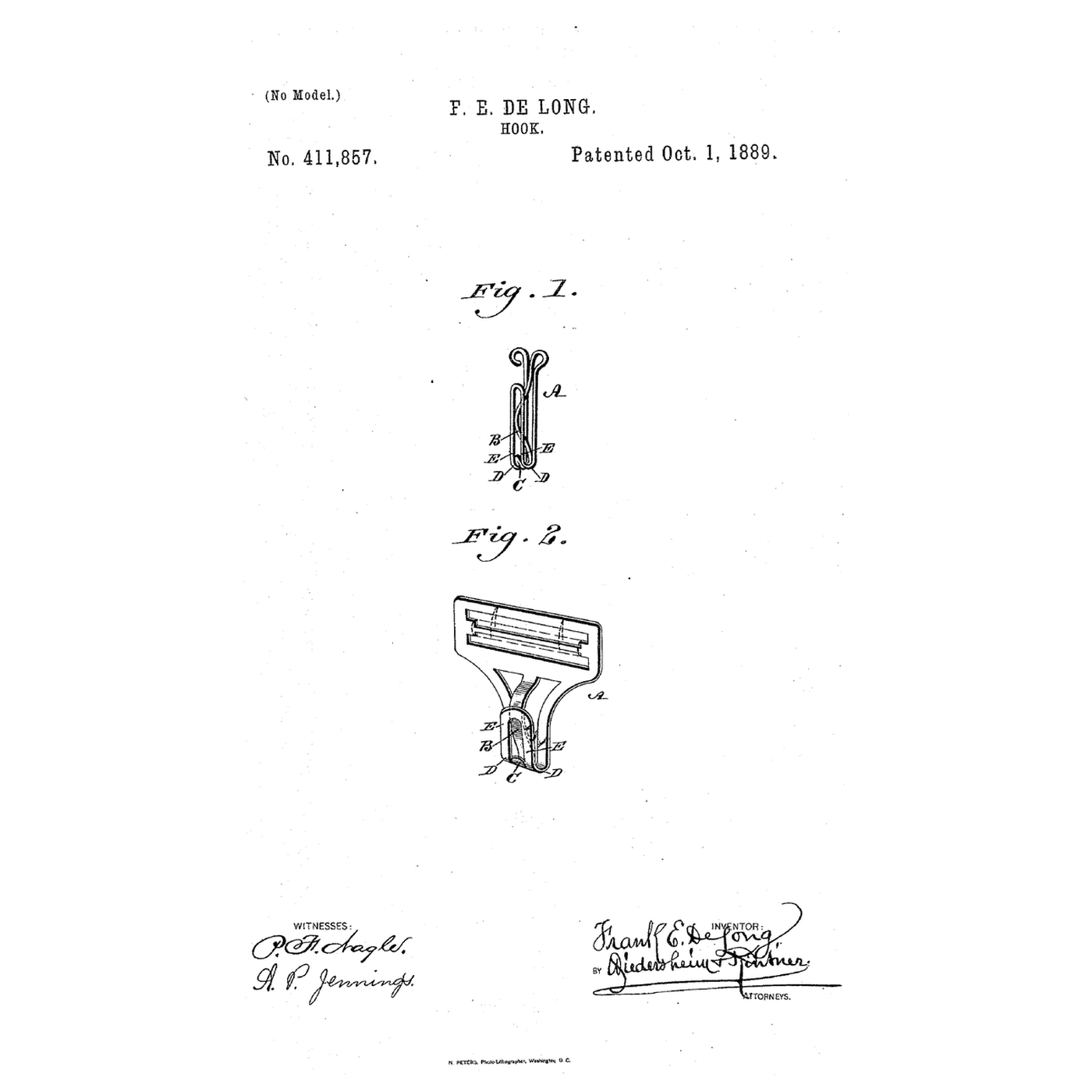
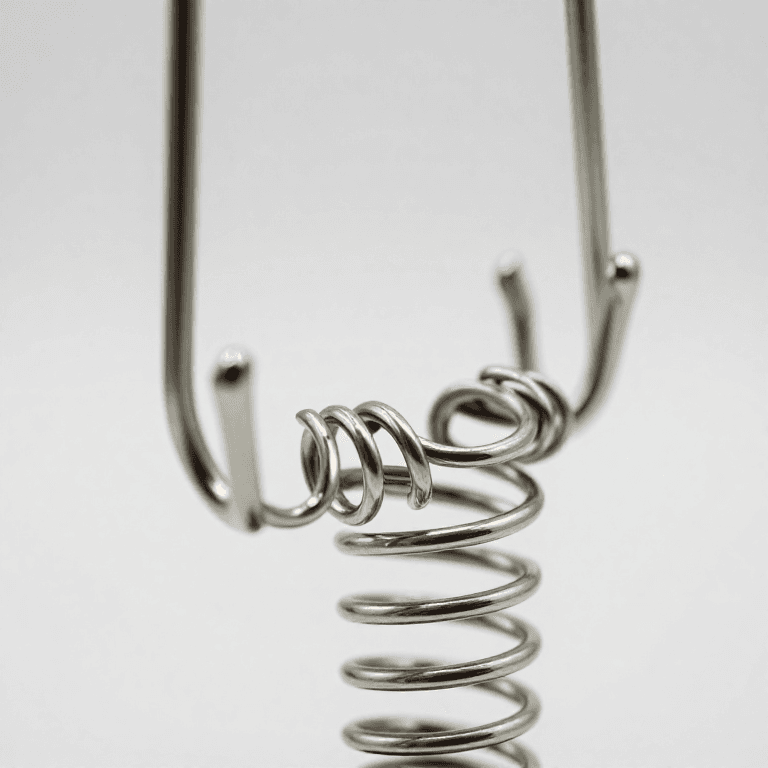
Frank E. De Long of Philadelphia patented a hook with a spring tongue inside it: US 411,857, filed 18 March 1889 and dated 1 October 1889, half assigned to Charles F. De Long. The hook proper and its shank are made of parallel side bars, and between them a tongue, bowed out towards the front of the hook, ends in a loop that sits in the bend. An eye pushed in forces the tongue back and passes; the tongue then closes behind it.
This rung works out how to size a wire tongue so it springs back instead of bending for good, and makes and tests hooks with and without one.
Beginner
About 2 hours
Instructions
1
1
Sizing a wire spring tongue
Sizing a wire spring tongue
Loading Jupyter Notebook...
2
2
A wire spring that guards a point
A wire spring that guards a point
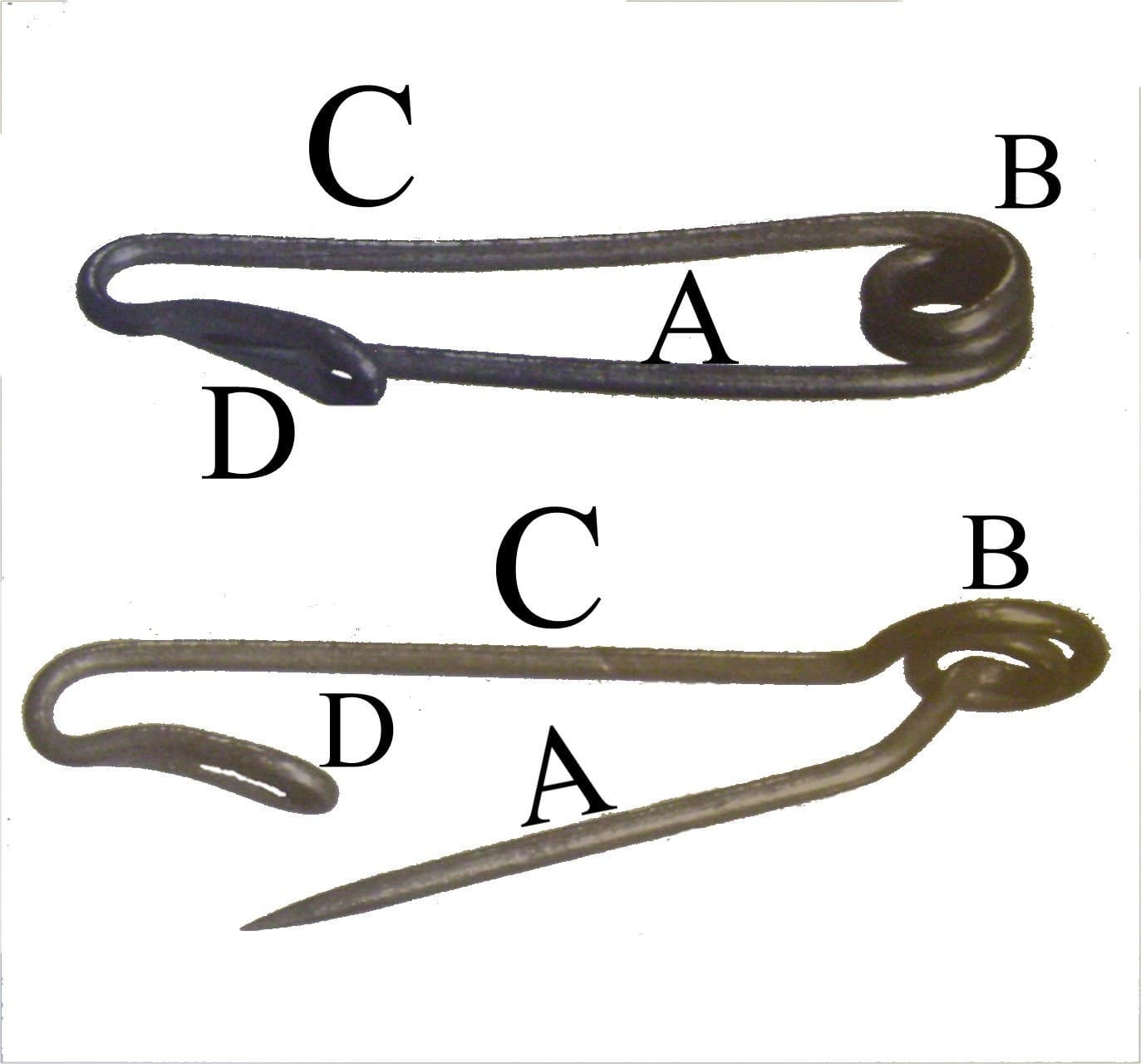
The safety pin bends one wire into a spring and a clasp. The embedded blueprint shows the older closure the hook-and-eye stands beside.
3
3
Read US 411,857
Read US 411,857
De Long describes "a hook or fastening for a garment, composed of front and rear portions or the hook proper and the shank formed of substantially parallel sides or bars, and a tongue having its free end forming a loop coincident with the bend of the hook". Fig. 1 is a hook for "a hook and eye"; Fig. 2 shows the same hook on the frame of a suspender buckle or slide.
The spring-tongue B "is bowed or swelled outwardly so as to approach the front portion." An eye drawn between the front and rear of the hook "bears against the tongue and rides over the same, forcing it backward", reaches the bend D, and the tongue returns, "serving to retain the eye". The eye then sits in both the bend D and the loop C; the loop strengthens the hook and stops the eye "from slipping behind the tongue". Both tongue and loop lie between the side pieces, so they are "laterally restrained" when the hook is under strain.
4
4
Bend hooks with and without a tongue
Bend hooks with and without a tongue
With round-nose and flat-nose pliers, bend two plain hooks and two eyes from steel wire about 0.6 mm thick. For two more hooks, bend the wire back on itself so the hook has two parallel side bars, and form a tongue from finer wire (about 0.3–0.4 mm) that runs inside the hook, bowed towards the front, with its end curled into the bend.
Sew one of each onto two scraps of cotton fabric, with eyes on the facing edges. Hook them up, then shake and flex the fabric with no tension on it for a minute. Count how often each pair comes apart. Check the tongues under a hand lens afterwards: a tongue that no longer touches the front of the hook has taken a set — make it longer or thinner, as the notebook says.
Materials for this step:
 Steel Wire1 piece
 Cotton Fabric (Lightweight)1 piece
 Thread1 pieceSteel Wire2 pieces
Tools needed:
 Round-nose Pliers
 Flat-Nose Pliers
 Diagonal Cutting Pliers
 Hand Sewing Needles
 Hand Lens - 10x
 Digital Caliper 6-Inch
5
5
A hook and eye that will not stay closed
A hook and eye that will not stay closed
Hook-and-eye troubleshooting.
Flow
Loading...
6
6
History and honest limits
History and honest limits
**Frank E. De Long** of Philadelphia filed US 411,857 on 18 March 1889; it is dated 1 October 1889, with one-half assigned to Charles F. De Long. The claim is the hook of parallel bars with a tongue whose free end forms a loop in the bend, both lying between the side bars.
**Honest limits.** The wire modulus and working stress in the notebook are assumed values; the patent gives no dimensions.
Materials
3- 3 piecesPlaceholder
- 1 piecePlaceholder
- 1 piecePlaceholder
Tools Required
6- Placeholder
- Placeholder
- Placeholder
- Placeholder
- Placeholder
- Placeholder
This blueprint makes
Related Blueprints
These blueprints share knowledge with this one — techniques, materials, or principles that connect them in the learning graph.
Safety Pin
by Tex
CRAFT
33
0
0
0
0
0
Greek Bronze Fibula — Bending a Bronze Fibula Brooch
by Forge
Metalworking
85
0
0
0
1
0

Sewing On a Button So It Stays On: The Shank Is the Whole Trick
by Tex
CRAFT
34
0
0
0
0
0
Drawing Wire Through a Drawplate — Reducing Iron Rod to Fine Wire
by Forge
Metalworking
50
0
0
0
3
0
Hooke's Law — Stretch a Spring and Find Its Stiffness
by Penny
Physics
39
0
0
0
0
0
CC0 Public Domain
This blueprint is released under CC0. You are free to copy, modify, distribute, and use this work for any purpose, without asking permission.
Support the Maker by purchasing products through their Blueprint where they earn a Maker Commission set by Vendors, or create a new iteration of this Blueprint and include it as a connection in your own Blueprint to share revenue.