ART
BEAUTY & WELLNESS
CRAFT
CULTURE & HISTORY
ENTERTAINMENT
ENVIRONMENT
FOOD & DRINKS
REVERSE ENGINEERING
SCIENCES
SPORTS
TECHNOLOGY
WEARABLES
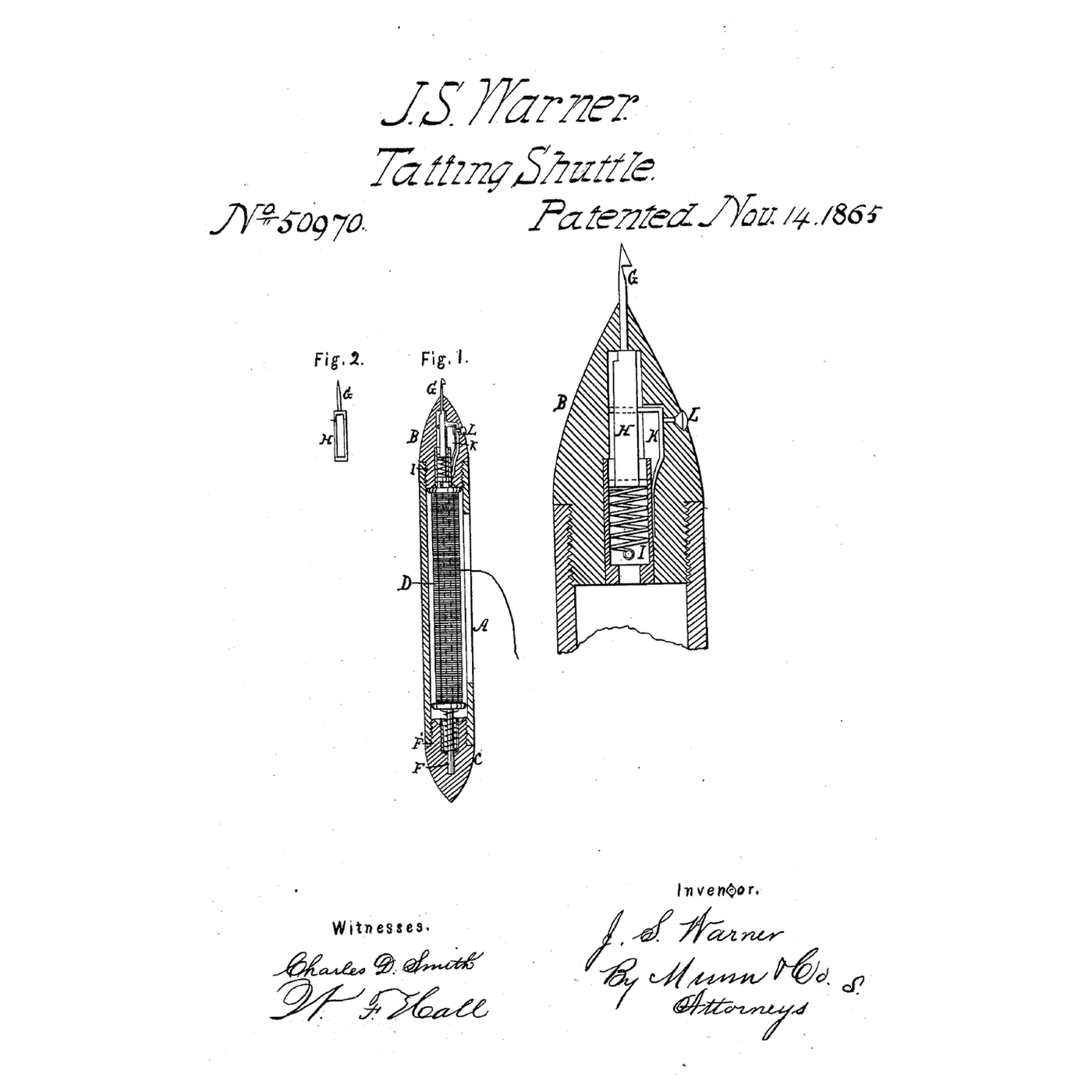


The Hooked Tatting Shuttle: A Spring Hook in One End, a Spool in the Barrel
Tatting needs a crochet hook or a pin to pick out the stitch, which has to be put down and found again, and the thread wound straight on the shuttle soon runs out.
Joel Sylvester Warner of Ogdensburg, New York, received US 50,970, dated 14 November 1865, for "attaching a tatting-hook to the shuttle, which can be sheathed or extended, as may be required; and second, in providing a tatting-shuttle with a spool." The spool turns on a spindle between end caps, held by a spring so it does not run freely; the hook is on a frame pushed out by a spring and held in by a catch, released by pressing a stud.
This rung works out how much thread the spool holds, then builds the shuttle from tube with a printed spool and a sprung, sheathing hook, and tats a ring.
Intermediate
About 4 hours
Instructions
1
1
Thread on the spool
Thread on the spool
Loading Jupyter Notebook...
2
2
The hook it carries
The hook it carries
The embedded blueprint works with a crochet hook. Warner puts such a hook in the end of the tatting shuttle so it is always at hand.
3
3
Read US 50,970
Read US 50,970
"The spool D, which carries the thread, is retained upon a spindle, F, which is journaled in the end caps, and is prevented from running too freely by the spring F′, which sets in a cavity in the cap C, impinges against the end of the spool, and holds it against the end of the cap B."
"The usual practice is to keep a crochet-hook or a pin with which to pick out the stitch in the same manner which is familiar to those who are versed in the art, but by my improvement the needed facility is always in readiness, and is concealed when not required for use."
4
4
Make the shuttle and tat a ring
Make the shuttle and tat a ring
**Barrel.** Cut 7 cm of aluminium tube about 12 mm across. Print two pointed end caps that plug its ends, one with a slot through its point for the hook and the other with a hole for the thread.
**Spool and spindle.** Print a spool that turns inside the barrel on a steel wire spindle held in the two caps, and put a small compression spring in a cavity in one cap against the spool's end as the brake F′.
**Hook.** File a small hook on the end of a short length of steel wire as the tatting hook, fix it to a slider in the pointed cap, and put a spring behind it so it projects. Bend a catch of spring strip that holds it in when pushed back, released by a small stud.
**Test.** Wind cotton thread on the spool and tat a ring of double stitches with a picot, using the hook to pick out and join. Then sheath the hook and carry the shuttle in a pocket.
Materials for this step:
 Aluminium Tube0.07 meter
 PLA Filament1 piece
 Steel Wire0.2 meter
 Compression Spring Assortment1 piece
 Spring Steel Strip0.05 meter
 Two-Part Epoxy1 piece
 Cotton Thread1 piece
Tools needed:
 FDM 3D Printer
 Hacksaw
 Needle File Set
 Round-nose Pliers
 Wire Cutters
 Cordless Drill
 Drill Bit Set
 Digital Caliper 6-Inch
5
5
A shuttle whose spool spins, sticks or whose hook will not stay
A shuttle whose spool spins, sticks or whose hook will not stay
Hooked tatting shuttle troubleshooting.
Flow
Loading...
6
6
History and honest limits
History and honest limits
**Joel Sylvester Warner** of Ogdensburg, St. Lawrence County, New York, received US 50,970, dated 14 November 1865. His barrel A had end caps B and C; the hook G was on a frame H pushed out by the spring I and retained by the spring catch K, released by pressing the stud L. His claim is the tatting shuttle as described, an article of manufacture.
**Honest limits.** Aluminium tube and printed caps and spool stand in for his made parts. The notebook's thread length is an idealised packing; its sizes are examples. Your tatted ring is the result.
Materials
7- 0.07 meterPlaceholder
- 1 piecePlaceholder
- 0.2 meterPlaceholder
- Placeholder
- 0.05 meterPlaceholder
- 1 piecePlaceholder
- 1 piecePlaceholder
Tools Required
8- Placeholder
- Placeholder
- Placeholder
- Placeholder
- Placeholder
- 1 vendor sell this, none ship to you yetPlaceholder
- Placeholder
- Placeholder
Related Blueprints
These blueprints share knowledge with this one — techniques, materials, or principles that connect them in the learning graph.

CC0 Public Domain
This blueprint is released under CC0. You are free to copy, modify, distribute, and use this work for any purpose, without asking permission.
Support the Maker by purchasing products through their Blueprint where they earn a Maker Commission set by Vendors, or create a new iteration of this Blueprint and include it as a connection in your own Blueprint to share revenue.