ART
BEAUTY & WELLNESS
CRAFT
CULTURE & HISTORY
ENTERTAINMENT
ENVIRONMENT
FOOD & DRINKS
REVERSE ENGINEERING
SCIENCES
SPORTS
TECHNOLOGY
WEARABLES



The Inclined-Valve Inkstand: A Glass Clapper That the Pen Pushes Open
An open inkstand lets the ink dry and thicken in the air, and spills when it is knocked over.
Walter Hunt of New York received US 4,221, dated 7 October 1845, for what he called the "Inclined-Valve Inkstand": "the application of an inclined valve or clapper A" of plate glass, hinged on a bracket and pressed upward by two coiled silver-wire springs against the bottom of the ink tube, a funnel cut at 45° that forms its seat. The pen pushes the clapper open to reach the ink; withdrawn, it is wiped by the valve's edge, and the springs close it again, excluding the air and holding the ink in if the stand is upset.
This rung works out what the springs must hold when the stand is upset, then makes the stand from a jar with a printed funnel, a glass clapper and a spring hinge.
Intermediate
About 4 hours
Instructions
1
1
Holding the ink in
Holding the ink in
Loading Jupyter Notebook...
2
2
An inkstand before it
An inkstand before it
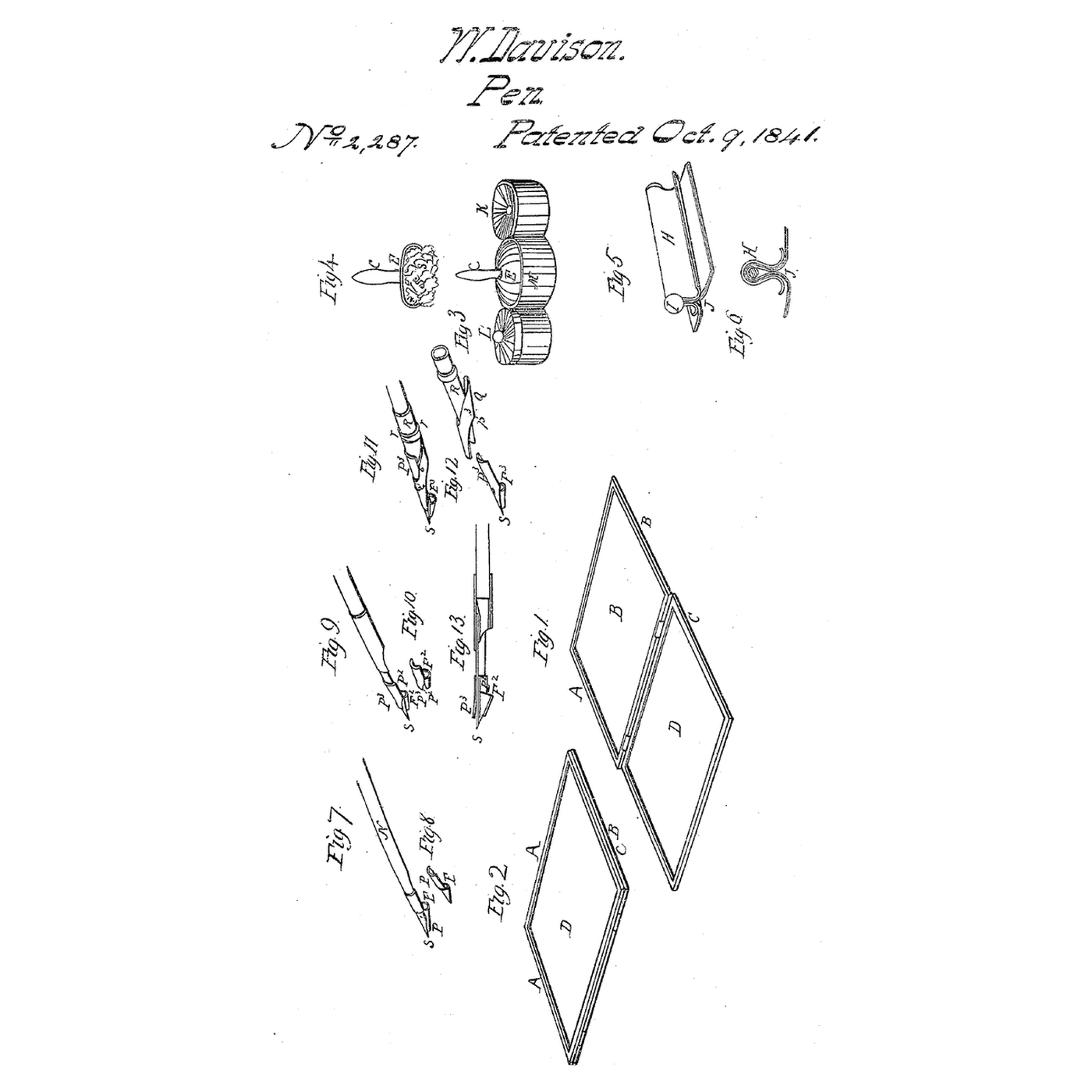
The embedded blueprint keeps the ink from the air with a float. Hunt closes the funnel with a spring valve the pen itself opens.
3
3
Read US 4,221
Read US 4,221
"The nature of my invention consists in the application of an inclined valve or clapper A. See the vertical cut section in the annexed drawings, Figure 1. Said clapper is made of plate glass, (or other material with a hard smooth surface) with a bracket hinge B, made of copper or silver plate, cemented upon its under surface."
"The objects gained by the above arrangement are, the exclusion of the atmosphere from the ink, and security from spilling the same in the upsetting of the inkstand, also of cleaning the point of the pen on the edge of the valve, which is an inevitable result at each time the pen is inserted or withdrawn in using."
4
4
Make the inkstand and try it
Make the inkstand and try it
**Top and funnel.** Print a lid for a small glass jar with a funnel through it whose lower end is cut off at 45°, and two small studs beside it with gaps for a hinge wire.
**Clapper.** Cut a small piece of glass sheet a little larger than the funnel's lower opening and grind its edges. Cement a strip of brass shim under it with epoxy, bent up at one side into a tube round a length of steel wire as the hinge.
**Springs.** Wind two small coil springs of steel wire on the hinge wire, one each side, with their ends set to press the clapper up against the funnel's cut end. Set the wire's ends into the studs' gaps and pinch them shut.
**Test.** Fill the jar with ink, fit the lid, and dip a pen through the funnel: the clapper opens and closes, and wipes the nib as it comes out. Over a tray, tip the stand over and see how much escapes. Leave it a week beside an open jar of the same ink and compare them.
Materials for this step:
 Glass Jar1 piece
 PLA Filament1 piece
 Glass Sheet1 piece
 Brass Shim (Reed Stock)1 piece
 Two-Part Epoxy1 piece
 Steel Wire0.3 meter
 India Ink1 piece
Tools needed:
 FDM 3D Printer
 Tin Snips
 Round-nose Pliers
 Flat-Nose Pliers
 Wire Cutters
 Sandpaper
 Calligraphy Pen Set
 Leather Work Gloves
5
5
A valve that leaks, sticks or will not open
A valve that leaks, sticks or will not open
Inclined-valve inkstand troubleshooting.
Flow
Loading...
6
6
History and honest limits
History and honest limits
**Walter Hunt** of New York, New York, assignor to Augustus T. Arrowsmith, received US 4,221, dated 7 October 1845. His bracket hinge B of copper or silver plate was cemented under the clapper and bent into a thimble C round the hinge wire E, whose ends were let into gaps in two studs F, F cast on the inkstand's top G; a plug tube L with a cork let the stand be cleaned. His claim is the inclined valve with a glass or other hard, smooth surface, with the inclined ink tube, the valve forced upward by springs.
**Honest limits.** A printed top, a steel-wire spring and brass shim stand in for his cast top, silver springs and copper plate. The notebook treats the ink as still; its sizes, depths and spring force are examples. Your upset test and week of standing are the result.
Materials
7- 1 piecePlaceholder
- 1 piecePlaceholder
- 1 piecePlaceholder
- 1 piecePlaceholder
- 1 piecePlaceholder
- 0.3 meterPlaceholder
- 1 piecePlaceholder
Tools Required
8- Placeholder
- Placeholder
- Placeholder
- Placeholder
- Placeholder
- Placeholder
- Placeholder
- Placeholder
Related Blueprints
These blueprints share knowledge with this one — techniques, materials, or principles that connect them in the learning graph.



CC0 Public Domain
This blueprint is released under CC0. You are free to copy, modify, distribute, and use this work for any purpose, without asking permission.
Support the Maker by purchasing products through their Blueprint where they earn a Maker Commission set by Vendors, or create a new iteration of this Blueprint and include it as a connection in your own Blueprint to share revenue.