ART
BEAUTY & WELLNESS
CRAFT
CULTURE & HISTORY
ENTERTAINMENT
ENVIRONMENT
FOOD & DRINKS
REVERSE ENGINEERING
SCIENCES
SPORTS
TECHNOLOGY
WEARABLES


The Inner-Valve Bottle Opener: A Tube That Holds the Valve Open and Clasps That Hold the Tube
A bottle closed by a valve on the inside keeps its gas until something pushes the valve in, and a finger or a stick pushed down the neck has to stay there while the drink is poured past it.
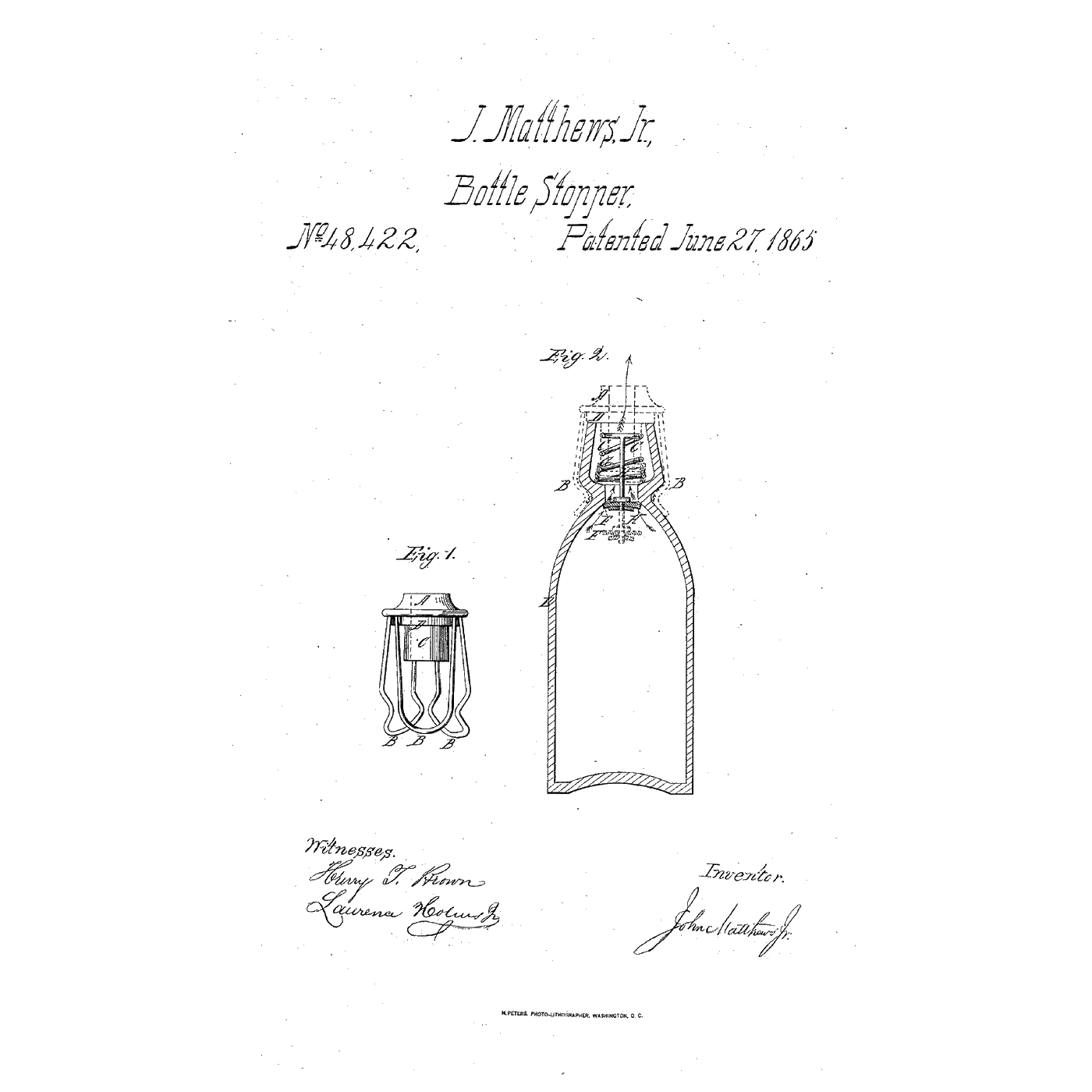
John Matthews, Jr., of New York received US 48,422, dated 27 June 1865, for an instrument "to provide for the opening of such stoppers as are applied within bottles or other vessels and closed from the inside either by means of a spring or by the pressure of the gas evolved from the liquid contents of the vessel or with which the said contents have been mechanically charged, or by any other means." A cap carries a hollow tube of vulcanized india-rubber or gutta-percha that enters the neck and holds the valve open, a soft-rubber packing ring that seals against the mouth, and spring clasps that snap into a groove round the neck and hold it there while the liquid runs out through the tube.
This rung works out the push needed to open an inner valve, then makes the instrument from a tin lid, spring steel and rubber and tries it on a pressurised bottle closed by a tyre valve, which also opens inward.
Intermediate
About 3 hours
Instructions
1
1
The push that opens the valve
The push that opens the valve
Loading Jupyter Notebook...
2
2
Where the tube and the packing ring come from
Where the tube and the packing ring come from
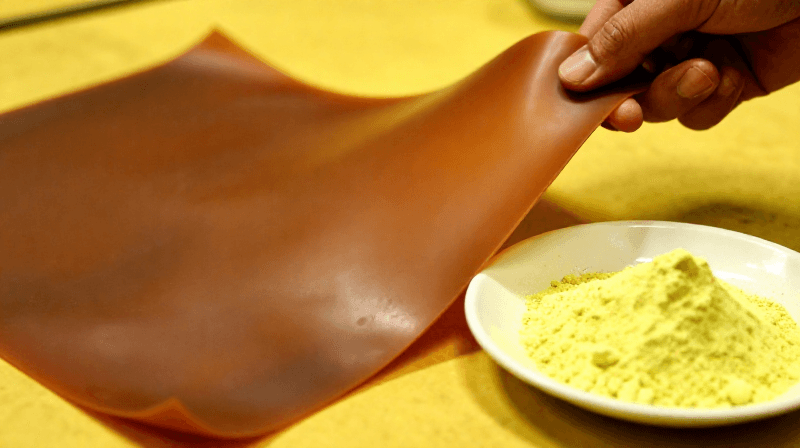
The embedded blueprint vulcanizes rubber. Matthews made the tube of vulcanized india-rubber or gutta-percha and sealed the mouth with a soft-rubber packing ring.
3
3
Read US 48,422
Read US 48,422
"The invention consists of a tube or other device of suitable size and form to enter the mouth of the bottle or other vessel and press the stopper inward away from its seat without interfering materially with the ingress or egress of the liquid, and one or more attached clasps or other devices to operate against the exterior of the bottle or other vessel in such manner as to serve both as a guide to keep the tube or other internally-acting device in place and as a means of holding it against the pressure by which the stopper is closed when the opening-instrument is removed from the bottle or vessel."
"In order to open a bottle closed by an inwardly-opening valve, such as is represented in section in Fig. 2, the instrument—the cap being uppermost—is forced downward over the neck of the bottle E, the clasps, clips, or springs B B B spring apart until they clear the upper portion of the neck of the bottle, and the portions of the springs which are bent toward the center enter the depression s of the bottle's neck and hold the valve F open by the hollow center pushing against the helical spring G′, which is fastened to the valve-stem H."
4
4
Make the instrument and open a pressurised bottle
Make the instrument and open a pressurised bottle
**Test bottle.** Drill the cap of a clean carbonated-drink PET bottle to take a snap-in tyre valve and pull the valve through from the inside so its rubber seals the hole. Half fill the bottle with water, screw the cap on and pump it to 2 bar with the floor pump, reading its gauge. The valve's spring and the air hold it shut from the inside, as Matthews' valve F was held.
**Cap and tube.** Cut a disc from a tin can's lid a little wider than the bottle cap and drill a hole in its centre. Cut 2 cm of aluminium tube that fits loosely over the valve's stem, file a notch across its end so the air and water can pass the valve pin, and fix it through the disc with epoxy, notched end out.
**Packing ring.** Cut a ring of rubber sheet to fit round the tube against the disc, where the tube will seal against the valve's mouth.
**Clasps.** Cut three strips of spring steel 6 cm long, bend the last centimetre of each inward as a hook, and rivet them round the disc's edge so the hooks spring over the bottle cap and catch beneath its lower edge.
**Test.** Measure the push needed to open the valve with the spring scale pressing the tube. Then, over a sink, hold the bottle upside down and push the instrument onto it until the clasps catch: the water runs out through the tube. Pull it off and the valve shuts again.
Materials for this step:
 Tin Can1 piece
 Aluminium Tube0.02 meter
 Rubber Sheet1 piece
 Spring Steel Strip0.2 meter
 Steel Rivets3 pieces
 Two-Part Epoxy1 piece
 Water0.5 liter
Tools needed:
 Bicycle Floor Pump
 Cordless Drill
 Drill Bit Set
 Tin Snips
 Hacksaw
 Files (Hand File)
 Flat-Nose Pliers
 Rivet Set
 Kitchen Knife
 Force Meter (Spring Scale)
 Clear Safety Glasses
 Leather Work Gloves
 PET Bottle (Carbonated Drink)
 Tire Valve
 Riveting Hammer
5
5
An opener that leaks, slips or will not open the valve
An opener that leaks, slips or will not open the valve
Inner-valve bottle opener troubleshooting.
Flow
Loading...
6
6
History and honest limits
History and honest limits
**John Matthews, Jr.,** of New York, New York, received US 48,422, dated 27 June 1865. His cap A carried the tube C, the springs B B B were of wire or steel plate, the packing ring D made a water-tight joint at the mouth, and the springs caught in a depression s round the bottle's neck. The same instrument let an empty bottle be filled through the valve.
**Honest limits.** A PET bottle, a tyre valve and a tin-lid cap stand in for his glass bottle with its inner valve and his metal cap; the clasps catch under the screw cap rather than in a groove in the glass. The notebook ignores friction; its pressures, seat sizes and spring force are examples. Your push and pour are the result.
Materials
7- 1 piecePlaceholder
- 0.02 meterPlaceholder
- 1 piecePlaceholder
- 0.2 meterPlaceholder
- 3 piecesPlaceholder
- 1 piecePlaceholder
- 0.5 literPlaceholder
Tools Required
15- Placeholder
- 1 vendor sell this, none ship to you yetPlaceholder
- Placeholder
- Placeholder
- Placeholder
- Placeholder
- Placeholder
- Placeholder
- Placeholder
- Placeholder
- Placeholder
- Placeholder
- Placeholder
- Placeholder
- Placeholder
This blueprint makes

Related Blueprints
These blueprints share knowledge with this one — techniques, materials, or principles that connect them in the learning graph.


CC0 Public Domain
This blueprint is released under CC0. You are free to copy, modify, distribute, and use this work for any purpose, without asking permission.
Support the Maker by purchasing products through their Blueprint where they earn a Maker Commission set by Vendors, or create a new iteration of this Blueprint and include it as a connection in your own Blueprint to share revenue.