ART
BEAUTY & WELLNESS
CRAFT
CULTURE & HISTORY
ENTERTAINMENT
ENVIRONMENT
FOOD & DRINKS
REVERSE ENGINEERING
SCIENCES
SPORTS
TECHNOLOGY
WEARABLES
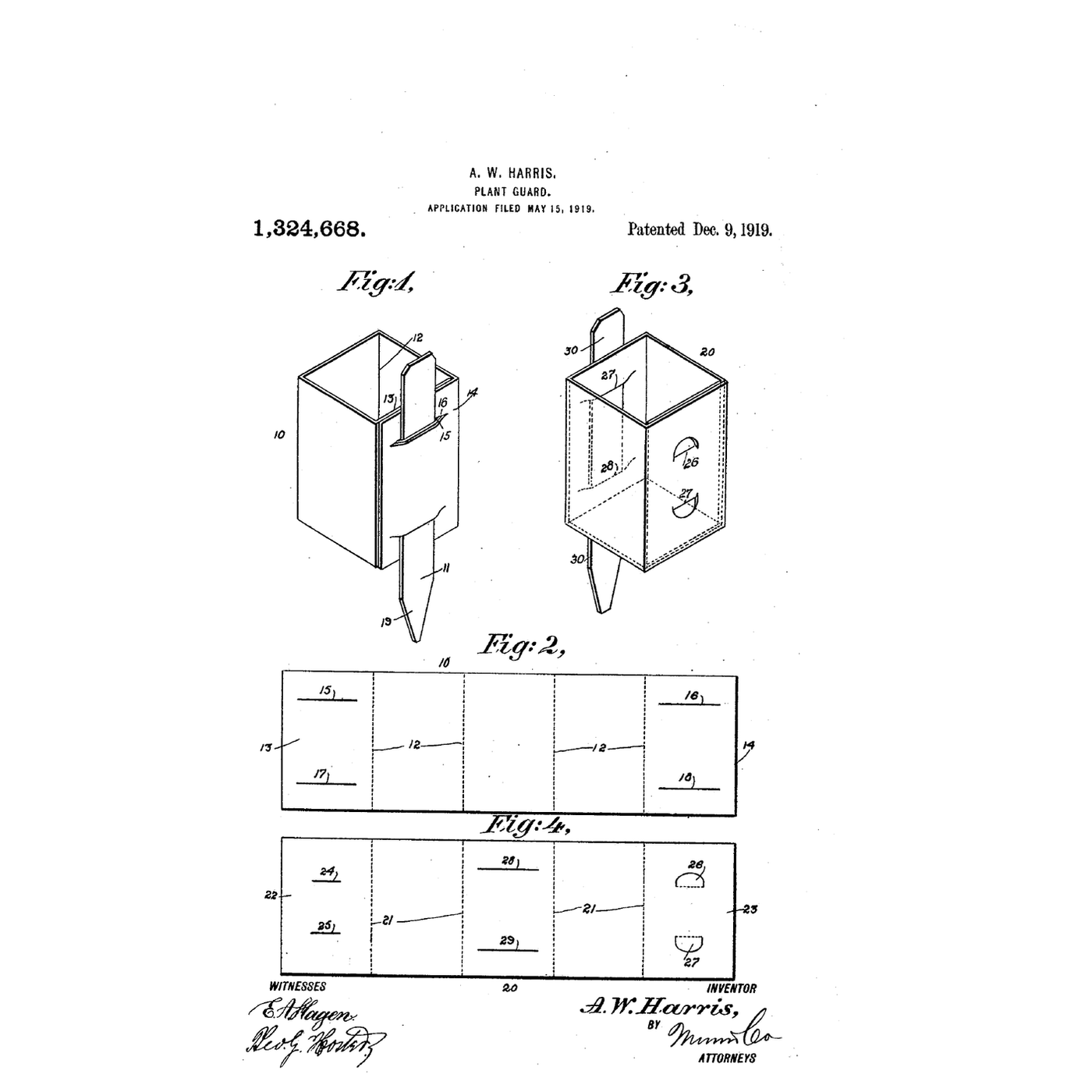


The Label-Anchored Plant Guard: A Folded Card Collar Pinned Down by the Plant's Own Label
A transplanted seedling stands exposed at the soil line, and a loose collar round it blows away.
Arthur W. Harris of Sleepy Eye, Minnesota, received US 1,324,668, patented 9 December 1919, for a plant guard "to prevent cutworms and other insects from reaching and injuring or destroying the plant": a creased card folded into a square tube, held to the ground by the plant's pointed label threaded through slots in its overlapping ends.
This rung counts how many guards one sheet of card gives, then folds one round a plant and measures how hard it can be pushed before it tips, with and without its label.
Beginner
About 1 hour
Instructions
1
1
Guards per sheet
Guards per sheet
Loading Jupyter Notebook...
2
2
Planting out before it
Planting out before it
The embedded blueprint moves a seedling outdoors. Harris's guard goes round it once it is in the ground.
3
3
Read US 1,324,668
Read US 1,324,668
"The anchoring member 11 is preferably in the form of a pot or plant label usually made of a piece of flat wood or other material and having a pointed lower end 19 to permit of conveniently threading the label through the registering slots 15, 16 and 17, 18 and to permit of conveniently pushing this pointed end 19 into the ground to securely hold the body 10 in upright position on the ground and around a growing plant."
"In practice, the lower end of the body 10 is pushed about half an inch into the ground as some of the cutworms are active near the surface of the ground as well as above ground."
4
4
Cut and crease the strip
Cut and crease the strip
Cut a strip of card 220 × 80 mm. Mark creases at 20, 70, 120 and 170 mm and score them with the bone folder against the ruler. The 20 mm end and the last 50 mm side overlap.
Materials for this step:
 Card Stock1 piece
Tools needed:
 Craft Knife
 Self-Healing Cutting Mat
 Ruler
Ruler Pencil
 Bone Folder
5
5
Slot the ends
Slot the ends
Fold the strip into a square tube with the ends overlapping. Through both layers cut two horizontal slits, one 15 mm from the top and one 15 mm from the bottom, each 2 mm wider than the plant label.
Tools needed:
Craft KnifeSelf-Healing Cutting MatRuler6
6
Set it round the plant
Set it round the plant
Write the plant's name on the label. Lower the tube over a plant in a pot of soil and push its edge about 1.3 cm (half an inch) in. Thread the label in through the upper slit and out through the lower one, then push its point into the soil.
Materials for this step:
 Plant Label1 piece
 Garden Soil1 piece
Tools needed:
 Flower Pot
 Permanent MarkerRuler
7
7
Measure the tipping push
Measure the tipping push
Punch a hole 10 mm below the top edge. Hook the force meter through it and pull sideways until the tube tips; note the force. Repeat three times with the label and three times without it. Then give it 30 sprays of water and pull again.
Tools needed:
 Hole Punch
 Force Meter (Spring Scale)
 Water Spray Bottle
8
8
A guard that tips, tears or crowds the plant
A guard that tips, tears or crowds the plant
Label-anchored plant guard troubleshooting.
Flow
Loading...
9
9
History and honest limits
History and honest limits
**Arthur W. Harris** of Sleepy Eye, Minnesota, filed US 1,324,668 on 15 May 1919; it was patented 9 December 1919. He also showed a form whose overlapping ends lock with struck-up lugs through slots, with the label threaded through the opposite side. He noted the tube ships flat with its label and is assembled by the user, and that the label keeps it from being disturbed by severe winds or rains.
**Honest limits.** He gives no sizes; the 50 mm square is an example. The test measures how firmly the guard stands, not how well it stops insects. Your forces are the result.
Materials
3- 1 piecePlaceholder
- 1 piecePlaceholder
- 1 piecePlaceholder
Tools Required
10- Placeholder
- Placeholder
- Placeholder
- 1 vendor sell this, none ship to you yetPlaceholder
- Placeholder
- Placeholder
- Placeholder
- Placeholder
- Placeholder
- Placeholder
Related Blueprints
These blueprints share knowledge with this one — techniques, materials, or principles that connect them in the learning graph.


CC0 Public Domain
This blueprint is released under CC0. You are free to copy, modify, distribute, and use this work for any purpose, without asking permission.
Support the Maker by purchasing products through their Blueprint where they earn a Maker Commission set by Vendors, or create a new iteration of this Blueprint and include it as a connection in your own Blueprint to share revenue.