ART
BEAUTY & WELLNESS
CRAFT
CULTURE & HISTORY
ENTERTAINMENT
ENVIRONMENT
FOOD & DRINKS
REVERSE ENGINEERING
SCIENCES
SPORTS
TECHNOLOGY
WEARABLES



The Loop-Spring Clothes-Pin: A Sugar-Tong Spring and Metal Pivots in Two Wooden Arms
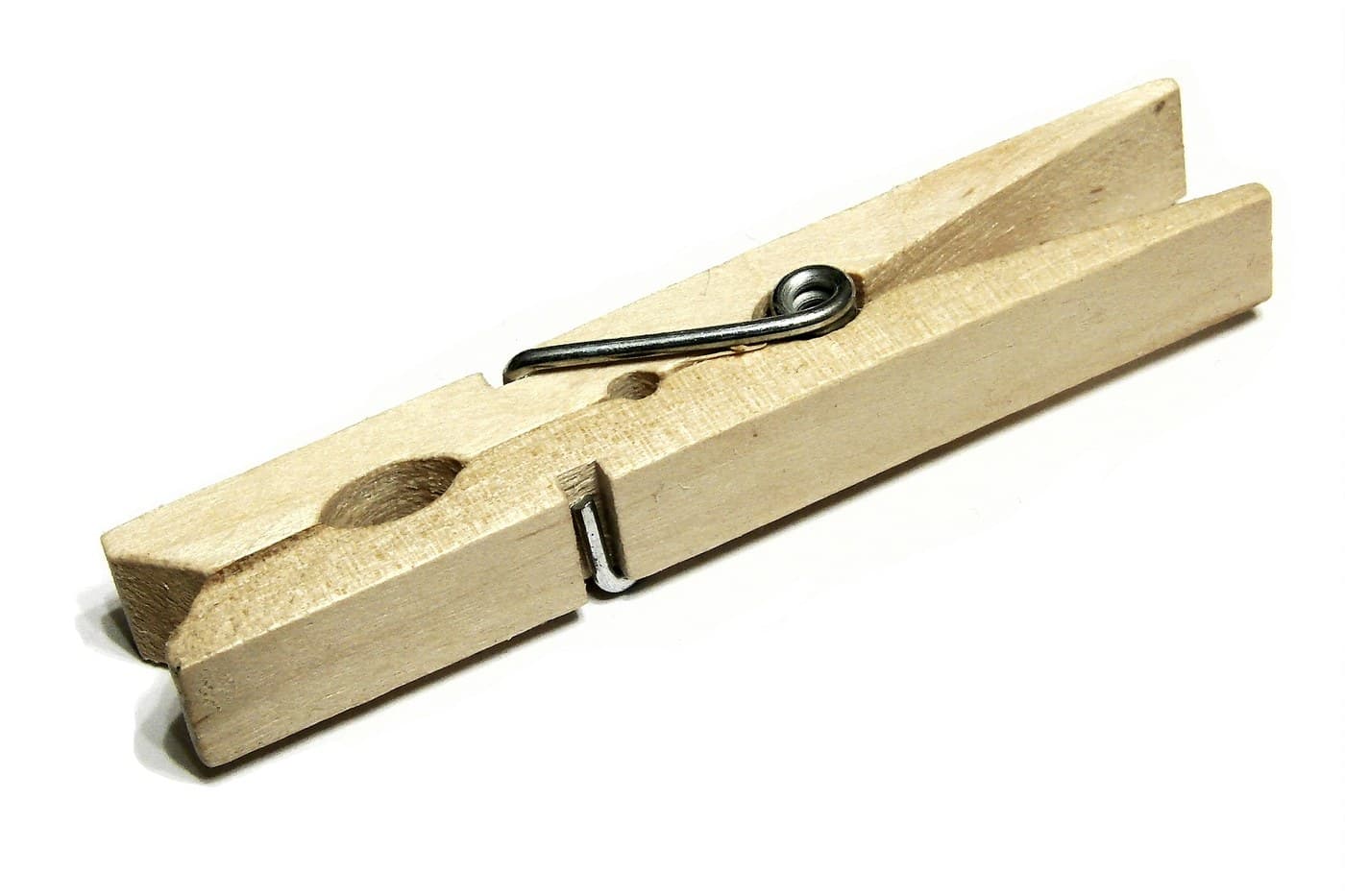
A spring clothes-pin whose spring also serves as its hinge pulls its wooden arms apart and tears loose from them.
George Topping of Chicago received US 166,160, dated 27 July 1875, for a clothes-pin in which, near the middle of the arms where they are hinged, deep recesses and grooves running to the handles' ends receive "a loop, e, and a leg, f, of a metallic spring, S, preferably of wire, and greatly resembling the well-known sugar-tongs in its general form", held by strong metal pivots through the arms and the loop, so the spring can expand freely "without danger of tearing them away from each other". A notch across the jaws takes the line.
This rung works out how hard the pin grips, then carves the arms, bends the spring and pins them, and hangs washing with it.
Beginner
About 3 hours
Instructions
1
1
The grip
The grip
Loading Jupyter Notebook...
2
2
The spring clothespin before it
The spring clothespin before it
The embedded blueprint is Smith's 1853 spring clothespin. Topping gives the spring a loop held on metal pivots so it cannot tear the arms apart.
3
3
Read US 166,160
Read US 166,160
"At the point where it is customary to hinge these wooden arms together—that is to say, at or near the center of their length—a deep longitudinal recess, h, is cut into their inner faces, and a groove, i, extending outwardly therefrom to the extremity of handles c, which recesses and grooves are each respectively designed to receive one end of a loop, e, and a leg, f, of a metallic spring, S, preferably of wire, and greatly resembling the well-known sugar-tongs in its general form."
"By this construction loop e is made to perform, in connection with pivots d, the function of a hinge, the power whereby the griping ends a a of arms A are actuated being produced by the resistance to compression of legs f"
4
4
Make the pins and hang washing
Make the pins and hang washing
**Arms.** Saw two 9 cm arms from hardwood, 10 × 8 mm, and shape their front ends as jaws with a notch b filed across both for the line. Chisel a deep recess h in the middle of each inner face and a groove i from it to the handle's end.
**Spring.** Bend spring steel wire into a sugar-tong shape: a loop in the middle and two legs, the legs sprung apart.
**Pivots.** Lay the loop's ends in the recesses and the legs in the grooves, drill through each arm and the loop, and drive a short steel pin through as the pivot d.
**Test.** Pin a wet towel and a thin shirt to a clothesline in a breeze. Hook a spring scale to a pinned strip of cloth and pull until it slips.
Materials for this step:
 Hardwood Board1 piece
 Spring Steel Wire0.3 meter
 Mild Steel Rod0.05 meter
 Clothesline1 piece
 Cotton Fabric (Lightweight)1 piece
Tools needed:
 Hand Saw
 Chisel Set - Wood
 Files (Hand File)
 Cordless Drill
 Drill Bit Set
 Round-nose Pliers
 Flat-Nose Pliers
 Hammer
 Sandpaper
 Force Meter (Spring Scale)
5
5
A pin that slips, splits or springs apart
A pin that slips, splits or springs apart
Loop-spring clothes-pin troubleshooting.
Flow
Loading...
6
6
History and honest limits
History and honest limits
**George Topping** of Chicago, Cook County, Illinois, filed US 166,160 on 30 January 1875; it is dated 27 July 1875. His pivots d were cylindrical to prevent undue friction, and the ends of the loop fitted snugly into the recesses. His claim is the clothes-pin with the jaws, recesses, grooves and pivots combined with the spring having the loop and legs.
**Honest limits.** Hand-carved arms and a hand-bent spring stand in for his made parts. The notebook treats the arms as rigid; its spring force, lengths and friction are examples. Your pull test is the result.
Materials
5- 1 piecePlaceholder
- 0.3 meterPlaceholder
- 0.05 meterPlaceholder
- 1 piecePlaceholder
- 1 piecePlaceholder
Tools Required
10- Placeholder
- Placeholder
- Placeholder
- 1 vendor sell this, none ship to you yetPlaceholder
- Placeholder
- Placeholder
- Placeholder
- Placeholder
- Placeholder
- Placeholder
This blueprint makes
Related Blueprints
These blueprints share knowledge with this one — techniques, materials, or principles that connect them in the learning graph.
CC0 Public Domain
This blueprint is released under CC0. You are free to copy, modify, distribute, and use this work for any purpose, without asking permission.
Support the Maker by purchasing products through their Blueprint where they earn a Maker Commission set by Vendors, or create a new iteration of this Blueprint and include it as a connection in your own Blueprint to share revenue.