ART
BEAUTY & WELLNESS
CRAFT
CULTURE & HISTORY
ENTERTAINMENT
ENVIRONMENT
FOOD & DRINKS
REVERSE ENGINEERING
SCIENCES
SPORTS
TECHNOLOGY
WEARABLES
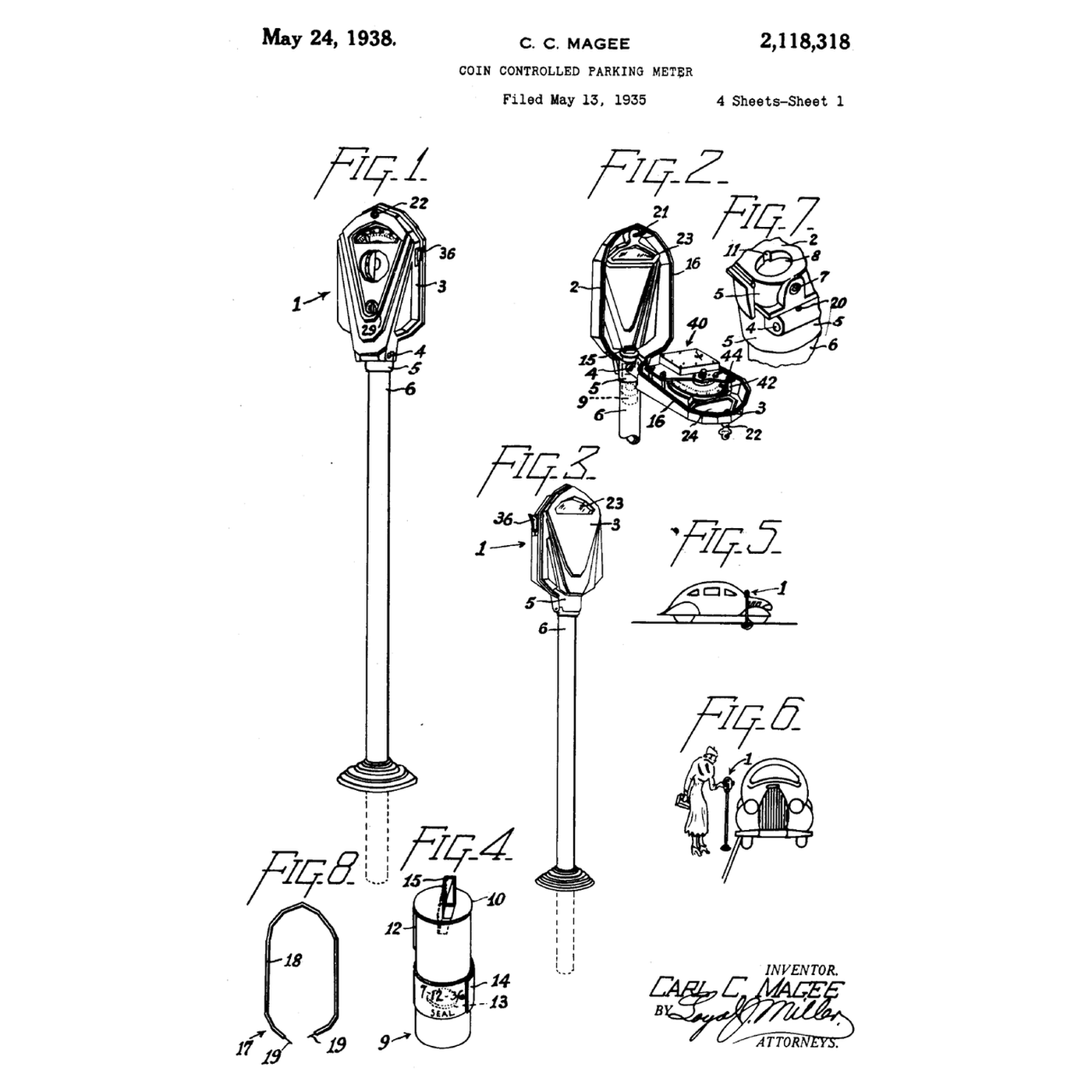


The Parking Meter: A Coin That Unlocks a Clock
By the 1930s city streets were lined with cars parked all day, and shops lost the customers who could not stop. A parking meter rations the kerb: a coin buys a set time, and a signal shows anyone passing when it has run out.
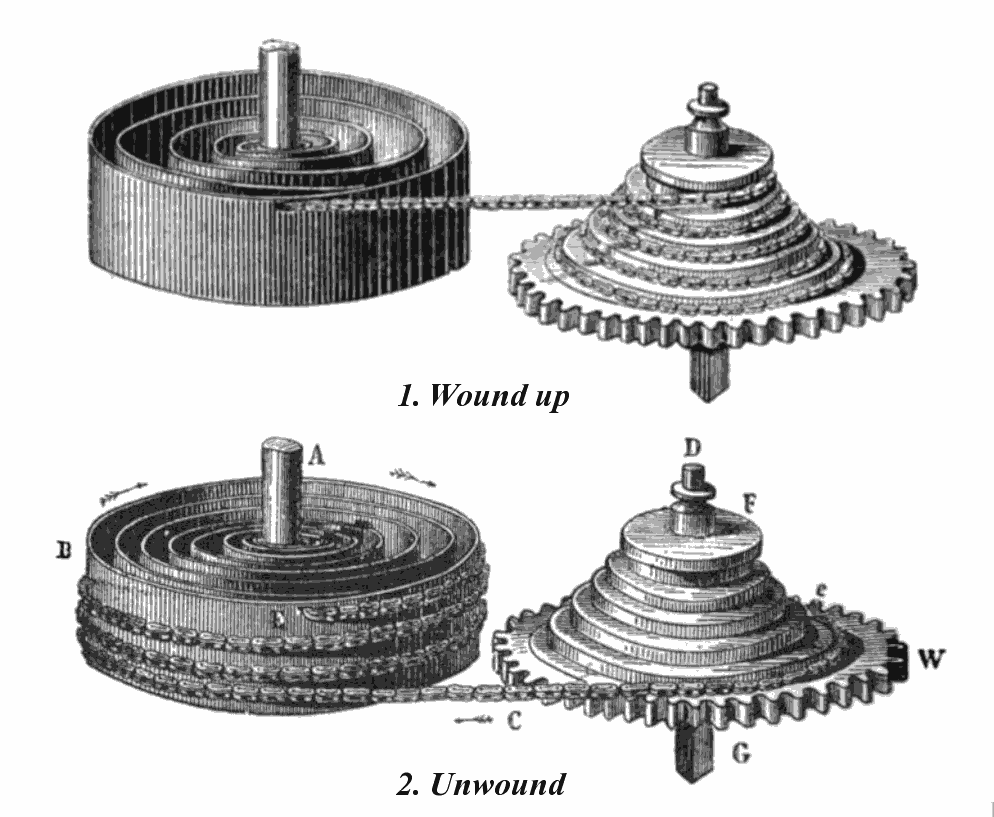
Carl C. Magee of Oklahoma City, assignor to the Dual Parking Meter Company, filed US 2,118,318, *Coin Controlled Parking Meter*, on 13 May 1935; it was granted 24 May 1938. Inside a lockable head on a post, a coin completes the winding mechanism; turning the handle winds a spring; an escapement-governed train runs it down; a signal shows while the time lasts and vanishes when it has elapsed. The last coin shows in a window, and the coins fall into a sealed container so the collections can be checked. Oklahoma City installed Magee's meters in July 1935.
This rung designs the gear train and the spring for a one-hour meter and builds a coin-interlocked timer from a wind-up motor.
Intermediate
About 5 hours
Instructions
1
1
Gear ratio and spring energy
Gear ratio and spring energy
Loading Jupyter Notebook...
2
2
One parking, as the patent describes it
One parking, as the patent describes it
Blockly Workspace
Loading Blockly workspace...
3
3
What keeps the time
What keeps the time
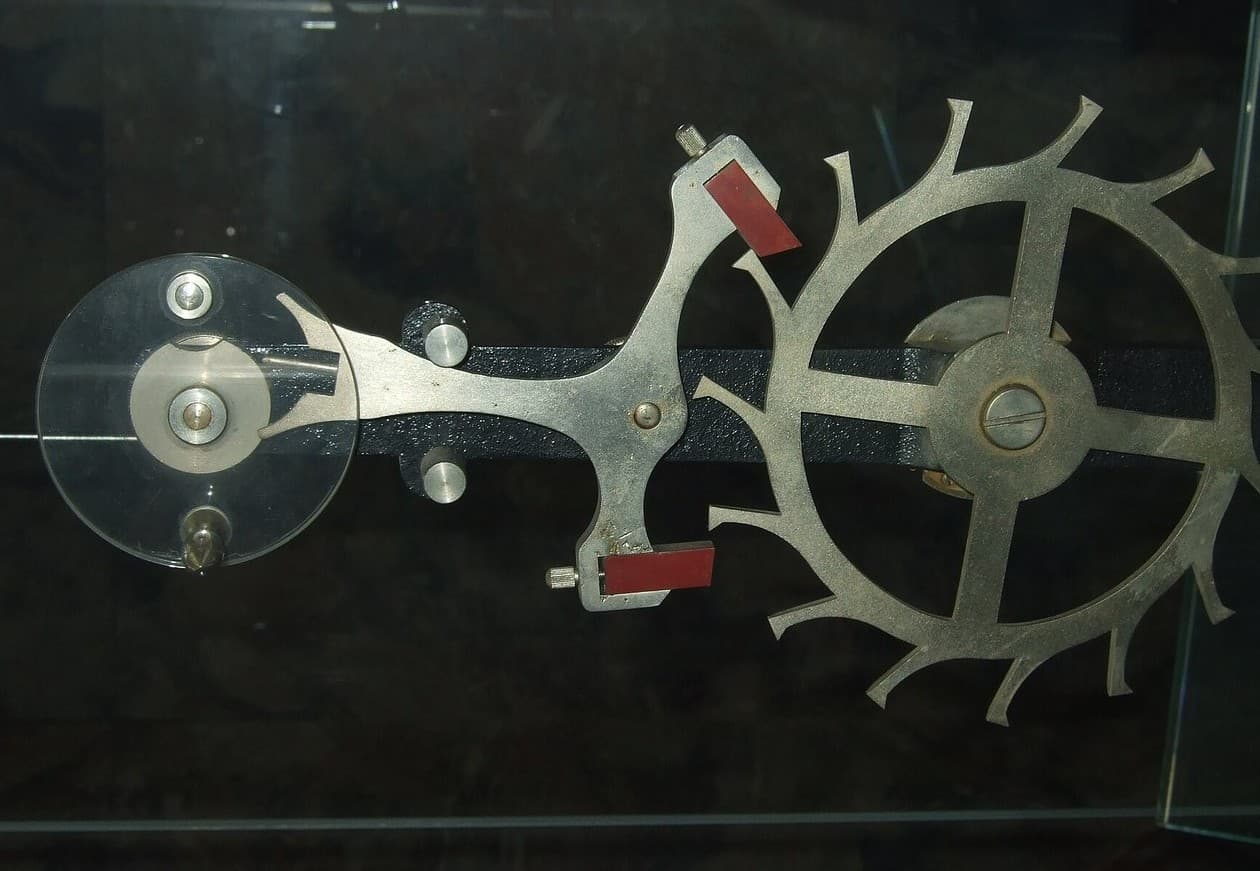
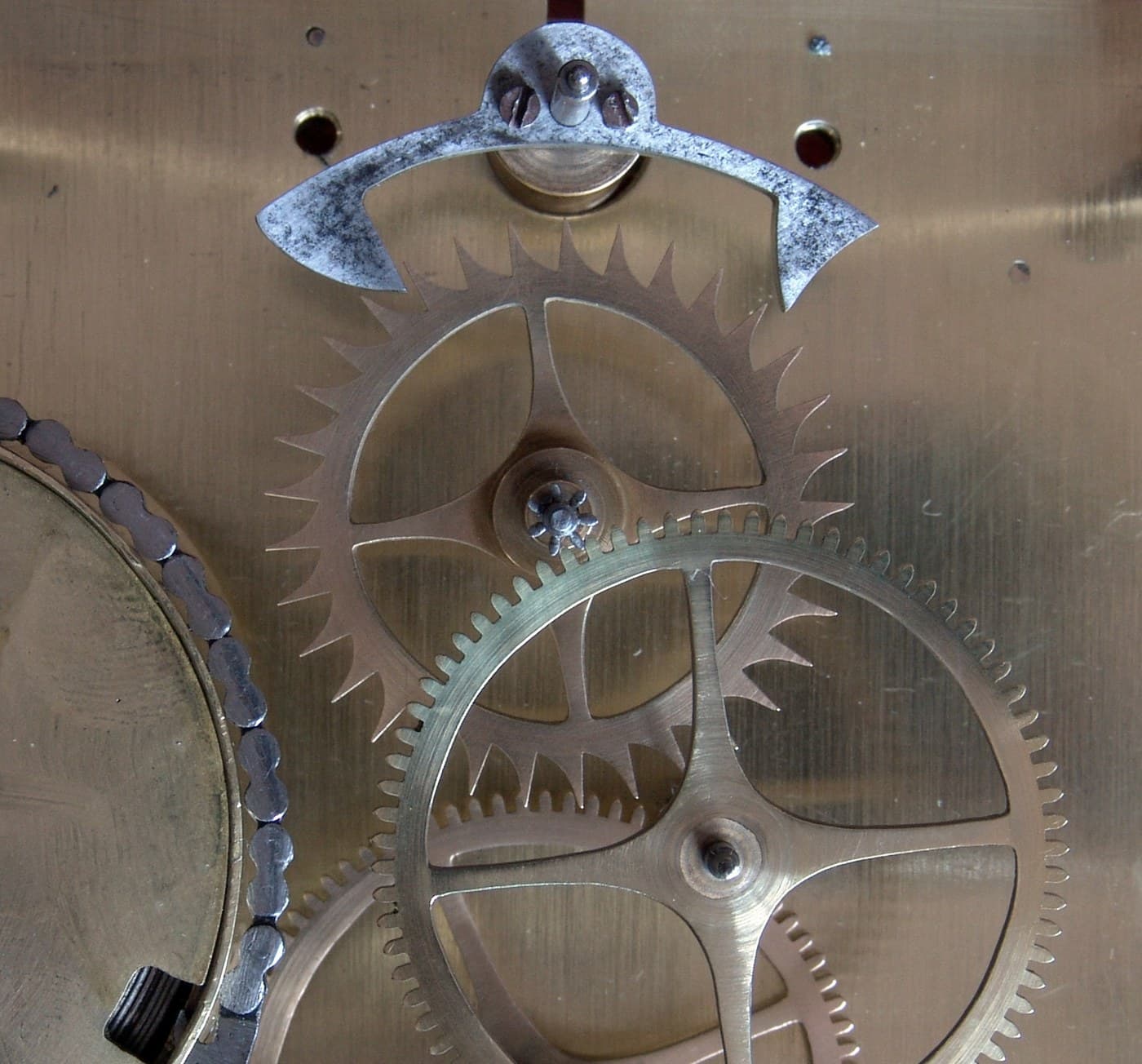
The meter's clockwork is governed by an escapement. The embedded blueprint shows how an escapement releases a gear train one tooth at a time.
4
4
Build a coin-interlocked timer
Build a coin-interlocked timer
Take a wind-up motor mechanism and fit a pointer to its slowest output shaft; mark the run-down time of a full wind on a card dial behind it.
Make the winding key the interlock, as Magee's coin was. 3D-print a crank that drives the winding shaft through a sliding coupling: two halves with a slot between them exactly as wide as the coin. Without a coin the outer half turns freely; drop a coin into the slot and it locks the halves together, so the crank winds the spring. Put a ramp below so that when the crank has turned half a revolution the coin falls out of the slot into a box.
Try it without a coin: the crank spins, nothing winds. With a coin: one wind, the pointer runs down across its dial. Time a full run and compare with the card.
Materials for this step:
 Wind-Up Motor Mechanism1 piece
 Copper Coin3 pieces
 Plywood Sheet1 piece
 Machine Screws6 pieces
 Hardwood Dowels1 piece
Tools needed:
 FDM 3D Printer
 PETG Filament
 Cordless Drill
 Drill Bit Set
 Digital Caliper 6-Inch
 Stopwatch
5
5
A meter that takes the coin but gives no time
A meter that takes the coin but gives no time
Coin-operated timer faults.
Flow
Loading...
6
6
History and honest limits
History and honest limits
**Carl C. Magee** of Oklahoma City filed **US 2,118,318** on 13 May 1935, assigned to the Dual Parking Meter Company; granted 24 May 1938. Oklahoma City installed 150 of his meters along 14 blocks downtown in July 1935, charging five cents an hour; within a few years they spread to cities across the United States and abroad.
**Honest limits.** The notebook's beat rate, train losses and spring figures are illustrative, not Magee's. The printed interlock accepts anything the size of the coin — real meters gauge a coin's diameter, thickness and sometimes its metal.
Materials
5- Wind-Up Motor Mechanism10% commission1 piecePlaceholder
- 3 piecesPlaceholder
- 1 piecePlaceholder
- 6 piecesPlaceholder
- 1 piecePlaceholder
Tools Required
6- Placeholder
- Placeholder
- 1 vendor sell this, none ship to you yetPlaceholder
- Placeholder
- Placeholder
- Placeholder
Related Blueprints
These blueprints share knowledge with this one — techniques, materials, or principles that connect them in the learning graph.


CC0 Public Domain
This blueprint is released under CC0. You are free to copy, modify, distribute, and use this work for any purpose, without asking permission.
Support the Maker by purchasing products through their Blueprint where they earn a Maker Commission set by Vendors, or create a new iteration of this Blueprint and include it as a connection in your own Blueprint to share revenue.