ART
BEAUTY & WELLNESS
CRAFT
CULTURE & HISTORY
ENTERTAINMENT
ENVIRONMENT
FOOD & DRINKS
REVERSE ENGINEERING
SCIENCES
SPORTS
TECHNOLOGY
WEARABLES
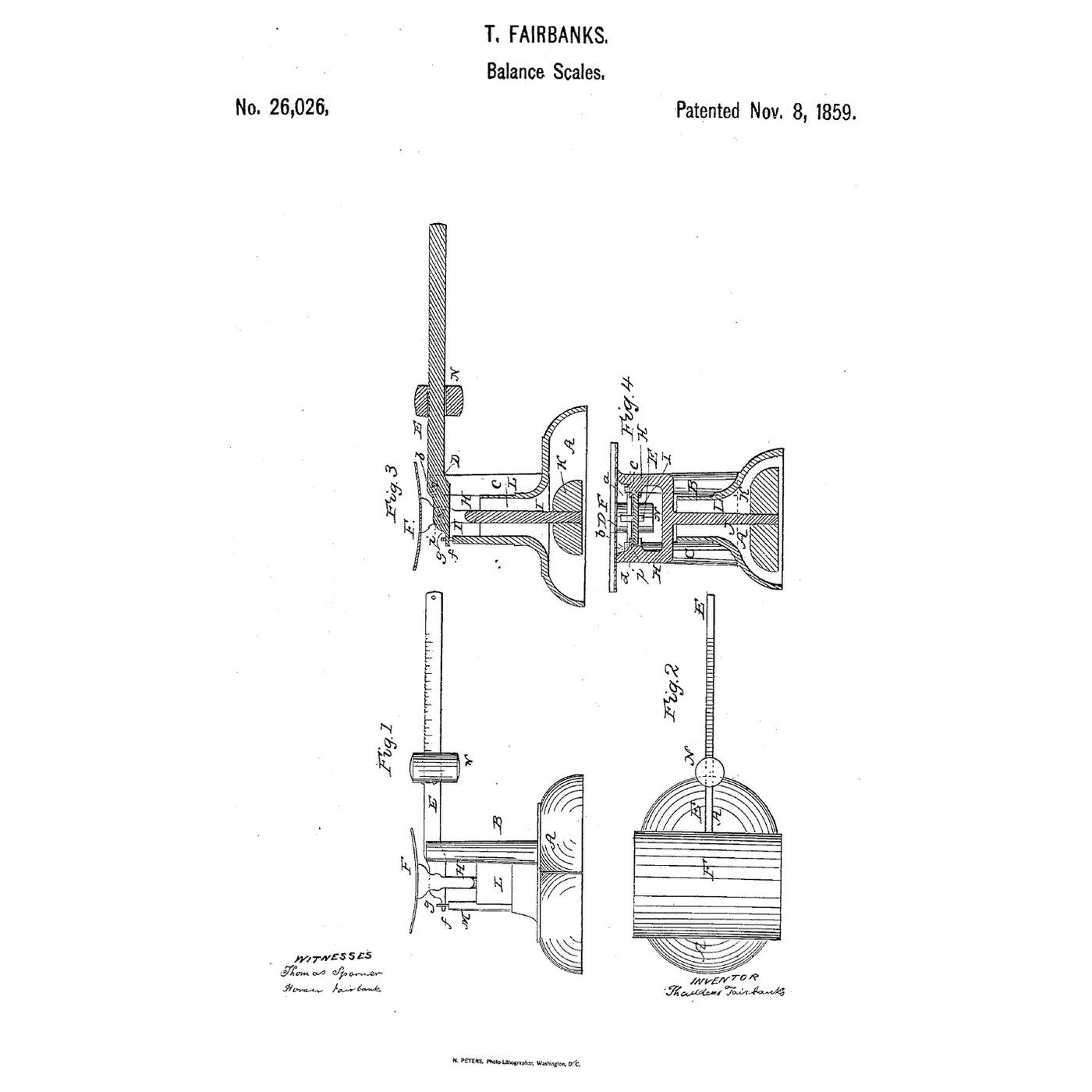


The Pendulous-Weight Letter Scale: A Steelyard With a Straight Arm, a Weight Below to Keep the Plate Level
A letter's postage depended on its weight, and a scale for letters had to be cheap, simple and keep its plate level as the arm tipped.
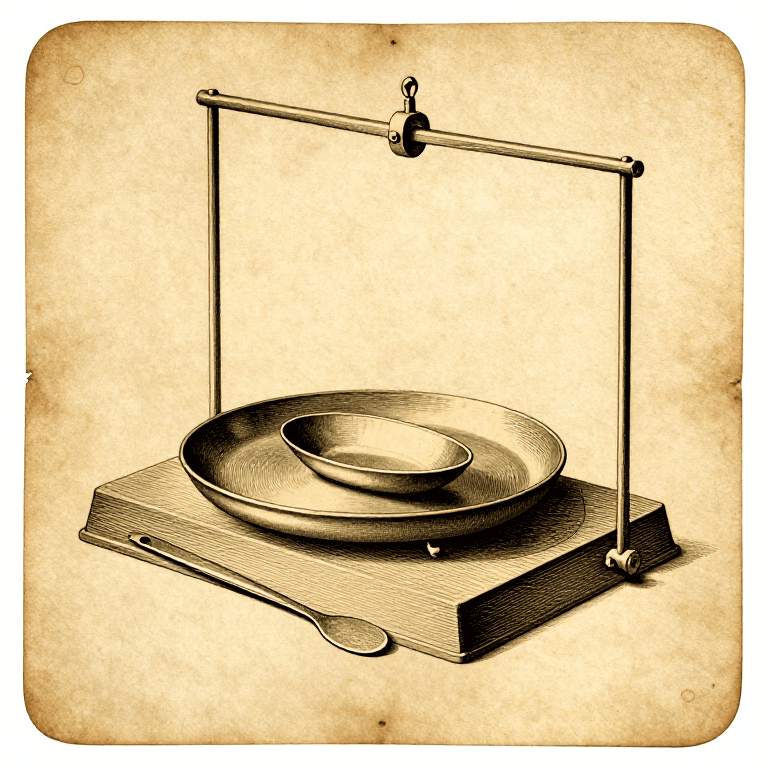
Thaddeus Fairbanks of St. Johnsbury, Vermont, received US 26,026, dated 8 November 1859, for an improved scale for weighing letters: a base with two standards whose tops carry a knife-edged fulcrum bar through a straight graduated arm; near the arm's rear a plate hung on a second knife-edge by a rectangular frame, from which a rod runs down through a hollow column to a pendulous weight that keeps the plate horizontal; a sliding poise on the arm; and a loop on a standard that limits the arm's tilt. He made the steelyard "without any bifurcation or fork, but simply as a straight bar".
This rung works out how the arm is graduated, then builds the scale from flat bar and hardwood with knife-edges, a pendulous weight and a poise, and calibrates it with known weights.
Intermediate
About 5 hours
Instructions
1
1
Graduating the arm
Graduating the arm
Loading Jupyter Notebook...
2
2
The steelyard it improves
The steelyard it improves
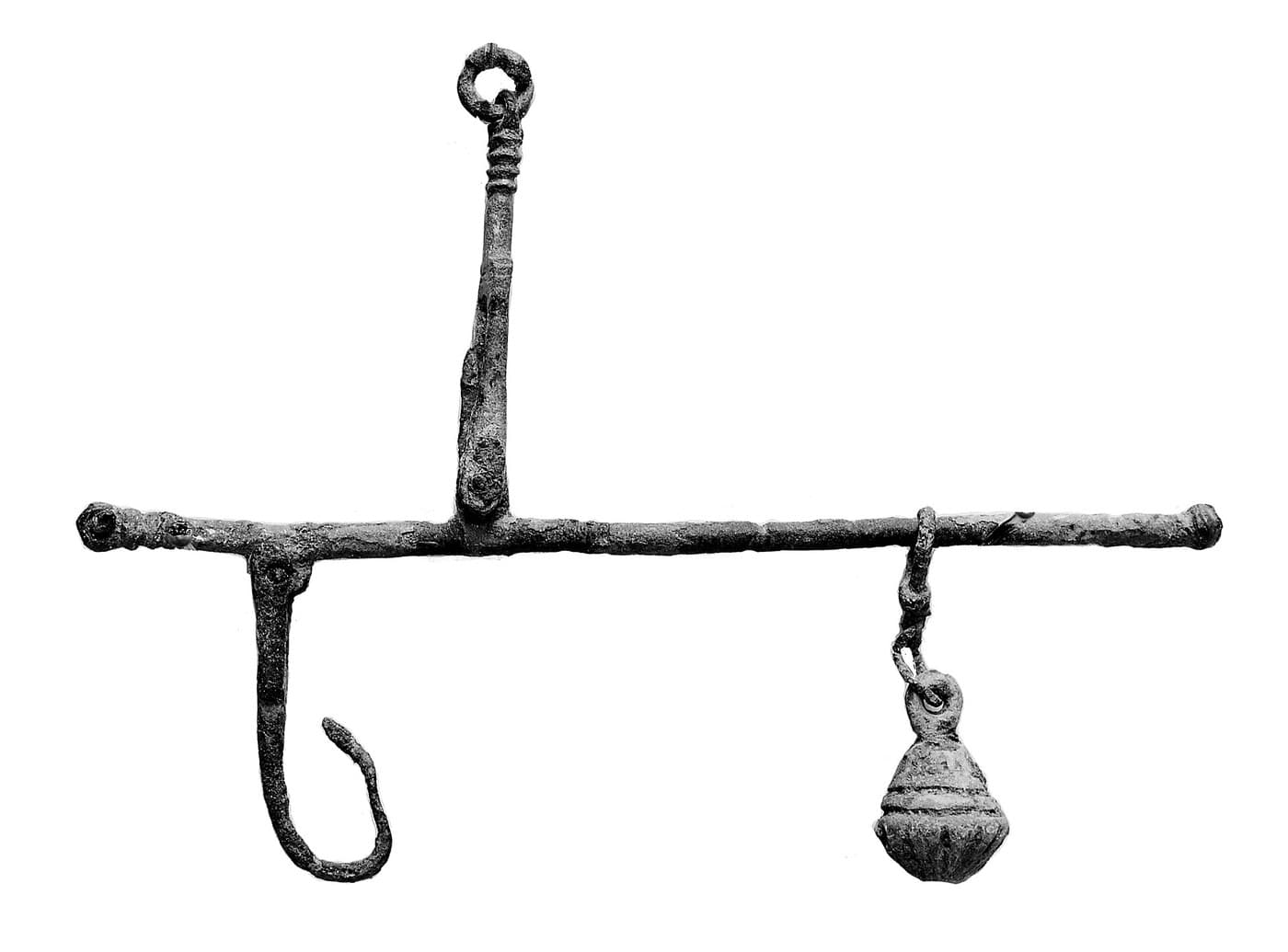
The embedded blueprint makes a steelyard. Fairbanks makes a straight-armed one for letters, with a pendulous weight that keeps the plate level.
3
3
Read US 26,026
Read US 26,026
"In the drawings, A, represents the foundation or base for supporting the operative parts. From the said base part, two vertical standards, or columns, B, C, extend upward and have mortises, a, b, made respectively in their top parts, the same being for the reception of a wedge or knife shaped bar, D, whose ends, c, d, rest respectively in the said mortises. The said bar, D, passes transversely through the graduated arm, E, and serves as a fulcrum for it, such arm being provided with divisions, to mark either the whole ounces, or fractions of the same"
"In my construction of scale, I make the weighing lever or steelyard without any bifurcation or fork, but simply as a straight bar provided with knife edges for supporting the bearing of a pendulous weight"
4
4
Build the scale and calibrate it
Build the scale and calibrate it
**Base and standards.** Screw two hardwood standards to a base 6 cm apart and file a V notch in the top of each.
**Arm and knife-edges.** Cut a 25 cm arm from aluminium flat bar. Drill it near one end and fit a short piece of steel rod filed to a knife-edge across it as the fulcrum D, resting in the notches. Fit a second knife-edge 20 mm behind it as I.
**Plate and pendulous weight.** Bend a wire frame H with notched ears that hang on the knife-edge I, fix a small plate F on top of it, and hang a rod from the frame's bottom down through a tube fixed to the base, with a weight on its end as K.
**Poise and stop.** Bend a sliding poise N from sheet and wire, and put a wire loop g round the arm's rear on a third standard to limit its tilt.
**Calibrate.** With nothing on the plate, add or file weight until the arm balances with the poise at zero. Put calibration weights of 28 g, 57 g and 113 g on the plate in turn, find the poise's balance and mark the arm; check that the marks are equally spaced, as the notebook says. Weigh a letter.
Materials for this step:
 Hardwood Board1 piece
 Hardwood Block2 pieces
 Wood Screws8 pieces
 Aluminium Flat Bar0.3 meter
 Mild Steel Rod0.1 meter
 Steel Wire0.5 meter
 Aluminium Tube0.08 meter
 Aluminium Sheet1 piece
 Weight1 piece
 Calibration Weight Set1 piece
 Paper1 piece
Tools needed:
 Hand Saw
 Cordless Drill
 Drill Bit Set
 Hacksaw
 Files (Hand File)
 Needle File Set
 Bench Vise
 Round-nose Pliers
 Screwdriver Set
 Ruler
Ruler Scriber
 Digital Kitchen Scale
5
5
A scale that sticks, drifts or reads unevenly
A scale that sticks, drifts or reads unevenly
Pendulous-weight letter scale troubleshooting.
Flow
Loading...
6
6
History and honest limits
History and honest limits
**Thaddeus Fairbanks** of St. Johnsbury, Caledonia County, Vermont, received US 26,026, dated 8 November 1859. The frame's ears h, i were recessed under to take the knife-edged bar I; the rod I′ ran down through the hollow column L to the weight K; the standard M bore the arm's rear on its top, with the loop g against too great an inclination. He did not claim balancing a pan by a pendulous weight on a straight arm, nor a pan on a forked steelyard, but the letter scale with its pendulous weight on a forked arm resting on the knife-edges of a bar extended from a straight steelyard, and the front end extended into a stationary staple.
**Honest limits.** Aluminium, wire and filed rod stand in for his made scale. The notebook treats the knife-edges as frictionless points; its lengths and poise are examples. Your calibrated marks are the result.
Materials
11- 1 piecePlaceholder
- 2 piecesPlaceholder
- 8 piecesPlaceholder
- 0.3 meterPlaceholder
- 0.1 meterPlaceholder
- 0.5 meterPlaceholder
- 0.08 meterPlaceholder
- 1 piecePlaceholder
- 1 piecePlaceholder
- 1 piecePlaceholder
- 1 piecePlaceholder
Tools Required
12- Placeholder
- 1 vendor sell this, none ship to you yetPlaceholder
- Placeholder
- Placeholder
- Placeholder
- Placeholder
- Placeholder
- Placeholder
- Placeholder
- Placeholder
- Placeholder
- Placeholder
Related Blueprints
These blueprints share knowledge with this one — techniques, materials, or principles that connect them in the learning graph.



CC0 Public Domain
This blueprint is released under CC0. You are free to copy, modify, distribute, and use this work for any purpose, without asking permission.
Support the Maker by purchasing products through their Blueprint where they earn a Maker Commission set by Vendors, or create a new iteration of this Blueprint and include it as a connection in your own Blueprint to share revenue.