ART
BEAUTY & WELLNESS
CRAFT
CULTURE & HISTORY
ENTERTAINMENT
ENVIRONMENT
FOOD & DRINKS
REVERSE ENGINEERING
SCIENCES
SPORTS
TECHNOLOGY
WEARABLES



The Perforated Paper Roll: Bonds That Break One Sheet at a Time
A roll of paper divided into sheets needs lines of weakness that part at a gentle pull — but only one at a time, and without tearing across the sheet.
Seth Wheeler of Albany, New York, filed US 459,516 on 10 June 1891; it is dated 15 September 1891. His "wrapping or toilet paper roll" has sheets "only partially separated", with the points of attachment between them placed "alternately out of parallel lines" through the roll, so that a pull on the free end "will not be transmitted in a direct line through a series of sheets" and each sheet separates easily on its own. His drawing shows the roll hung on a simple fixture with the paper coming over the top.
This rung works out how much paper a roll holds and what the bonds must carry, and tests rolls with different bond patterns.
Beginner
About 2 hours
Instructions
1
1
Length on a roll and bond strength
Length on a roll and bond strength
Loading Jupyter Notebook...
2
2
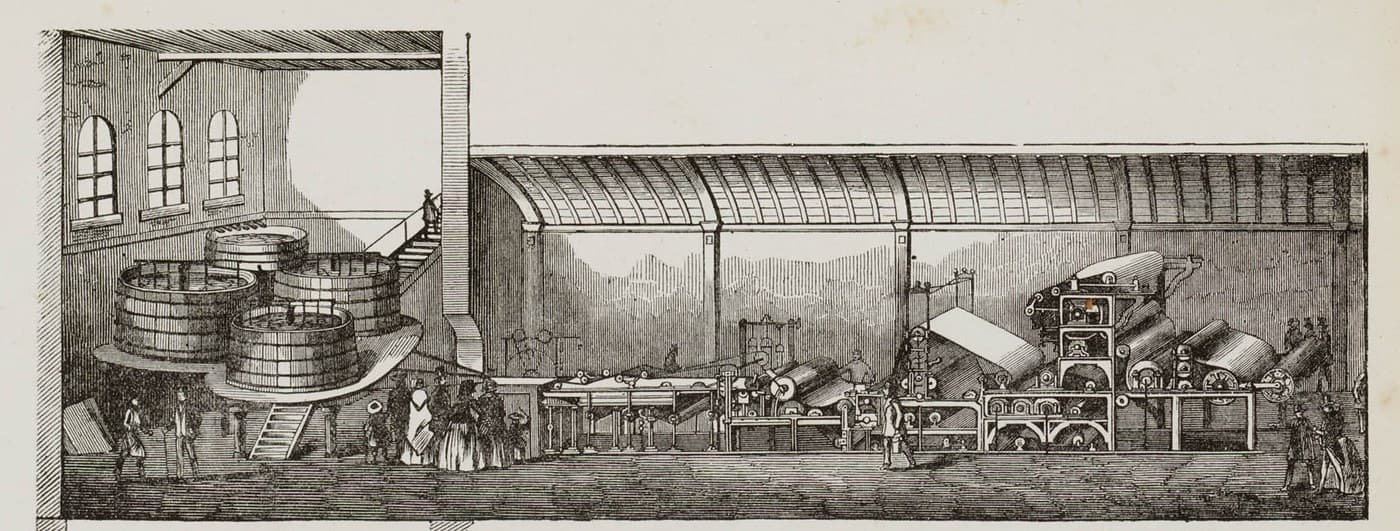
Where continuous paper comes from
Where continuous paper comes from
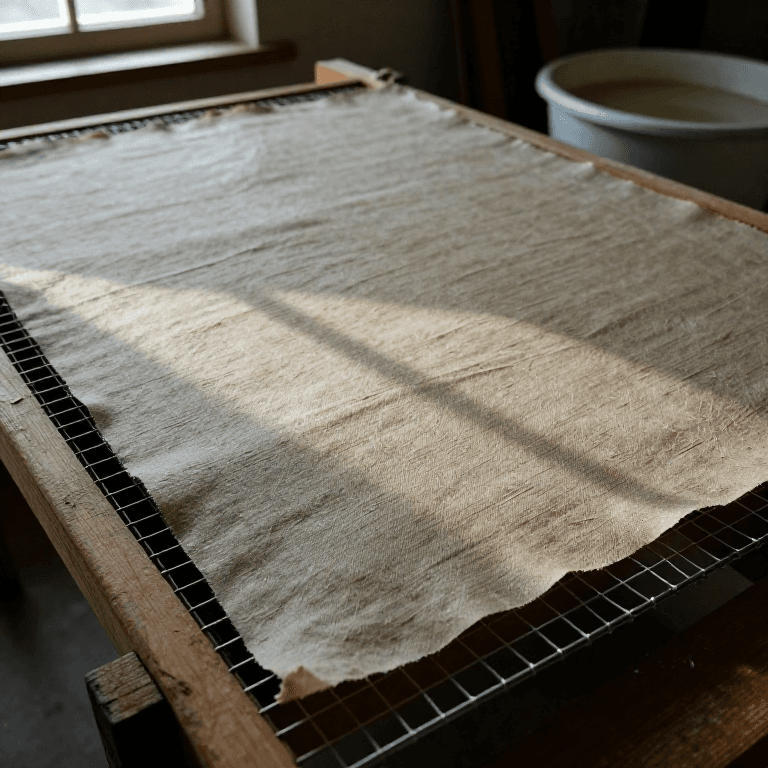
Rolls of paper became possible when paper was made in a continuous web. The embedded blueprint shows the machine.
3
3
Read US 459,516
Read US 459,516
Wheeler's roll is "so constructed that the points of attachment and severance between the sheets will be alternately out of parallel lines running through the whole body of the sheets, so that a pull upon the free end of the web will not be transmitted in a direct line through a series of sheets, but will be diverted by the spaces opposite the connecting points of the sheet pulled upon, thereby producing a transverse strain upon the next line of connecting points sufficient to break them."
Earlier roll-makers had put "the connecting points or bonds in parallel lines, or nearly so", so that if the free end were pulled in line with them "a long series of sheets may be drawn from the roll unless the free movement of the roll is prevented by friction or other means." Other inventors had instead built holders to stop the roll unwinding — "more or less complicated, liable to derangement, and expensive".
In Fig. 1 the points e and e′ lie near the margins and "alternate through the whole roll"; nearer the centre (f, f′) "they should be narrower to avoid any probability of tearing into the body of the sheets". Other figures show two points alternating with one, and an oblique form of sheet. "My improved roll may be used on the simplest holders."
4
4
Make bond patterns and pull them
Make bond patterns and pull them
Cut three long strips of paper towel. On each, every 11 cm, cut across the strip with a craft knife on the cutting mat, leaving bonds uncut: on the first, two 5 mm bonds at the edges on every line; on the second, one 5 mm bond alternating from edge to edge line by line, as Wheeler did; on the third, one 5 mm bond in the middle of every line.
Roll each strip onto a card tube, hang it on a dowel and pull the free end at a steady rate, sometimes straight and sometimes towards one side. Count how many sheets come off per pull and whether any sheet tears across. Hook the spring scale to the end to read the parting force.
Materials for this step:
 Card Stock1 piece
 Hardwood Dowels1 piece
Tools needed:
 Craft Knife
 Self-Healing Cutting Mat
 Ruler
Ruler Force Meter (Spring Scale)
 Paper Towel
 Toilet Paper
5
5
A paper roll that misbehaves
A paper roll that misbehaves
Perforated roll troubleshooting.
Flow
Loading...
6
6
History and honest limits
History and honest limits
**Seth Wheeler** of Albany, New York, filed US 459,516 on 10 June 1891; it is dated 15 September 1891. He claims a roll of partially separated sheets whose points of attachment are arranged out of line from sheet to sheet.
**Honest limits.** Roll sizes, paper thickness and tear forces in the notebook are examples; tearing depends on the fibre, the moisture and the pull's direction.
Materials
2- 1 piecePlaceholder
- 1 piecePlaceholder
Tools Required
6- Placeholder
- Placeholder
- Placeholder
- Placeholder
- Placeholder
- Placeholder
Related Blueprints
These blueprints share knowledge with this one — techniques, materials, or principles that connect them in the learning graph.




CC0 Public Domain
This blueprint is released under CC0. You are free to copy, modify, distribute, and use this work for any purpose, without asking permission.
Support the Maker by purchasing products through their Blueprint where they earn a Maker Commission set by Vendors, or create a new iteration of this Blueprint and include it as a connection in your own Blueprint to share revenue.