ART
BEAUTY & WELLNESS
CRAFT
CULTURE & HISTORY
ENTERTAINMENT
ENVIRONMENT
FOOD & DRINKS
REVERSE ENGINEERING
SCIENCES
SPORTS
TECHNOLOGY
WEARABLES
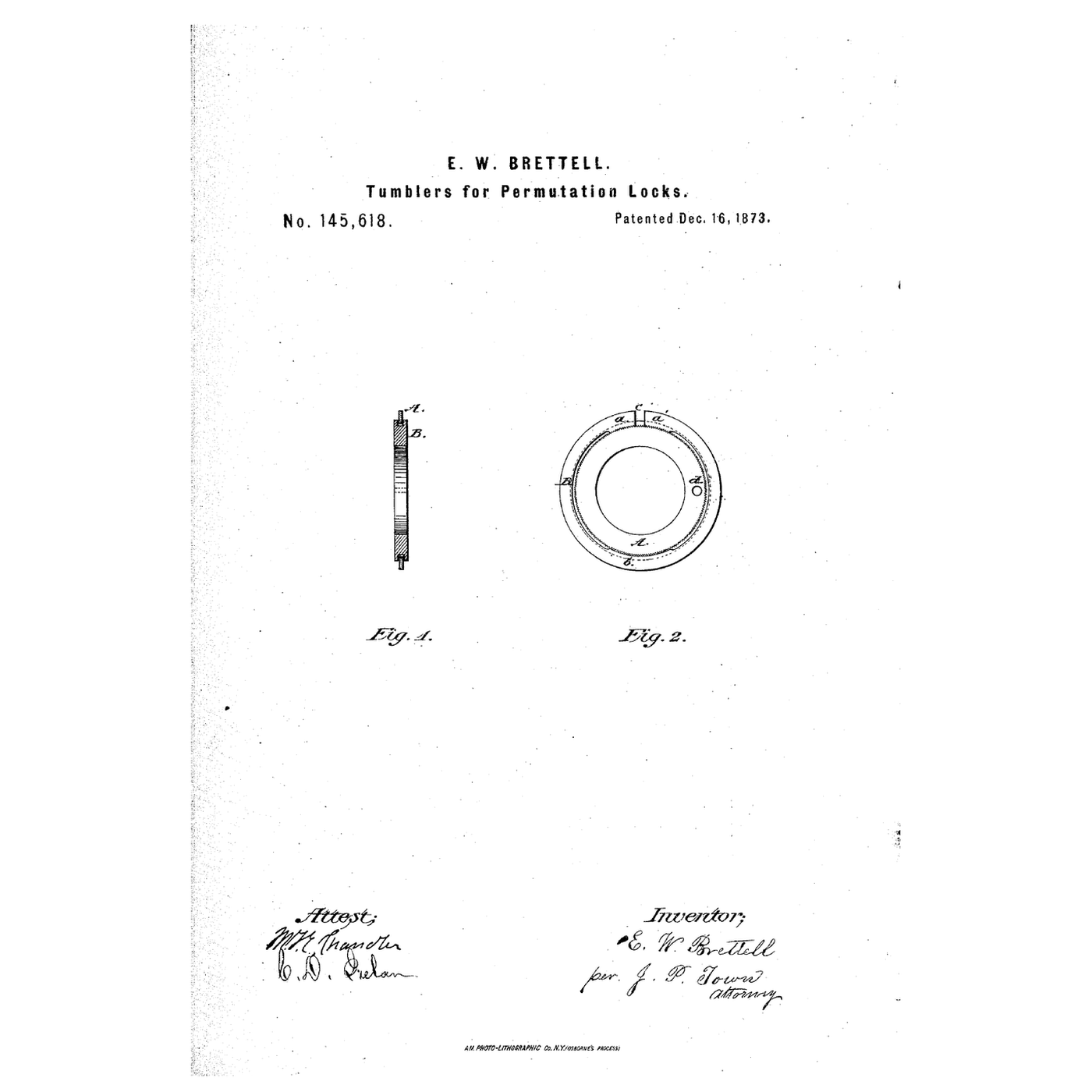


The Permutation Lock: Tumbler Wheels You Can Re-set
A permutation, or combination, lock has no keyhole. A pack of wheels behind the dial must all be turned so their gates line up; only then can the bolt move. A lock whose combination cannot be changed is only as safe as everyone who has ever known it.
Edward W. Brettell of New Haven, Connecticut, received US 145,618, dated 16 December 1873 (filed 3 May 1873), for tumblers "formed by encircling an inner ring or wheel with an elastic stop-ring". His steel stop-ring bears at three points, two of them toothed, which "lock into corresponding teeth" in the inner ring's groove. A key spreads the ring, the wheel is turned to a new position, and the ring snaps back: a new combination.
This rung counts combinations honestly, then builds a two-wheel plywood model that shows the wheels picking each other up.
Intermediate
About 3 hours
Instructions
1
1
Counting combinations
Counting combinations
Loading Jupyter Notebook...
2
2
The keyed lock of the same years
The keyed lock of the same years
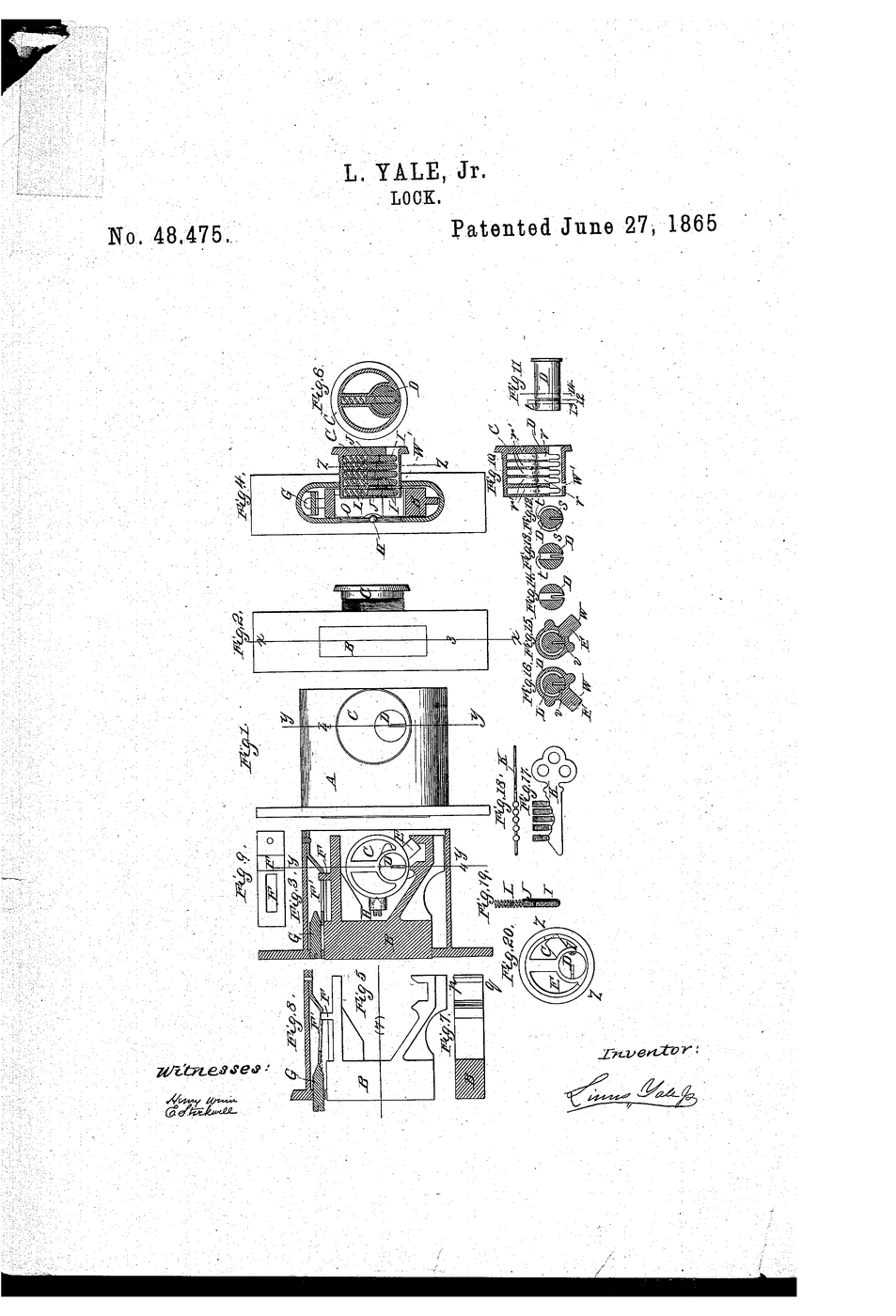
Linus Yale Jr.'s pin-tumbler cylinder is the keyed answer to the same problem. The embedded blueprint builds one.
3
3
Read US 145,618
Read US 145,618
"This invention relates to an improvement in that class of locks in which the tumblers are formed by encircling an inner ring or wheel with an elastic stop-ring, which is generally held in position by its friction upon the inner ring". Brettell forms the stop-ring "to give it a bearing at three points within a groove which encircles the inner ring, at two of which points, namely, those nearest the opening in the stop-ring, a series of triangular teeth are formed which lock into corresponding teeth formed in the bottom of the groove".
"In order to set the stop-ring at any desired point upon the ring A, a key of proper form is forced into the opening c in the stop-ring, thus spreading it sufficiently to raise the teeth a a' out of the serrations in the groove of the ring A, when the latter may be turned so as to bring any desired part of its periphery opposite the opening in the ring B."
He does not claim merely roughened rings: that "only increases the friction of one part upon the others, but does not securely lock them together until released by spreading the outer ring".
4
4
Build a two-wheel model
Build a two-wheel model
Cut two plywood discs 80 mm across and one 40 mm drive disc. Cut a gate, a notch 8 mm wide, in each large disc's rim. Glue a short dowel pin to the front face of the drive disc and to the front face of the first wheel, near the rim, so each can catch the next wheel's pin.
Stack them loosely on one bolt through a base board: drive disc, wheel one, wheel two. Mark 0-39 round the drive disc. Fix a strip of wood above the stack as the fence: it can drop only when both gates are under it.
Turn the dial two full turns one way to gather both wheels, then to the first number; one turn the other way past it, then to the second. Watch the pins pick the wheels up. Move one gate by re-gluing its pin elsewhere: that is what Brettell's key and stop-ring do without glue.
Materials for this step:
 Plywood Sheet1 piece
 Hardwood Dowels1 piece
 Wood Glue1 piece
Tools needed:
 Coping Saw
 Cordless Drill
 Drill Bit Set
 Combination Lock
5
5
A combination lock that will not open
A combination lock that will not open
Combination lock troubleshooting.
Flow
Loading...
6
6
History and honest limits
History and honest limits
**Edward W. Brettell** of New Haven, Connecticut, filed US 145,618 on 3 May 1873; it is dated 16 December 1873. The patent covers the tumbler only, not a whole lock.
**Honest limits.** The patent does not describe the dial, fence or bolt; the notebook's lock is the general wheel-pack principle. Dial size, wheel count, gate width and time per try are examples.
Materials
3- 1 piecePlaceholder
- 1 piecePlaceholder
- 1 piecePlaceholder
Tools Required
4- Placeholder
- 1 vendor sell this, none ship to you yetPlaceholder
- Placeholder
- Placeholder
Related Blueprints
These blueprints share knowledge with this one — techniques, materials, or principles that connect them in the learning graph.
CC0 Public Domain
This blueprint is released under CC0. You are free to copy, modify, distribute, and use this work for any purpose, without asking permission.
Support the Maker by purchasing products through their Blueprint where they earn a Maker Commission set by Vendors, or create a new iteration of this Blueprint and include it as a connection in your own Blueprint to share revenue.