ART
BEAUTY & WELLNESS
CRAFT
CULTURE & HISTORY
ENTERTAINMENT
ENVIRONMENT
FOOD & DRINKS
REVERSE ENGINEERING
SCIENCES
SPORTS
TECHNOLOGY
WEARABLES
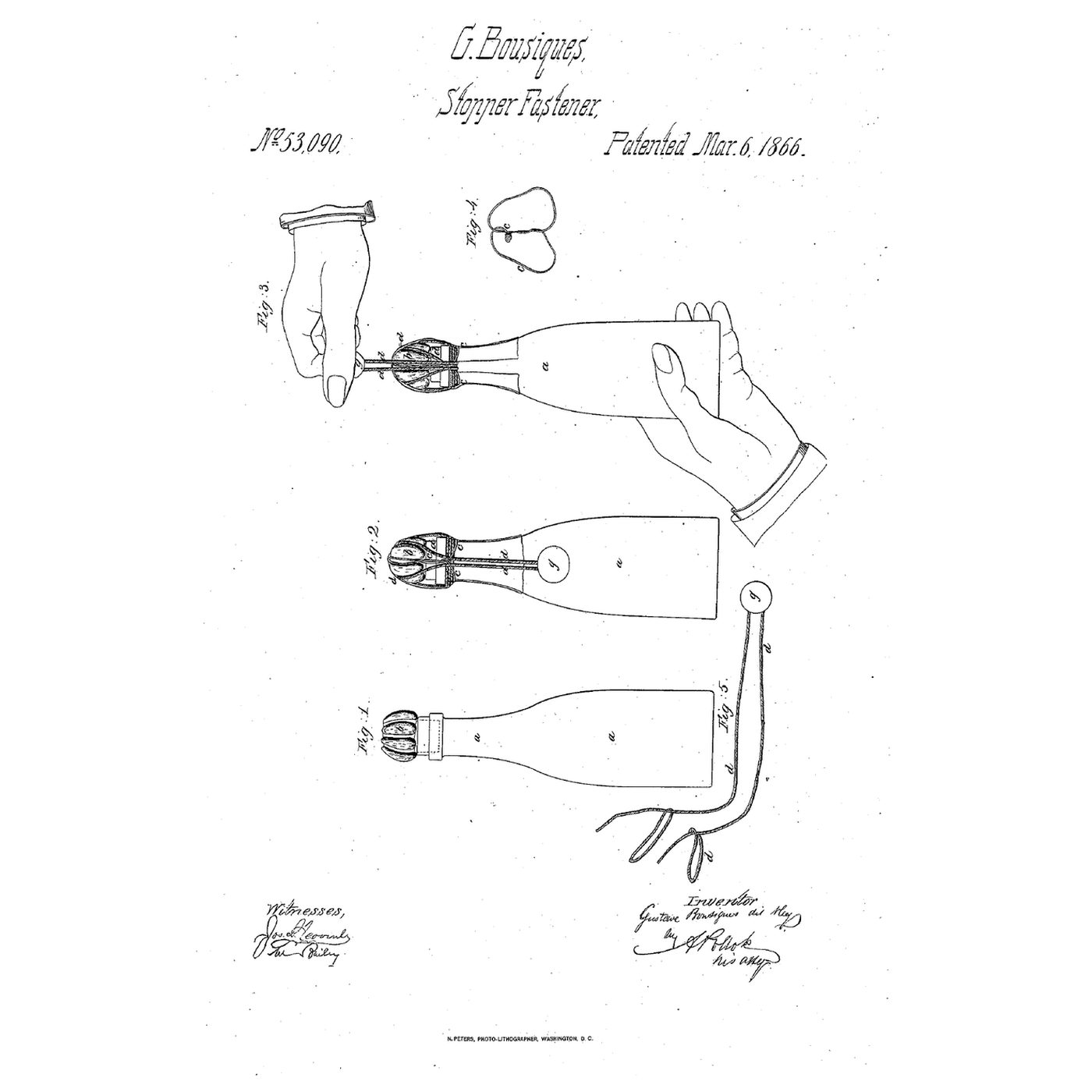


The Pull-String Champagne Fastening: One Pull Lifts the Wire and Frees the Cork
A bottle of sparkling wine is corked under twine and wire, and opening it meant cutting and twisting them off with a knife or a corkscrew.
Gustave Bousigues, called Bley, of Rheims, France, received US 53,090, dated 6 March 1866, for a way of fastening corks that "consists in passing the pieces of twine which bind the cork under the iron wire in such manner that the cork can be freed from the twine and wire by pulling upward the two ends of twine, which extend down the neck below the tin-foil, where they are united by a plate or disk of lead or other metal." The bottle is "just as securely corked" as before, but opened by hand without any instrument.
This rung works out what each leg of twine and wire carries, then fastens a corked bottle his way and opens it with one pull.
Beginner
About 2 hours
Instructions
1
1
The load on the legs
The load on the legs
Loading Jupyter Notebook...
2
2
A fastener removed with a tool
A fastener removed with a tool
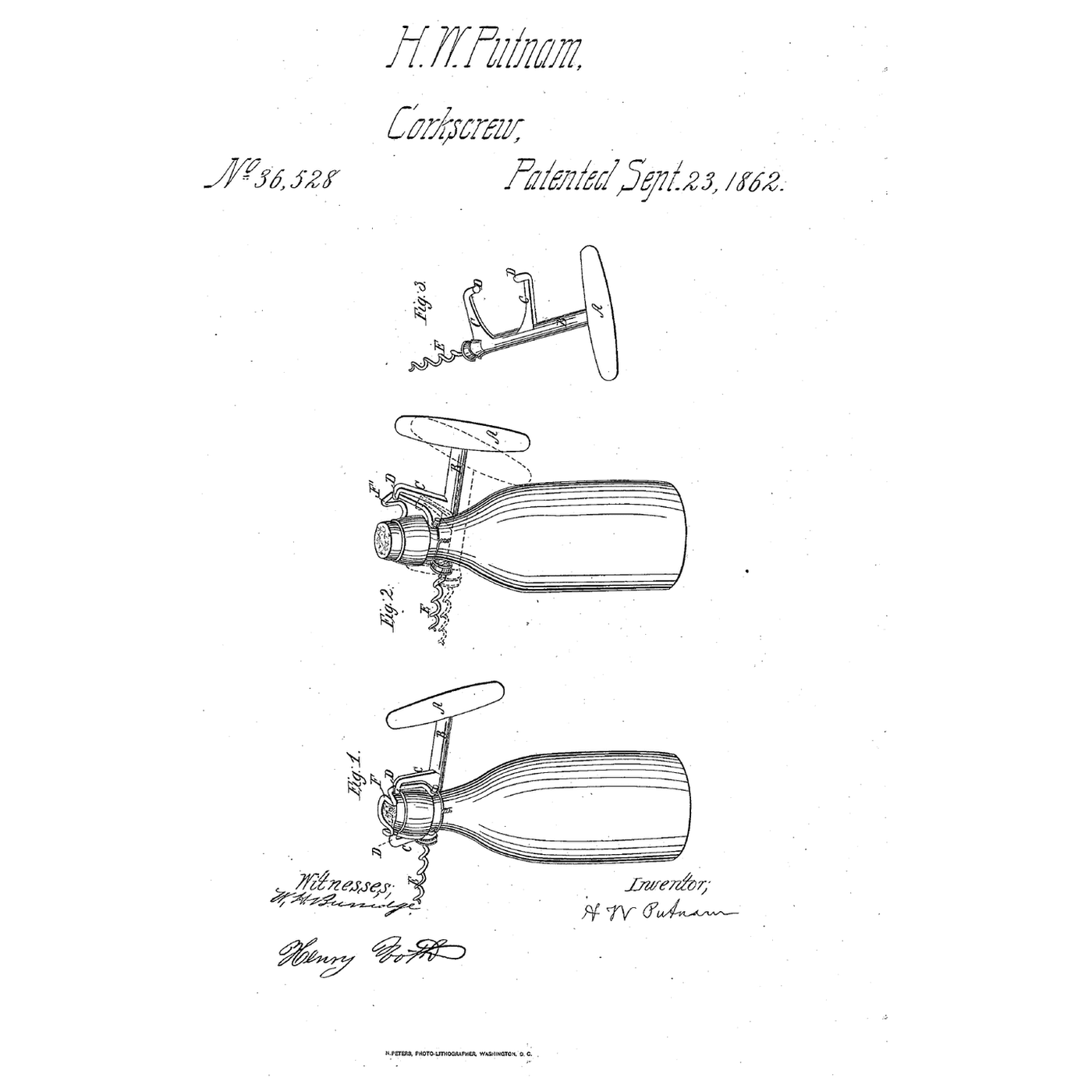
The embedded blueprint throws a wire fastener off with a key. Bousigues arranges the twine and wire so that a pull on the twine's ends removes them without any tool.
3
3
Read US 53,090
Read US 53,090
"When the first piece of twine has been tightly drawn over the cork and secured under the rim or flange on the neck of the bottle, instead of cutting off both ends of the piece close up to the cork the end which is held in the right hand of the operator should be cut so as to be between two and three inches in length."
"They are then brought together at the point near the flange of the neck of the bottle, where the wire is twisted, as shown in the accompanying drawings, and are passed under the wire in the manner represented, so as to enable any one, by an upward pull on the ends of the twine, to remove the wire, and by continuing the pull to disengage the twine from the cork."
4
4
Fasten a bottle and open it with one pull
Fasten a bottle and open it with one pull
**Cork.** Pour chilled soda water into a clean beer bottle and press a cork in firmly, leaving its top standing above the lip.
**Twine.** Tie a piece of twine tightly over the cork and under the lip, leaving one end 6 cm long. Tie a second piece across the first in the same way, its long end on the opposite side. Cut the other ends short.
**Wire.** Twist galvanised wire once round the neck under the lip at the point where the two long ends meet, with the ends passing under it. Carry the wire's twisted ends up over the cork to where the twines cross and twist them firmly together there.
**Handle.** Bring the two long ends together below and tie them through a washer as the disc g. Wrap foil over the neck, leaving the washer hanging below it.
**Test.** Wearing safety glasses and pointing the bottle away, pull the washer upward: the wire lifts off, then the twine comes free. Time it against cutting a second bottle's twine and wire off with a knife.
Materials for this step:
 Carbonated Water (Sealed Bottle)1 piece
 Corks2 pieces
 Cotton Twine1 meter
 Galvanised Steel Wire0.6 meter
 Flat Washer2 pieces
 Aluminium Foil1 piece
Tools needed:
 Flat-Nose Pliers
 Wire Cutters
 Kitchen Knife
 Stopwatch
 Clear Safety Glasses
 Amber Beer Bottles
5
5
A fastening that will not come off or lets the cork go
A fastening that will not come off or lets the cork go
Pull-string champagne fastening troubleshooting.
Flow
Loading...
6
6
History and honest limits
History and honest limits
**Gustave Bousigues** (called Bley) of Rheims, France, received US 53,090, dated 6 March 1866. He meant it principally for sparkling wines but for any fermented liquid corked with wire and twine; the two twine ends hang on opposite sides, held by the lips the twine presses into the cork, and the disc g of lead or other metal is the handle. His claim is the method of fastening whereby twine and wire are removed by hand without any instrument.
**Honest limits.** A beer bottle of re-corked soda water stands in for sparkling wine, and a steel washer for the lead disc, which is not used here. The notebook shares the load evenly between the legs; its pressures, cork and leg counts are examples. Your pull is the result.
Materials
6- Placeholder
- 2 piecesPlaceholder
- 1 meterPlaceholder
- 0.6 meterPlaceholder
- 2 piecesPlaceholder
- 1 piecePlaceholder
Tools Required
6- Placeholder
- Placeholder
- Placeholder
- Placeholder
- Placeholder
- Placeholder
Related Blueprints
These blueprints share knowledge with this one — techniques, materials, or principles that connect them in the learning graph.


CC0 Public Domain
This blueprint is released under CC0. You are free to copy, modify, distribute, and use this work for any purpose, without asking permission.
Support the Maker by purchasing products through their Blueprint where they earn a Maker Commission set by Vendors, or create a new iteration of this Blueprint and include it as a connection in your own Blueprint to share revenue.