ART
BEAUTY & WELLNESS
CRAFT
CULTURE & HISTORY
ENTERTAINMENT
ENVIRONMENT
FOOD & DRINKS
REVERSE ENGINEERING
SCIENCES
SPORTS
TECHNOLOGY
WEARABLES



The Rafter Layout Instrument: One Length, Two Bevels, Every Rafter Alike
Marking rafters with a separate measuring rod and two loose bevels lets every rafter come out a little different, because the bevels shift and follow any twist in the timber.
LeGrand Crofoot of Syracuse, New York, received US 15,600, dated 26 August 1856, for an instrument for laying out rafters: a wooden measure in two parts that slide through each other's clasps, graduated in feet and inches, with an adjustable bevel on a pivot at each end, so that "the planes of the bevels laid off will always bear the same relation to each other" and, once set, "it will serve for marking or laying out any desired number of rafters of the same dimensions."
This rung works out rafter length and cut angles from span and pitch, then builds the instrument from strips and plywood and lays out a model roof.
Intermediate
About 4 hours
Instructions
1
1
Rafter length and cut angles
Rafter length and cut angles
Loading Jupyter Notebook...
2
2
The roof it lays out
The roof it lays out
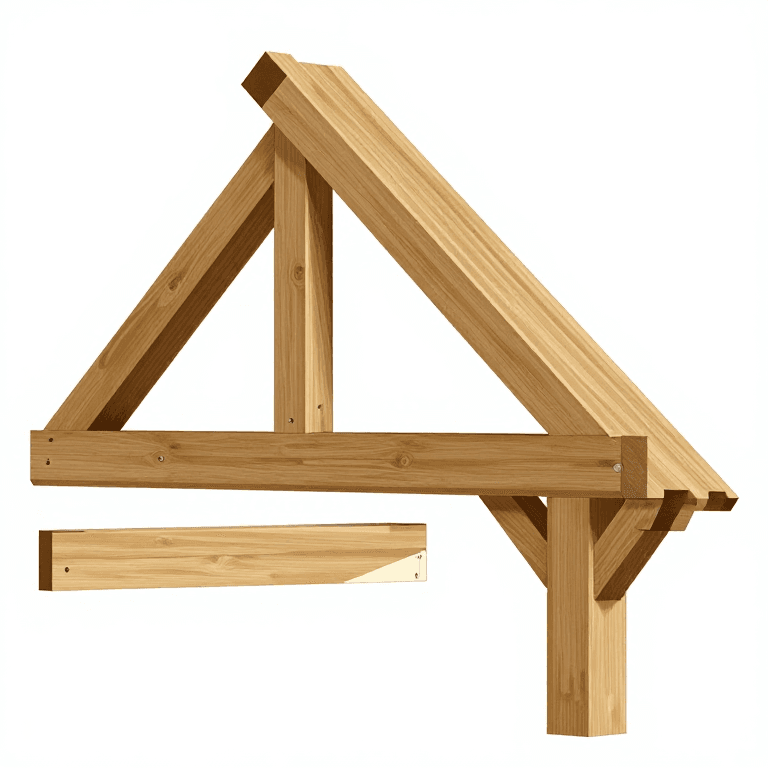
The embedded blueprint builds a timber roof truss. Crofoot's instrument marks every rafter of such a roof to one length and one pair of cuts.
3
3
Read US 15,600
Read US 15,600
"In making my invention, construct the measure (A—B) of wood having the extremities plated with brass; make it in two parts with clasps (C) so arranged as to connect the two parts together and at the same time allow them to be drawn or extended lengthwise by each part sliding through the clasp of the other part."
"Each end of the measure is provided with a bevel (D—E) working upon a pivot (H)."
4
4
Build the instrument and lay out a model roof
Build the instrument and lay out a model roof
**Measure.** Saw two strips 60 × 2.5 × 1 cm from hardwood board. Bend two strips of aluminium sheet round both strips into clasps and rivet one to the end of each strip, so each slides through the other's clasp. Mark centimetres along both with the ruler and pencil.
**Bevels.** Cut two blades 15 × 3 cm from plywood and bolt one to each end with a hex bolt and nut, tight enough to stay where set. Draw a half-circle protractor on card at each pivot and glue it on.
**Test.** Lay out a 1:10 model of a 6 m span at 35°: set the measure to the notebook's rafter length divided by ten, set the top bevel to 35° and the bottom to 55°, and mark four rafters on a pine board. Saw them, stand pairs on a base 60 cm wide and check they meet at the ridge and sit flat. Mark two more with a loose bevel gauge and ruler and compare the fit.
Materials for this step:
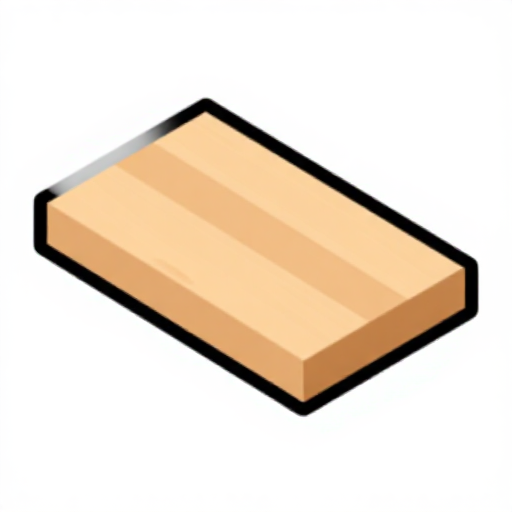 Hardwood Board1 piece
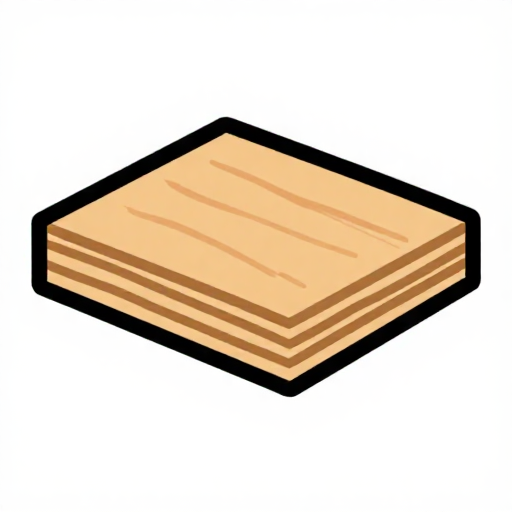 Plywood Sheet1 piece
 Aluminium Sheet1 piece
 Steel Rivets4 pieces
 Hex Bolt Assortment1 piece
 Hex Nut2 pieces
 Card Stock1 piece
 Wood Glue5 ml
 Pine Board1 piece
Tools needed:
 Hand Saw
 Coping Saw
 Tin Snips
 Cordless Drill
 Drill Bit Set
 Rivet Set
 Adjustable Wrench
 Protractor
 Ruler
Ruler Pencil
 Tape Measure
 Bevel Gauge
 Riveting Hammer
5
5
An instrument that slips, drifts or cuts rafters that do not meet
An instrument that slips, drifts or cuts rafters that do not meet
Rafter layout instrument troubleshooting.
Flow
Loading...
6
6
History and honest limits
History and honest limits
**LeGrand Crofoot** of Syracuse, New York, received US 15,600, dated 26 August 1856, for an instrument for laying out rafters. His bevels were held by set screws on graduated arcs whose divisions could be read as roof pitch or as degrees, fixed square plates at each end marked the side surfaces, and sliding square plates marked tenons on the ends of timbers.
**Honest limits.** Wooden strips, riveted clasps and bolted plywood blades stand in for his brass-tipped measure and set-screw bevels, and the model is at 1:10. The notebook ignores overhang and the ridge board's thickness; its spans and pitches are examples. Your model's fit is the result.
Materials
9- 1 piecePlaceholder
- 1 piecePlaceholder
- 1 piecePlaceholder
- 4 piecesPlaceholder
- 1 piecePlaceholder
- 2 piecesPlaceholder
- 1 piecePlaceholder
- 5 mlPlaceholder
- 1 piecePlaceholder
Tools Required
13- Placeholder
- Placeholder
- Placeholder
- 1 vendor sell this, none ship to you yetPlaceholder
- Placeholder
- Placeholder
- Placeholder
- Placeholder
- Placeholder
- 1 vendor sell this, none ship to you yetPlaceholder
- 1 vendor sell this, none ship to you yetPlaceholder
- Placeholder
- Placeholder
Related Blueprints
These blueprints share knowledge with this one — techniques, materials, or principles that connect them in the learning graph.

CC0 Public Domain
This blueprint is released under CC0. You are free to copy, modify, distribute, and use this work for any purpose, without asking permission.
Support the Maker by purchasing products through their Blueprint where they earn a Maker Commission set by Vendors, or create a new iteration of this Blueprint and include it as a connection in your own Blueprint to share revenue.