ART
BEAUTY & WELLNESS
CRAFT
CULTURE & HISTORY
ENTERTAINMENT
ENVIRONMENT
FOOD & DRINKS
REVERSE ENGINEERING
SCIENCES
SPORTS
TECHNOLOGY
WEARABLES


The Revolving Shear Can Opener: A Wheel and a Fixed Cutter That Cut Tin Like Shears
The forked can openers of the day tore the tin, took force, and could slip and cut the hand.
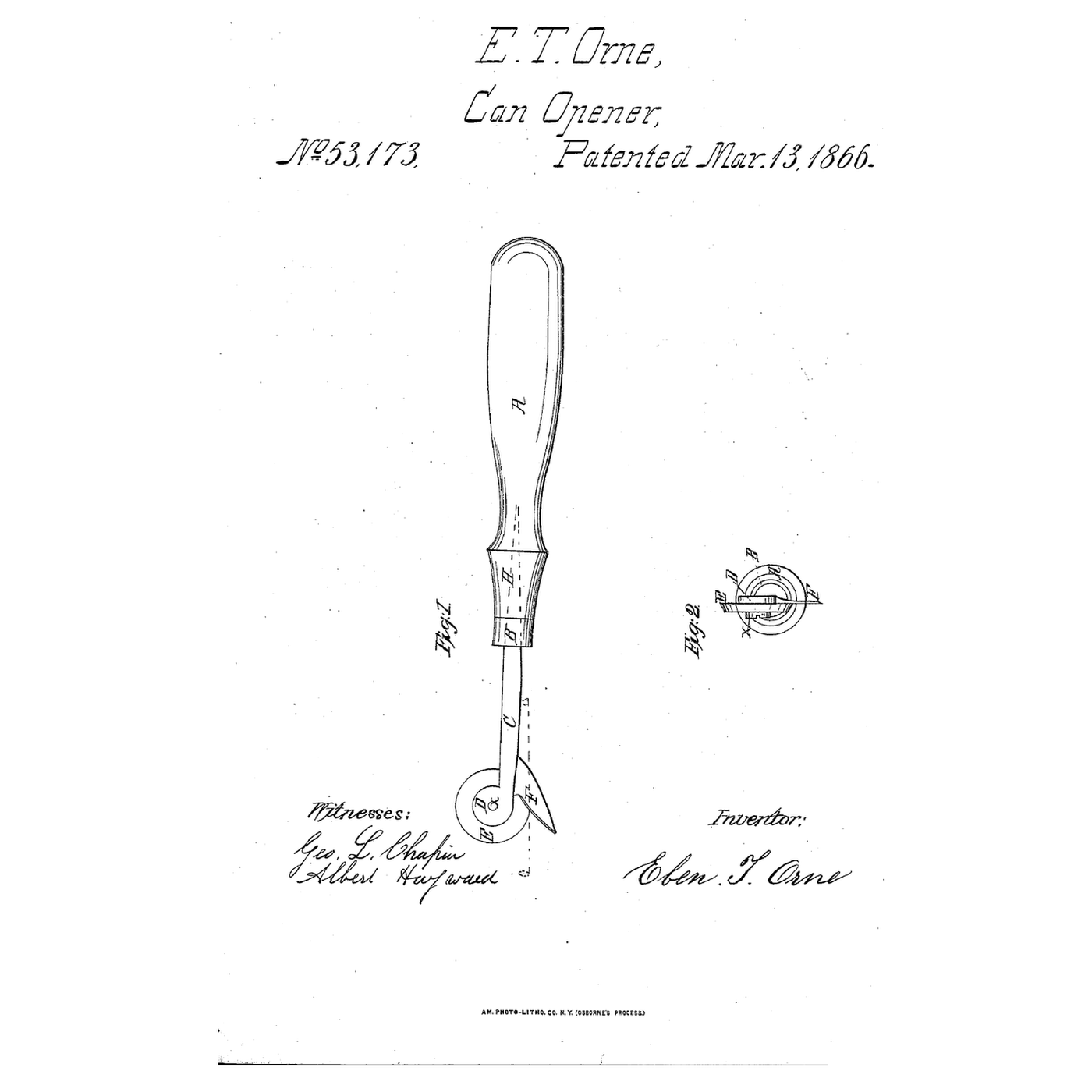
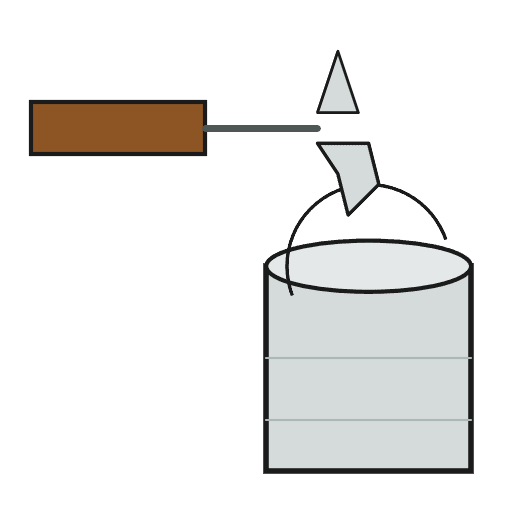
Eben T. Orne of Chicago received US 53,173, dated 13 March 1866, for "a convenient and substantial device for opening any metallic can commonly used for preserving fruits and meat, and for other purposes where an opening in thin metallic plates is required to be made", one "that cuts so easily as not to endanger the hand of the operator while cutting the can in any desired manner." The shaft is forged at its end into a stationary cutter with a shear point, and a sharp-edged shear wheel turns beside it on a screw like the screw of common shears; pushed forward, the wheel and cutter shear the tin between them.
This rung works out the shearing force, then forges the cutter from steel rod, fits a hardened shear wheel on a screw beside it, and opens a can with it.
Advanced
About 5 hours
Instructions
1
1
Shearing tin
Shearing tin
Loading Jupyter Notebook...
2
2
A can opener before it
A can opener before it
The embedded blueprint drives a blade into the lid and saws it round by hand. Orne cuts the tin between a fixed cutter and a revolving wheel, like shears.
3
3
Read US 53,173
Read US 53,173
"The outside of the shear E is beveled so as to form an edge which operates against the lower cutter, F, when cutting the metallic plate. This sharp-edged revolving shear E and cutter F obviate the necessity of levers, and also constitute a simple and effectual means for cutting openings in any kind of thin metallic plate."
"The handle A is grasped with one hand while the other holds the can, and the point of the cutter E is thrust through the plate of the can, so that the revolving shear E may strike the plate of the can, as shown by the line o o, referred to. Then force the can-opener forward in a manner to suit the form of the opening required in the can."
4
4
Forge the opener and open a can
Forge the opener and open a can
**Cutter.** Cut 15 cm of 8 mm steel rod. Heat one end and forge it flat, then file it to a pointed cutter F with a straight, square edge along one side. Just behind it, forge or file a small round flat as the plate D and drill it for an M4 screw.
**Shear wheel.** Grind a steel washer about 20 mm across to a bevelled edge on one face, as the shear E. Mount it on the plate with an M4 screw and lock nut so its flat face bears against the cutter's side and it turns freely, its edge meeting the cutter's edge as shear blades meet.
**Harden.** Heat the cutter's point and the wheel's edge cherry red, quench them, and temper them to a straw colour, as Orne tempered his cast steel.
**Handle.** Drive the rod's other end into a drilled hardwood handle with a ferrule of steel tube.
**Test.** Hold a can steady on the bench, thrust the point through the lid near its rim, and push the opener forward round the lid. Compare the cut edge with one made by stabbing and levering a knife.
Materials for this step:
 Mild Steel Rod0.15 meter
 Flat Washer1 piece
 Machine Screws1 piece
 Hex Nut1 piece
 Hardwood Handle Stock1 piece
 Aluminium Tube0.02 meter
 Tin Can2 pieces
Tools needed:
 Hacksaw
 Propane Torch
 Anvil
Anvil Hammer
 Bench Vise
 Files (Hand File)
 Bench Grinder
 Cordless Drill
 Drill Bit Set
 Screwdriver Set
 Heat-Resistant Gloves
 Clear Safety Glasses
5
5
An opener that tears, jams or slips
An opener that tears, jams or slips
Revolving shear can opener troubleshooting.
Flow
Loading...
6
6
History and honest limits
History and honest limits
**Eben T. Orne** of Chicago, Cook County, Illinois, received US 53,173, dated 13 March 1866. His shank C was driven into a common wooden handle A with a band B, the cutter F and plate D were forged out of the shaft, and the cutter and shear were cast steel, tempered in the usual manner for cutting metals. His claim is the sharp-edged revolving shear combined with the stationary cutter.
**Honest limits.** Forged mild steel rod, hardened only at the surface, and a ground washer stand in for his cast steel. The notebook's shear formula is an approximation; its strength, thicknesses and angles are examples. Your cut can is the result.
Materials
7- 0.15 meterPlaceholder
- 1 piecePlaceholder
- 1 piecePlaceholder
- 1 piecePlaceholder
- 1 piecePlaceholder
- 0.02 meterPlaceholder
- 2 piecesPlaceholder
Tools Required
12- Placeholder
- Placeholder
- Placeholder
- Placeholder
- Placeholder
- Placeholder
- Placeholder
- 1 vendor sell this, none ship to you yetPlaceholder
- Placeholder
- Placeholder
- Placeholder
- Placeholder
This blueprint makes
Related Blueprints
These blueprints share knowledge with this one — techniques, materials, or principles that connect them in the learning graph.
CC0 Public Domain
This blueprint is released under CC0. You are free to copy, modify, distribute, and use this work for any purpose, without asking permission.
Support the Maker by purchasing products through their Blueprint where they earn a Maker Commission set by Vendors, or create a new iteration of this Blueprint and include it as a connection in your own Blueprint to share revenue.