ART
BEAUTY & WELLNESS
CRAFT
CULTURE & HISTORY
ENTERTAINMENT
ENVIRONMENT
FOOD & DRINKS
REVERSE ENGINEERING
SCIENCES
SPORTS
TECHNOLOGY
WEARABLES

The Saddle-Girth Tightener: Two Hinged Plates That Grip the Girth and Lever It Tight
Drawing a saddle-girth tight through its buckle by hand takes a hard pull, and a horseman needs a hoof pick, an awl and a nail puller besides.
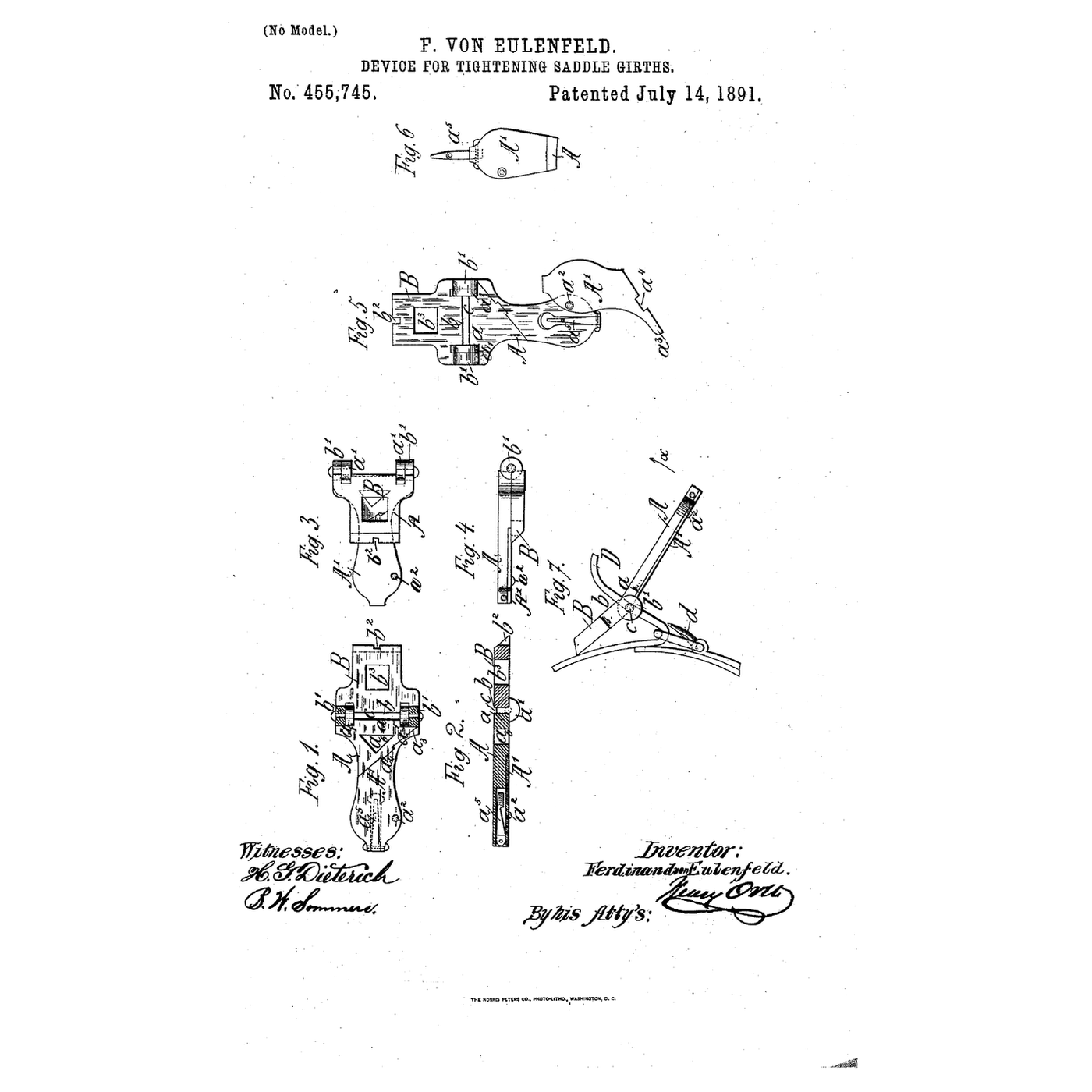
Ferdinand von Eulenfeld of Breslau, Germany, received US 455,745, dated 14 July 1891, for a combination tool "more particularly designed for the use of horsemen and cavalry-men and adapted to be compactly folded and constructed for use as a saddle-girth tightener, nail-extractor, punch or awl, calk-tightener, hoof-cleaner, and for other purposes". Two plates hinged together leave a slot between the knuckles for the girth's end; plate B, bevelled, rests on the girth as a fulcrum; moving plate A toward B narrows the slot to grip the girth, and then both plates act as a lever and draw it through the buckle. B carries a nail-extracting notch and a slot for tightening calks; A has a chamber with a pivoted awl under a cover whose arm is a hoof-cleaner.
This rung works out the lever's pull, with a work check, then makes the plates from flat bar with a knuckle hinge and an awl, and tightens a leather strap through a buckle with it.
Intermediate
About 5 hours
Instructions
1
1
Grip and lever
Grip and lever
Loading Jupyter Notebook...
2
2
A horseman's tool before it
A horseman's tool before it
The embedded blueprint combines a hoof-cleaner with a knife and other tools. Von Eulenfeld builds his around a girth tightener.
3
3
Read US 455,745
Read US 455,745
"When it is desired to tighten a saddle-girth the free end thereof is passed through the slot c. The outer end of plate B, which is beveled, is placed against the girth and serves as a fulcrum. The plate A is then moved toward plate B, as indicated by arrow x, Fig. 7. As the plate A moves toward plate B the slot c becomes narrower, the upper edges of the slot tightly grasping the girth."
"By a further movement of plate A toward plate B both plates act as a lever, being rigidly connected, or substantially so, by the interposed girth D, thereby drawing the said girth through the buckle d and tightening the same. As the leverage afforded by plates A B is considerable, but a slight effort is required to tighten the girth."
4
4
Make the tightener and tighten a strap
Make the tightener and tighten a strap
**Plates.** Cut two 12 cm plates from 25 × 5 mm mild steel flat bar. Bevel the outer end of plate B, file a rectangular notch in it for nails, and cut a rectangular slot through it for calks or nuts.
**Knuckles.** Bend a short strip of flat bar round a rod at the inner end of each plate as hinge-knuckles, set so that when the plates are hinged on a pin through the knuckles a slot about 6 mm wide is left between the knuckles and the plates' ends.
**Awl and cover.** File a chamber into plate A's outer end, pivot a short awl in it on a rivet, and pivot a thin cover over it with a rounded arm as the hoof-cleaner.
**Test.** Buckle a leather strap round a post. Pass its free end through the slot, rest plate B's bevel against the strap, and swing plate A toward B: the slot grips, and the strap is drawn through the buckle. Compare how far you can tighten it by hand, reading the pull with the spring scale.
Materials for this step:
 Mild Steel Flat Bar0.4 meter
 Mild Steel Rod0.1 meter
 Steel Rivets3 pieces
 Leather Strap1 piece
 Belt Buckle Hardware Set1 piece
Tools needed:
 Hacksaw
 Files (Hand File)
 Needle File Set
 Bench Vise
 Hammer
 Propane Torch
 Cordless Drill
 Drill Bit Set
 Rivet Set
 Force Meter (Spring Scale)
 Leather Work Gloves
 Clear Safety Glasses
5
5
A tightener that slips, pinches or will not fold
A tightener that slips, pinches or will not fold
Saddle-girth tightener troubleshooting.
Flow
Loading...
6
6
History and honest limits
History and honest limits
**Ferdinand von Eulenfeld** of Breslau, Germany, filed US 455,745 on 11 March 1891; it is dated 14 July 1891. The plates A and B had hinge-knuckles a′ a′ and b′ b′; the notch b² extracted nails from a horse's hoof or shoe and the slot b³ served for calks or small nuts; the chambered end of A held a pivoted punch a⁵ under a cover A′ with an arm a³ as hoof-cleaner and a notch a⁴ for opening stirrup-bars. His claims cover the two hinged plates forming the slot, and the combinations with the chambered handle, awl, cover and notches.
**Honest limits.** Filed flat bar and a riveted awl stand in for his made tool, and the test uses a strap on a post, not a horse. The notebook treats the plates as a rigid lever; its forces and lengths are examples. Your tightened strap is the result.
Materials
5- 0.4 meterPlaceholder
- 0.1 meterPlaceholder
- 3 piecesPlaceholder
- 1 piecePlaceholder
- 1 piecePlaceholder
Tools Required
12- Placeholder
- Placeholder
- Placeholder
- Placeholder
- Placeholder
- Placeholder
- 1 vendor sell this, none ship to you yetPlaceholder
- Placeholder
- Placeholder
- Placeholder
- Placeholder
- Placeholder
Related Blueprints
These blueprints share knowledge with this one — techniques, materials, or principles that connect them in the learning graph.
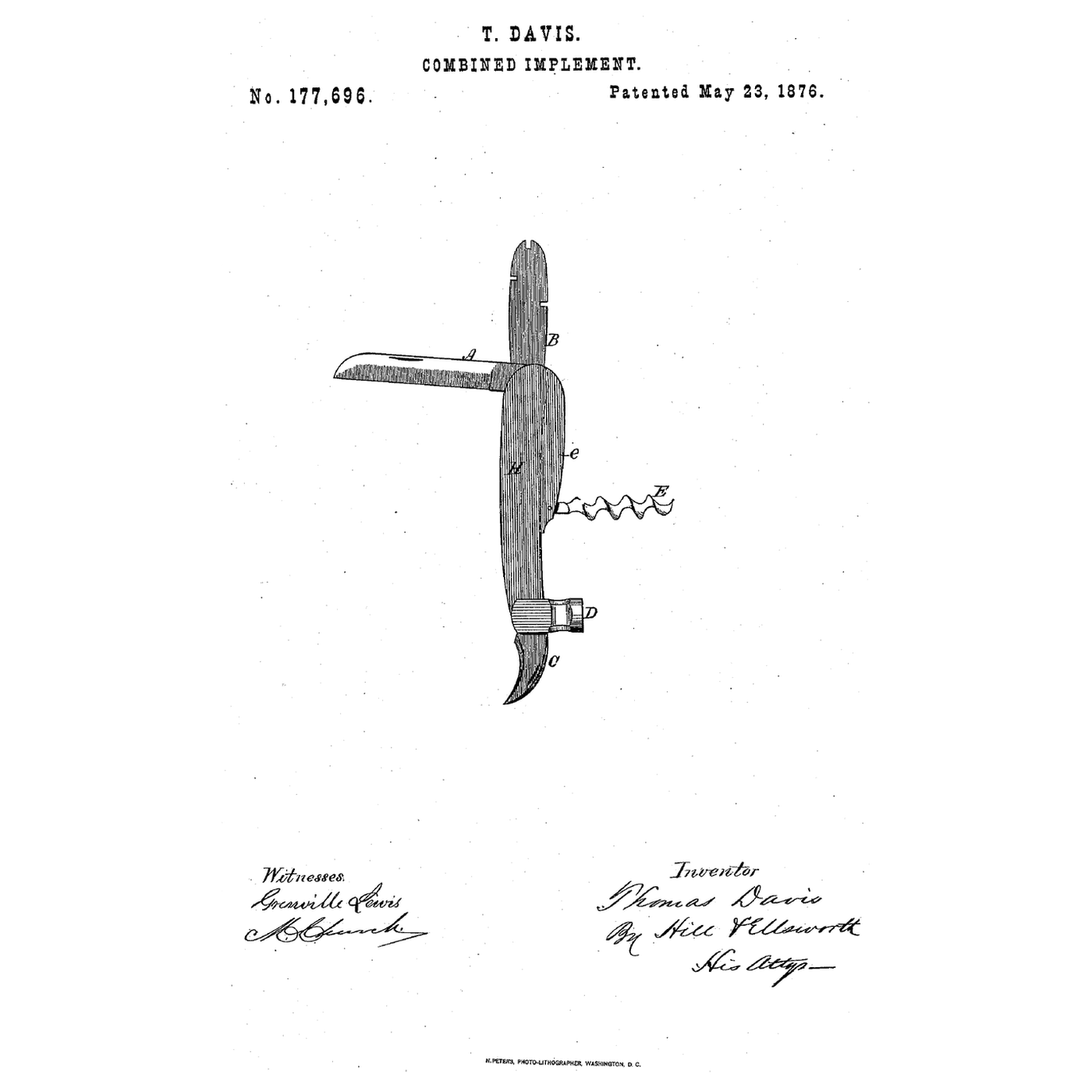
The Hoof-Cleaner Pocket Knife: Blade, Box Opener, Hoof Pick, Hammer and Corkscrew in One Handle
by Karen
Metalworking
36
0
0
0
0
0
The Thumb-Ring Curry Comb: A Ring for the Thumb Instead of a Handle
by Karen
Metalworking
22
0
0
0
0
0
The Law of the Lever — Archimedes' Balance of Weight and Distance
by Martin
Physics
63
0
0
0
1
0
CC0 Public Domain
This blueprint is released under CC0. You are free to copy, modify, distribute, and use this work for any purpose, without asking permission.
Support the Maker by purchasing products through their Blueprint where they earn a Maker Commission set by Vendors, or create a new iteration of this Blueprint and include it as a connection in your own Blueprint to share revenue.