ART
BEAUTY & WELLNESS
CRAFT
CULTURE & HISTORY
ENTERTAINMENT
ENVIRONMENT
FOOD & DRINKS
REVERSE ENGINEERING
SCIENCES
SPORTS
TECHNOLOGY
WEARABLES
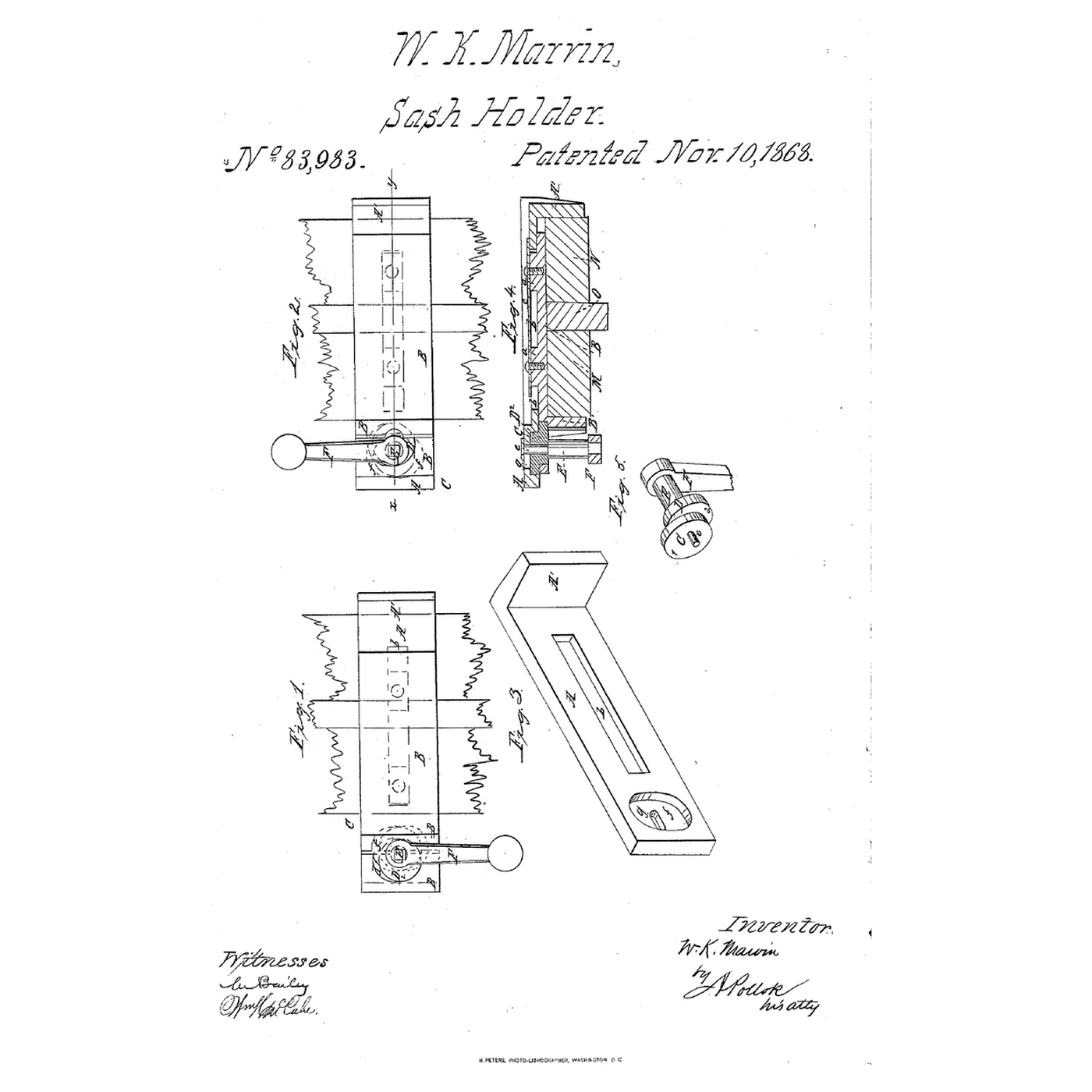


The Sash Fastener: Two Cams on One Shaft Squeeze the Window Shut
A sash window that is merely shut rattles in the wind and can be pushed open from outside. A sash fastener locks it and squeezes the sashes tight at the same time, with one turn of a handle.
Walter K. Marvin of New York received US 83,983, dated 10 November 1868, for a sash-fastener "in which a cam is employed to compress the sash to be locked or fastened". Two cams on one shaft, their high points opposite, work two sliding jawed plates let into the frame, "so that the plate B and its jaw will traverse a distance equal to the sum of the eccentricities of the two cams."
This rung works out the jaw travel and squeeze over the handle's turn, then builds a plywood model of the double cam.
Beginner
About 2 hours
Instructions
1
1
Jaw travel and squeeze
Jaw travel and squeeze
Loading Jupyter Notebook...
2
2
What a cam does
What a cam does
A cam turns rotation into a set movement. The embedded blueprint works through a plate cam and its follower.
3
3
Read US 83,983
Read US 83,983
"My invention relates to that class of sash-fasteners in which a cam is employed to compress the sash to be locked or fastened". It consists "in the employment, for the purpose mentioned, of a double cam or eccentric, or two cams, or eccentrics, mounted upon the same shaft, arranged in such manner that the movement of the fastening-device or devices, by which the sash is compressed, shall be equal to the sum of the eccentricities of the two cams."
"The fastener is composed of two plates, A B, placed one upon the other." The two eccentrics "are so placed that the point of greatest departure from the axis of the shaft in the one will be diametrically opposite, or thereabouts, the like point of the other." "These two plates may be let into the side of the window-frame contiguous to the sash or sashes, so that the exterior plate B will be flush with the face of the jamb. They can be used with either one or two sashes, and to compress either or both."
4
4
Build a double-cam model
Build a double-cam model
Cut two plywood strips 120 x 30 mm to be the plates, and two discs 30 mm across to be the cams. Drill each disc 3 mm off its centre and glue them together on one bolt with their offsets opposite.
Cut a round-ended slot in the top strip a little wider than a disc, and one in the bottom strip for the other disc; in the bottom strip also cut a slot for the bolt, as long as the cam's throw, so the shaft itself can move. Put a lever on the bolt head.
Turn the lever and measure the top strip's travel with a caliper, first with the bottom strip clamped still and then with it free. Compare with one throw and with the sum of both. Then look at a sash lock on a real window: find its cam, and where the turn stops pushing and starts squeezing.
Materials for this step:
 Plywood Sheet1 piece
 Machine Screws1 piece
 Wood Glue1 piece
Tools needed:
 Coping Saw
 Cordless Drill
 Drill Bit Set
 Digital Caliper 6-Inch
 Sash Lock
5
5
A window that rattles or will not lock
A window that rattles or will not lock
Sash fastener troubleshooting.
Flow
Loading...
6
6
History and honest limits
History and honest limits
**Walter K. Marvin** of New York received US 83,983, dated 10 November 1868 (no filing date is printed on patents of that period). He notes it can fasten "the single sashes of railway-car windows" too.
**Honest limits.** The patent gives no sizes. The throws, crank length and handle force in the notebook are examples, and the squeeze figure ignores friction, which is what actually lets the cam hold.
Materials
3- 1 piecePlaceholder
- 1 piecePlaceholder
- 1 piecePlaceholder
Tools Required
5- Placeholder
- 1 vendor sell this, none ship to you yetPlaceholder
- Placeholder
- Placeholder
- Placeholder
Related Blueprints
These blueprints share knowledge with this one — techniques, materials, or principles that connect them in the learning graph.
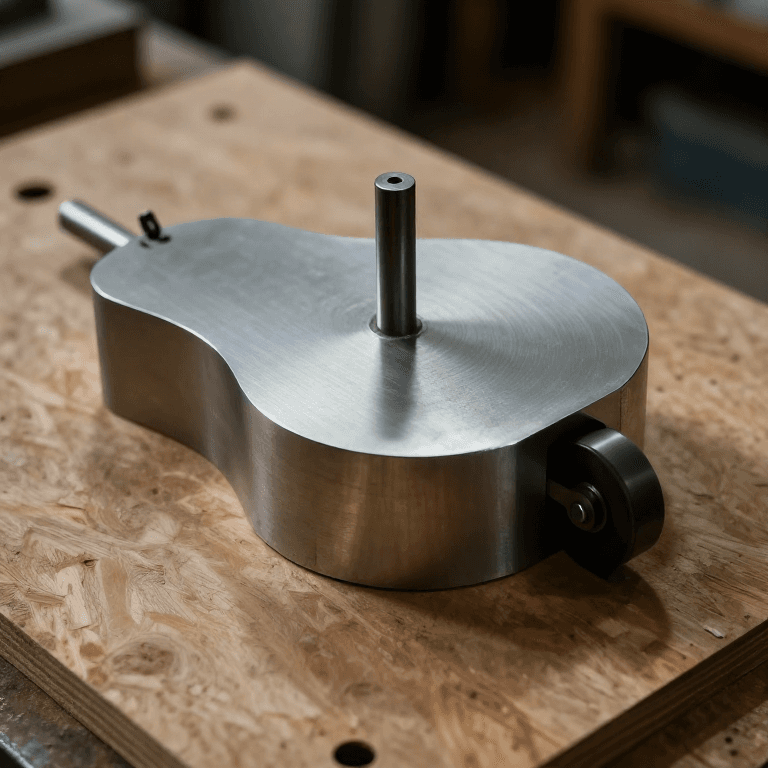


CC0 Public Domain
This blueprint is released under CC0. You are free to copy, modify, distribute, and use this work for any purpose, without asking permission.
Support the Maker by purchasing products through their Blueprint where they earn a Maker Commission set by Vendors, or create a new iteration of this Blueprint and include it as a connection in your own Blueprint to share revenue.