ART
BEAUTY & WELLNESS
CRAFT
CULTURE & HISTORY
ENTERTAINMENT
ENVIRONMENT
FOOD & DRINKS
REVERSE ENGINEERING
SCIENCES
SPORTS
TECHNOLOGY
WEARABLES


The Screw-Casing Lemon Squeezer: A Plunger Driven Down by a Screw
Squeezing a lemon by hand leaves juice in the fruit and sends pips into the glass.
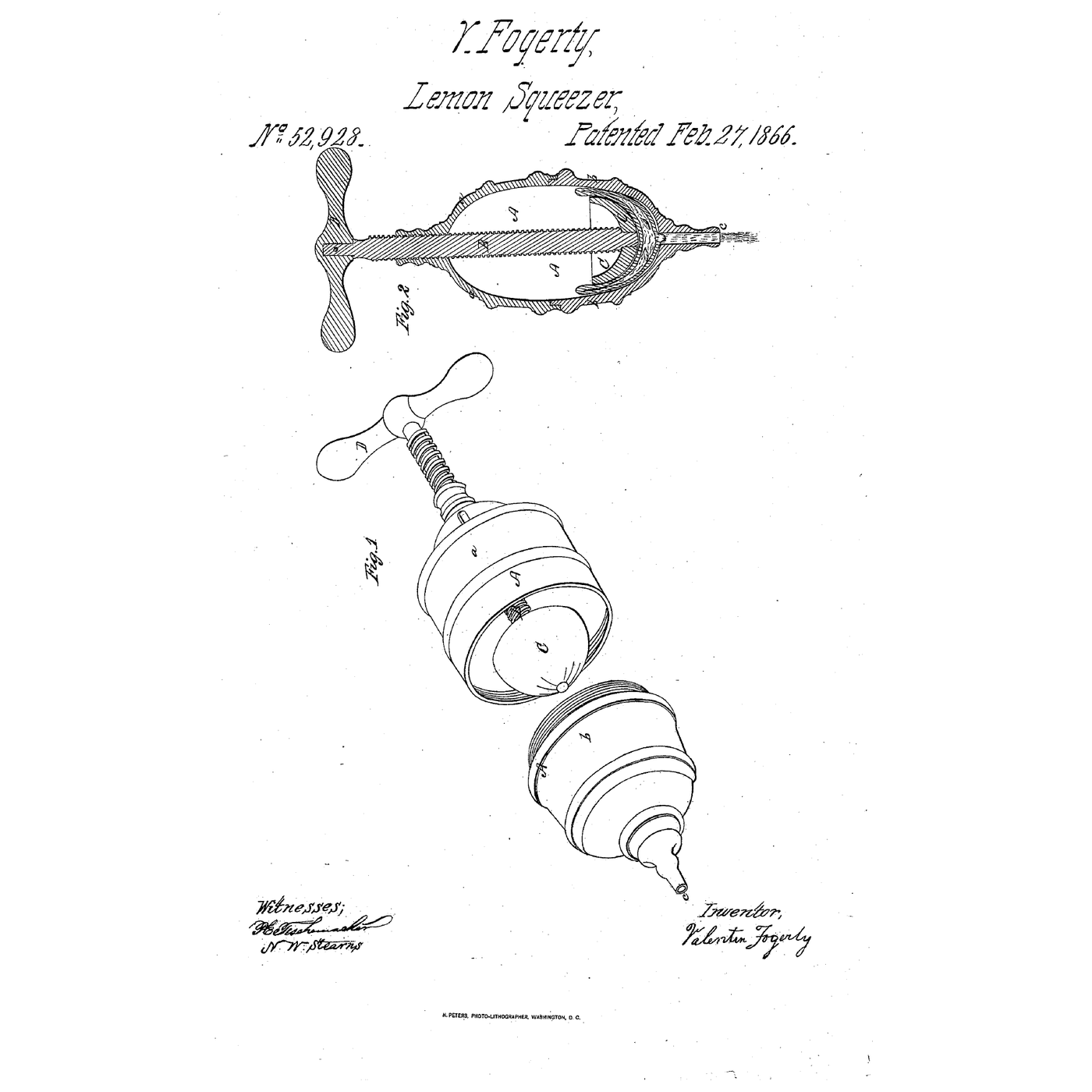
Valentine Fogerty of Boston received US 52,928, dated 27 February 1866, for a lemon-squeezer made of "a hollow shell or casing, within which the lemon is placed, a plunger being forced down onto the lemon by means of a screw so as to extract the juice, which is forced out through a nozzle or orifice at the bottom of the casing." The casing comes apart in two halves that screw together, and the plunger turns loosely on the screw's end.
This rung works out the force a screw puts on the lemon, then builds the casing from PVC pipe and an M10 rod and weighs the juice it gives.
Intermediate
About 3 hours
Instructions
1
1
Screw force on the plunger
Screw force on the plunger
Loading Jupyter Notebook...
2
2
Why the screw multiplies force
Why the screw multiplies force
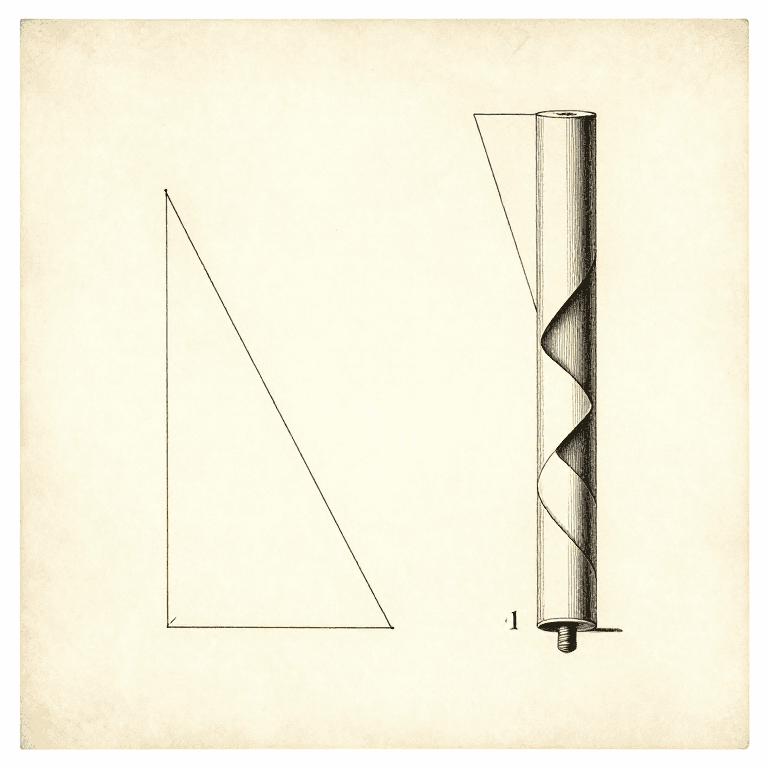
The embedded blueprint explains the thread as a ramp. Fogerty's squeezer turns that ramp into pressure on a lemon.
3
3
Read US 52,928
Read US 52,928
"B is a screw which passes through the upper portion of the casing A, and carries at its lower end a plunger, C, which turns loosely thereon, and is of the form seen in Fig. 1, its diameter being considerably less than that of the interior of the casing A."
"When the plunger C is forced down the lemon assumes the shape seen in Fig. 2, the upper half being forced into the lower half, thus extracting every particle of juice and avoiding all waste."
4
4
Build the casing and press a lemon
Build the casing and press a lemon
**Casing.** Cut 90 mm of 50 mm PVC pipe and push a 50 mm PVC end cap onto each end. Drill a 6 mm hole in the centre of the bottom cap: the nozzle. Drill two 5 mm holes through the top cap's skirt and the pipe, opposite each other, and hold the cap on with two M5 bolts and nuts so it comes off to load the lemon.
**Screw.** Drill 10.5 mm through the centre of the top cap and epoxy an M10 nut over the hole inside it. Screw 20 cm of M10 threaded rod through. Drill 10 mm across the middle of 12 cm of hardwood dowel and lock it on the rod's top between two nuts: the T-handle.
**Plunger.** Drill a 10.5 mm hole in the centre of a 32 mm PVC end cap and fit it, open side up, on the rod's bottom end between a washer and two nuts tightened against each other, loose enough to turn.
**Test.** Weigh a lemon, cut off both ends, put it in the casing and bolt the cap on. Over the measuring jug, turn the handle until no more juice comes; hook the spring scale to the handle's end once to read your push. Weigh the juice. Squeeze a second lemon of the same weight by hand and weigh its juice.
Materials for this step:
 PVC Pipe0.09 meter
 PVC Pipe Fittings Assortment1 piece
 Threaded Rod0.2 meter
 Hex Nut5 pieces
 Flat Washer1 piece
 Hex Bolt Assortment1 piece
 Epoxy Resin5 ml
 Hardwood Dowels0.12 meter
 Lemon2 pieces
Tools needed:
 Hacksaw
 Cordless Drill
 Drill Bit Set
 Adjustable Wrench
 Files (Hand File)
 Kitchen Knife
 Measuring Jug
 Digital Kitchen Scale
 Force Meter (Spring Scale)
 Clear Safety Glasses
5
5
A squeezer that leaks, jams or leaves juice behind
A squeezer that leaks, jams or leaves juice behind
Screw-casing lemon squeezer troubleshooting.
Flow
Loading...
6
6
History and honest limits
History and honest limits
**Valentine Fogerty** of Boston, Massachusetts, assigned US 52,928 to Corns. Callaghan of Boston and James Birmingham of Roxbury; it is dated 27 February 1866. His casing was "of iron or other suitable material", the lower end of the lemon "previously cut off or perforated", and the handle could be turned a few times for a little juice and again later.
**Honest limits.** PVC pipe, caps, an M10 rod and a locked pair of nuts stand in for Fogerty's iron casing and screw, and bolts for his screwed halves. The notebook uses a square-thread efficiency, a little high for a V-thread; its hand force, handle radius and friction are examples. Your juice weights are the result.
Materials
9- 0.09 meterPlaceholder
- 1 piecePlaceholder
- 0.2 meterPlaceholder
- 5 piecesPlaceholder
- 1 piecePlaceholder
- 1 piecePlaceholder
- 5 mlPlaceholder
- 0.12 meterPlaceholder
- 2 piecesPlaceholder
Tools Required
10- Placeholder
- 1 vendor sell this, none ship to you yetPlaceholder
- Placeholder
- Placeholder
- Placeholder
- Placeholder
- Placeholder
- Placeholder
- Placeholder
- Placeholder
This blueprint makes

Related Blueprints
These blueprints share knowledge with this one — techniques, materials, or principles that connect them in the learning graph.



CC0 Public Domain
This blueprint is released under CC0. You are free to copy, modify, distribute, and use this work for any purpose, without asking permission.
Support the Maker by purchasing products through their Blueprint where they earn a Maker Commission set by Vendors, or create a new iteration of this Blueprint and include it as a connection in your own Blueprint to share revenue.