ART
BEAUTY & WELLNESS
CRAFT
CULTURE & HISTORY
ENTERTAINMENT
ENVIRONMENT
FOOD & DRINKS
REVERSE ENGINEERING
SCIENCES
SPORTS
TECHNOLOGY
WEARABLES

The Screw Lamp Socket: Fitting a Bulb Makes the Circuit
An electric lamp burns out and must be replaced — by anyone, quickly, without tools and without touching bare wires. Its base has to hold it, connect it and let it go again.
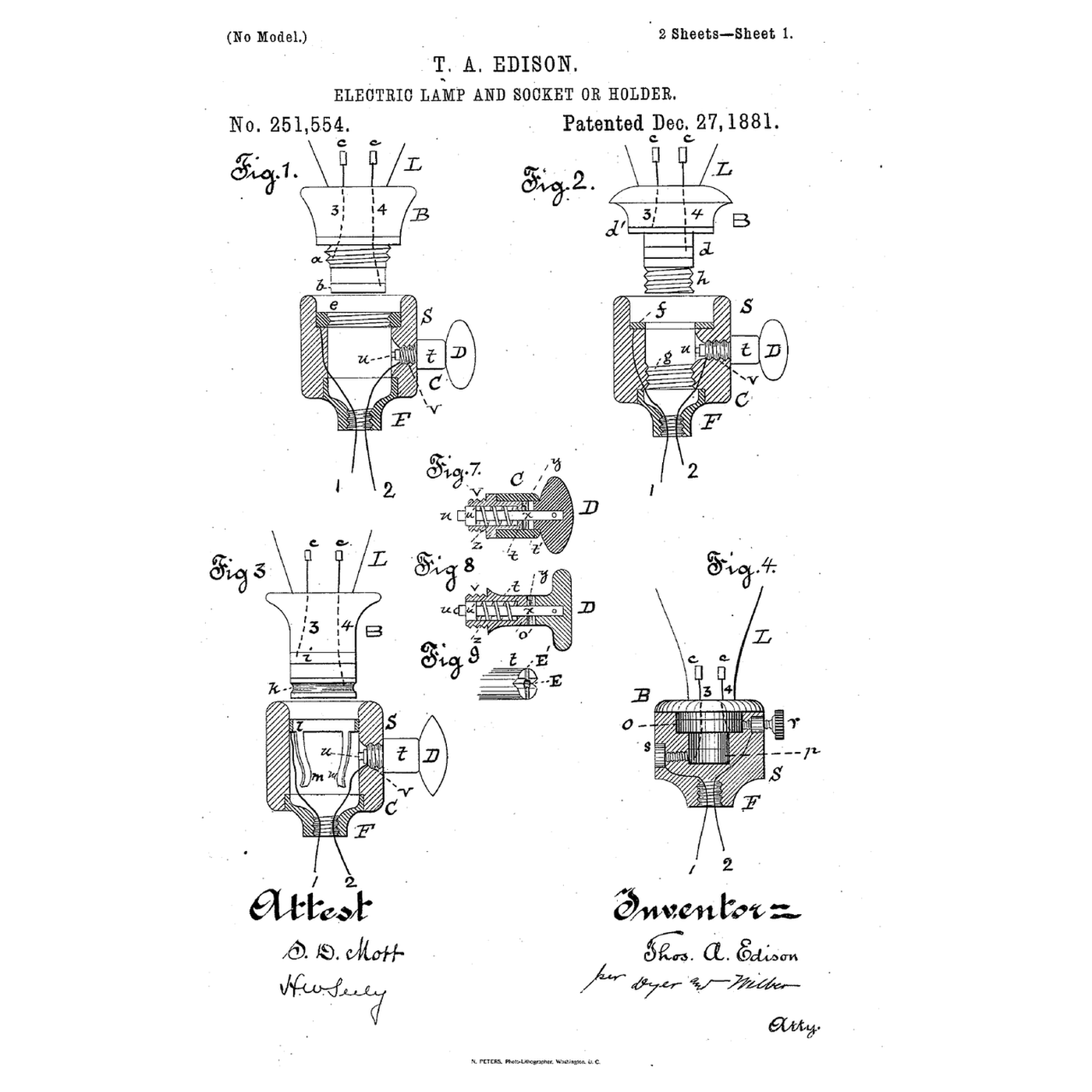
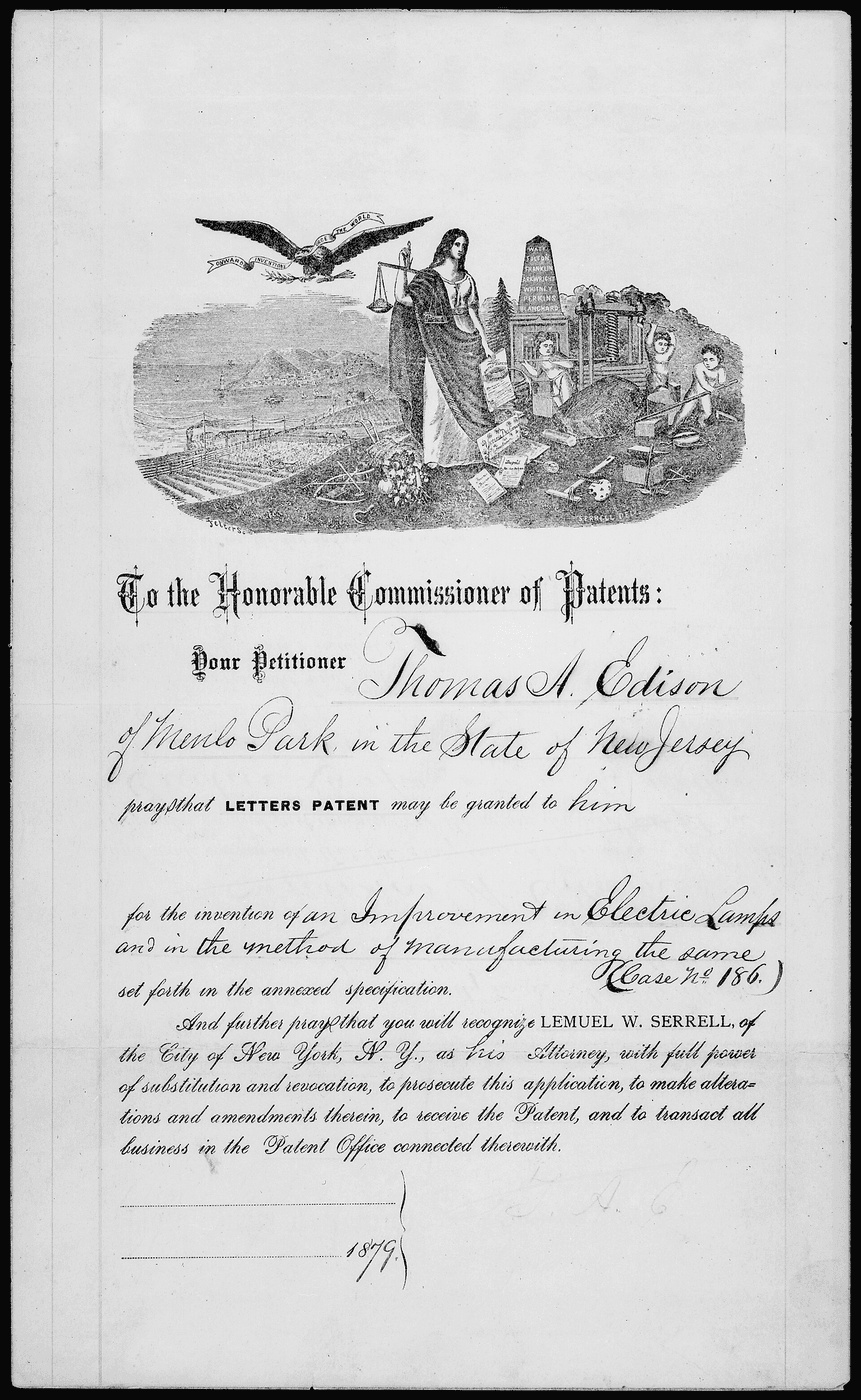
Thomas A. Edison of Menlo Park, assignor to the Edison Electric Light Company, filed US 251,554 on 26 March 1881; it is dated 27 December 1881, for an "Electric Lamp and Socket or Holder". The lamp's neck carries two metal bands, one formed as a screw thread; the socket has a matching threaded band inside and a circuit-controller, and screws itself onto an ordinary gas fixture. Screwing the lamp in makes both connections at once; the controller switches the current.
This rung works out how the thread presses the contacts and why a loose one heats, and wires a low-voltage socket.
Beginner
About 2 hours
Instructions
1
1
Seating force and contact heating
Seating force and contact heating
Loading Jupyter Notebook...
2
2
The lamp the socket holds
The lamp the socket holds
The socket was made for the carbon-filament lamp. The embedded blueprint covers it.
3
3
Read US 251,554
Read US 251,554
"In a system of electric lighting where the lamps used consist of an incandescing conductor hermetically sealed in a glass inclosing globe it is desirable that the lamp and its supporting-socket should be so constructed that the lamp may be readily removed from or placed in the socket, and that at the same time by the act of placing in or removing the lamp from the socket the appropriate circuit connections to the conductor be formed, subject, however, and only, to the control of a suitable circuit-controller".
The socket is of insulating material, hollowed to receive the neck at one end and "formed with a screw-thread at the other end, by which it may be attached to any ordinary gas-fixture, chandelier, or bracket." "Upon the interior of the socket is a metal band, which may be formed into a female screw-thread", joined to one conductor; "One or two turns of the screw-thread is sufficient". When the lamp is in place one neck band touches the socket's band, and the other is in position to be touched by the circuit-controller. Instead of a thread, a concave band held by curved spring fingers is also described.
4
4
Twist in, circuit made
Twist in, circuit made
Blockly Workspace
Loading Blockly workspace...
5
5
Wire a low-voltage socket
Wire a low-voltage socket
Use only low voltage: a screw-base 12 V lamp and socket, a 12 V battery or power supply, and a switch. With the multimeter, trace which of the socket's two terminals goes to the threaded shell and which to the centre contact. Wire the switch into the centre-contact lead, fit the lamp and switch it on.
Loosen the lamp half a turn until it flickers; measure the voltage across the loose contact while it is lit and compare with the notebook's heating. Never do this on mains wiring.
Materials for this step:
 Jumper Wires1 piece
 Push Button1 piece
Tools needed:
 Multimeter
 DC Power Supply
 Screwdriver - Flat
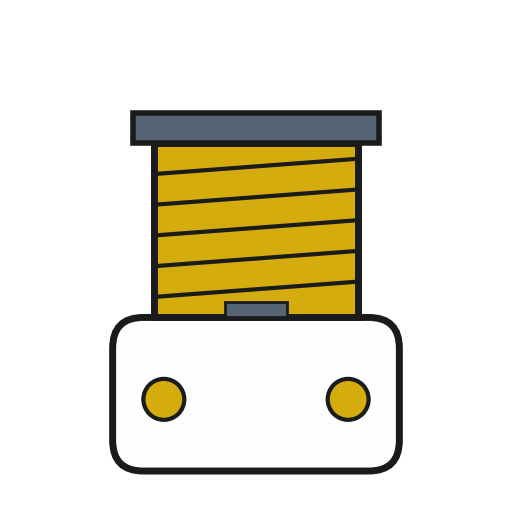 Lamp Socket
6
6
A socket that flickers
A socket that flickers
Lamp socket troubleshooting.
Flow
Loading...
7
7
History and honest limits
History and honest limits
**Thomas A. Edison** of Menlo Park, New Jersey, assignor to the **Edison Electric Light Company**, filed US 251,554 on 26 March 1881; it is dated 27 December 1881.
**Honest limits.** Thread size, friction, lamp current and contact resistances in the notebook are examples; the patent gives no dimensions.
Materials
2- Placeholder
- Placeholder
Tools Required
4- Placeholder
- Placeholder
- Placeholder
- Placeholder
This blueprint makes
Related Blueprints
These blueprints share knowledge with this one — techniques, materials, or principles that connect them in the learning graph.

CC0 Public Domain
This blueprint is released under CC0. You are free to copy, modify, distribute, and use this work for any purpose, without asking permission.
Support the Maker by purchasing products through their Blueprint where they earn a Maker Commission set by Vendors, or create a new iteration of this Blueprint and include it as a connection in your own Blueprint to share revenue.