ART
BEAUTY & WELLNESS
CRAFT
CULTURE & HISTORY
ENTERTAINMENT
ENVIRONMENT
FOOD & DRINKS
REVERSE ENGINEERING
SCIENCES
SPORTS
TECHNOLOGY
WEARABLES
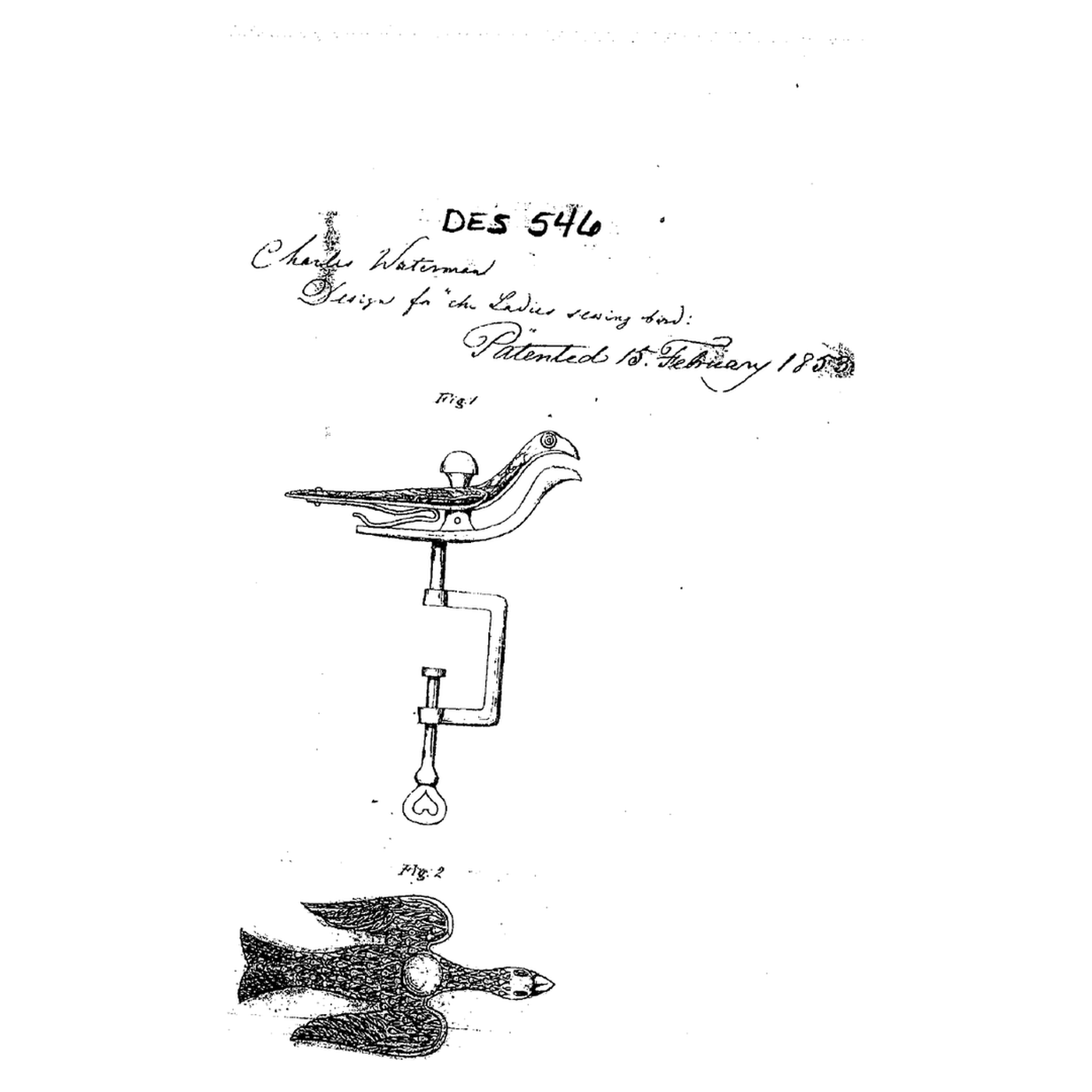


The Sewing Bird: A Spring-Beaked Clamp as a Third Hand
Hand-sewing a long hem needs the cloth held taut, and two hands are not enough to hold it and sew.
Charles Waterman of Meriden, Connecticut, received design patent D546, dated 15 February 1853, for "the instrument known as the 'Sewing bird'": a table clamp topped by "a bird on the wing bearing a burden upon its back". The burden is "in fact the emery ball" for cleaning needles. A spring in the tail holds the beak shut on the cloth.
This rung works out how hard a spring beak must grip to hold cloth under a sewing pull, then makes a spring-jaw sewing clamp and measures its hold.
Beginner
About 2 hours
Instructions
1
1
The grip a beak needs
The grip a beak needs
Loading Jupyter Notebook...
2
2
Sewing that needs the cloth held
Sewing that needs the cloth held
The embedded blueprint darns and patches by hand. A sewing bird holds the work while you do.
3
3
Read D546
Read D546
"It is a settled principle of taste in all works of Design that the highest degree of beauty is attained where the useful and ornamental are properly blended or combined."
"The burden borne upon the back of the bird is in fact the emery ball and while it is an indispensable accompaniment of the sewing bird its position is here appropriate in every respect."
"What I claim is the design herein represented by the feathered bird upon the wing, bearing a burden upon its back."
4
4
Make a spring-jaw clamp and measure its hold
Make a spring-jaw clamp and measure its hold
Screw a C-clamp to the table edge as the base. On it, fix a pair of short hardwood jaws hinged together at one end, like a clothespin, with a spring from the assortment pushing the other ends apart so the front ends close. Glue a strip of emery cloth inside the jaws for grip.
Clamp one end of a strip of cloth in the jaws. Hook the force meter to the other end and pull slowly until it slips; read the force. Compare with the notebook. Then hem the strip by hand with the end held in the clamp.
Materials for this step:
 Hardwood Board1 piece
 Compression Spring Assortment1 piece
 Wood Glue1 piece
 Cotton Fabric (Lightweight)1 piece
 Sewing Thread1 piece
Tools needed:
 Sewing Clamp
 C-Clamp
 Hand Saw
 Cordless Drill
 Force Meter (Spring Scale)
 Hand Sewing Needles
 Emery Cloth
5
5
A sewing clamp that slips, marks or wobbles
A sewing clamp that slips, marks or wobbles
Sewing clamp troubleshooting.
Flow
Loading...
6
6
History and honest limits
History and honest limits
**Charles Waterman** of Meriden, New Haven County, Connecticut, received design patent D546, dated 15 February 1853. A design patent protects the look of an object, not its mechanism: the claim is the feathered bird bearing its burden, and the spring clamp itself is not claimed.
**Honest limits.** The notebook treats the grip as simple friction on two faces. Soft or slippery cloth changes the result. The spring forces and friction values are examples. Your force-meter reading is the measurement.
Materials
5- 1 piecePlaceholder
- Placeholder
- 1 piecePlaceholder
- 1 piecePlaceholder
- 1 piecePlaceholder
Tools Required
7- Placeholder
- Placeholder
- Placeholder
- 1 vendor sell this, none ship to you yetPlaceholder
- Placeholder
- Placeholder
- Placeholder
Related Blueprints
These blueprints share knowledge with this one — techniques, materials, or principles that connect them in the learning graph.

CC0 Public Domain
This blueprint is released under CC0. You are free to copy, modify, distribute, and use this work for any purpose, without asking permission.
Support the Maker by purchasing products through their Blueprint where they earn a Maker Commission set by Vendors, or create a new iteration of this Blueprint and include it as a connection in your own Blueprint to share revenue.