ART
BEAUTY & WELLNESS
CRAFT
CULTURE & HISTORY
ENTERTAINMENT
ENVIRONMENT
FOOD & DRINKS
REVERSE ENGINEERING
SCIENCES
SPORTS
TECHNOLOGY
WEARABLES
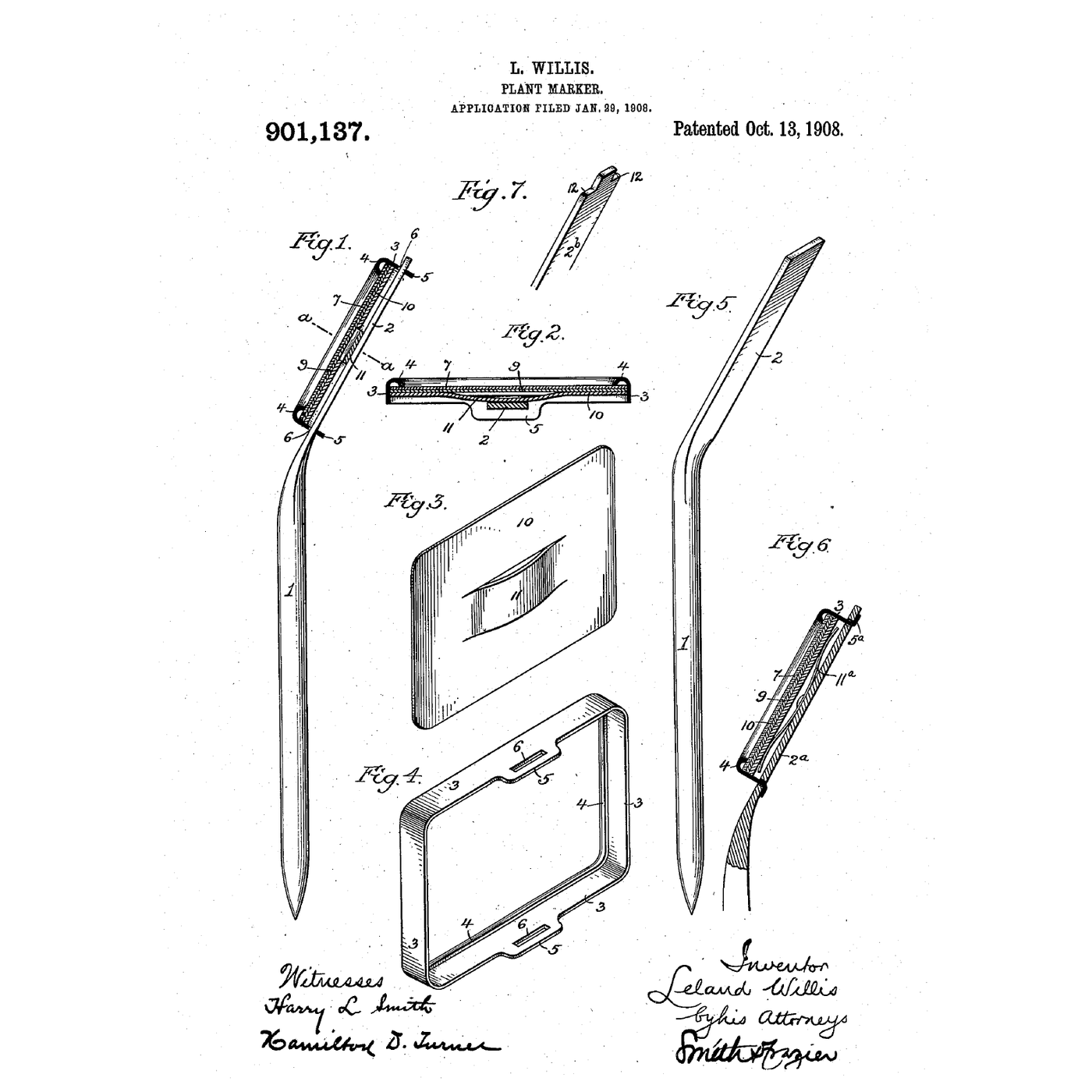


The Sheet-Steel Plant Marker: A Spring Strip Instead of a Key
A cast-iron plant marker is heavy, breaks when dropped, and its loose key goes missing in the soil.
Leland Willis of Grenloch, New Jersey, assignor to the Bateman Manufacturing Company, received US 901,137, dated 13 October 1908, improving Frank Bateman's marker of 1906: "the object of my invention being to simplify and cheapen the construction of said device and to provide a marker whose parts are light, strong and easily assembled or taken apart." A sheet-steel frame with an inturned flange holds the card and cover; a backing plate carries a struck-up spring strip; the stake's flattened end passes through slotted ears on the frame and presses the spring.
This rung works out how hard the strip presses and how much the sheet metal saves, then builds the marker and compares it with the 1906 one.
Intermediate
About 3 hours
Instructions
1
1
Spring pressure and weight
Spring pressure and weight
Loading Jupyter Notebook...
2
2
The marker it simplifies
The marker it simplifies
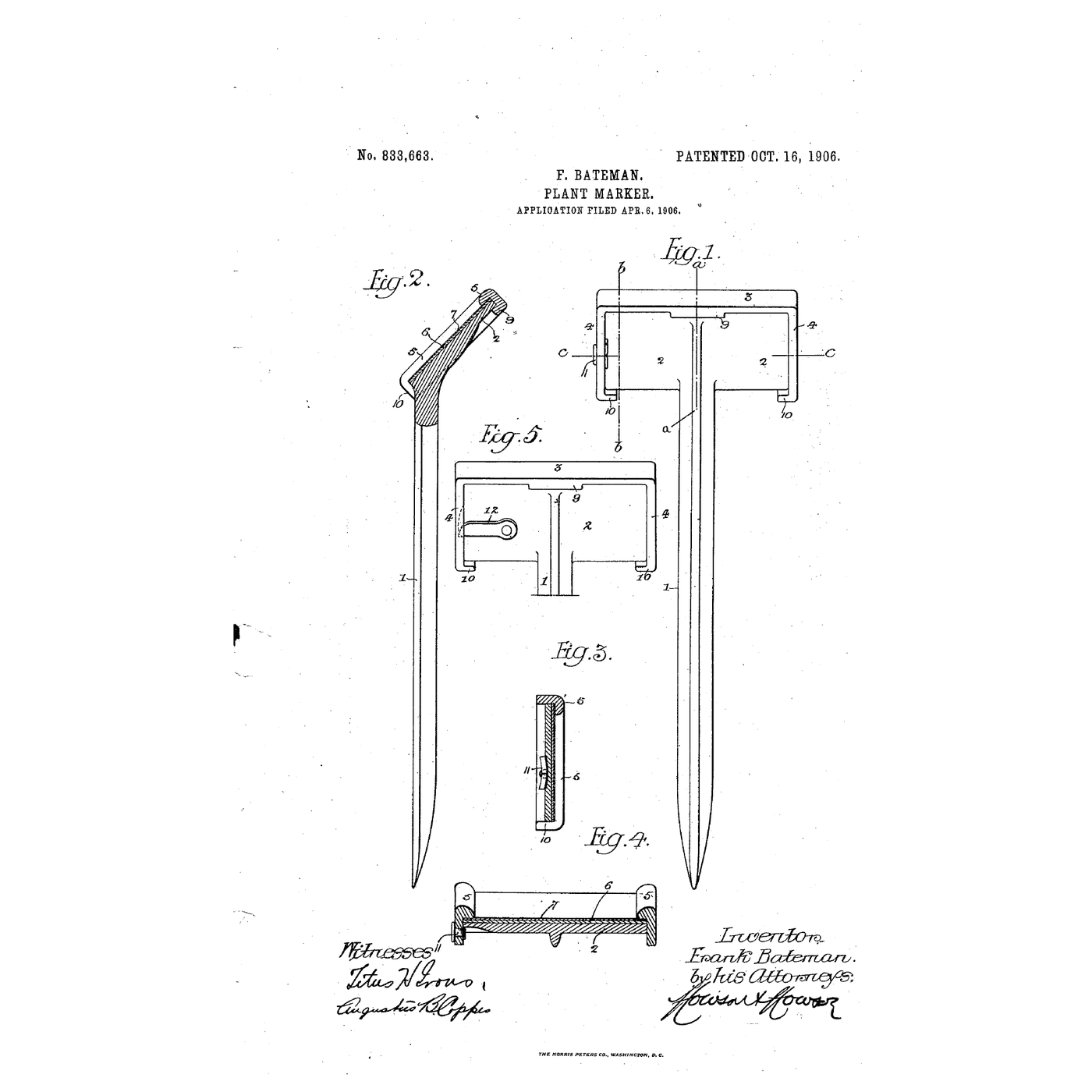
The embedded blueprint builds Bateman's 1906 marker with a split-pin key. Willis's version drops the key and holds everything with the stake and one spring strip.
3
3
Read US 901,137
Read US 901,137
"The cover plate 7 of the marking card is pressed against the inturned flange 4 of the frame with such force as to maintain a substantially watertight joint between the two, and thus prevent the staining of the marking card or other injury thereto by reason of its becoming wet."
"The device, moreover, does not necessitate the employment of keys or other small parts which are likely to be lost or mislaid."
4
4
Build the marker and compare it
Build the marker and compare it
**Stake.** Cut 35 cm of 25 × 3 mm mild steel flat bar, file one end to a point, and bend the top 7 cm back to about 45° in the vice, checking with the protractor.
**Frame.** Cut a strip of aluminium sheet 15 mm wide and 32 cm long. Fold 4 mm of one long edge inward along its length: the bearing flange. Bend the strip round a 90 × 60 mm card into a rectangle, flange to the front, and rivet the overlapping ends. Rivet a tab across the back at the top and one at the bottom, each with a 26 × 4 mm slot for the stake's end.
**Backing plate.** Cut a plate 90 × 60 mm. Drill a starting hole and snip a tongue 10 mm wide and 30 mm long in its middle, then bend the tongue out into a gentle curve: the spring.
**Assemble.** Put the card, a clear plastic cover and the backing plate, tongue outward, into the frame. Slide the stake's bent end through both slots so it presses the tongue flat.
**Test.** Time the build and weigh the marker. Give it 30 sprays from 30 cm, wait an hour and check the card. Compare time, weight and card with a marker built to the embedded 1906 blueprint.
Materials for this step:
 Mild Steel Flat Bar0.35 meter
 Aluminium Sheet1 piece
 Steel Rivets6 pieces
 Card Stock1 piece
 Clear Plastic Sheet1 piece
 Water0.2 liter
Tools needed:
 Hacksaw
 Files (Hand File)
 Bench Vise
 Hammer
 Protractor
 Tin Snips
 Cordless Drill
 Drill Bit Set
 Rivet Set
 Flat-Nose Pliers
 Ruler
Ruler Pencil
 Flower Pot
 Water Spray Bottle
 Digital Kitchen Scale
 Stopwatch
 Leather Work Gloves
 Clear Safety Glasses
5
5
A marker that leaks, rattles or will not go together
A marker that leaks, rattles or will not go together
Sheet-steel plant marker troubleshooting.
Flow
Loading...
6
6
History and honest limits
History and honest limits
**Leland Willis** of Grenloch, New Jersey, assignor to the Bateman Manufacturing Company, filed US 901,137 on 29 January 1908; it is dated 13 October 1908. He also showed the ears carried on the stake and passing through slots in the frame, and the stake narrowed at the top to form shoulders that limit how far the frame slides down.
**Honest limits.** Aluminium sheet and rivets stand in for Willis's sheet steel, and a snipped tongue for his struck-up strip. The notebook treats the strip as a straight spring arm; its sizes and presses are examples. Your spray check, weights and build times are the result.
Materials
6- 0.35 meterPlaceholder
- 1 piecePlaceholder
- 6 piecesPlaceholder
- 1 piecePlaceholder
- 1 piecePlaceholder
- 0.2 literPlaceholder
Tools Required
18- Placeholder
- Placeholder
- Placeholder
- Placeholder
- Placeholder
- Placeholder
- 1 vendor sell this, none ship to you yetPlaceholder
- Placeholder
- Placeholder
- Placeholder
- Placeholder
- 1 vendor sell this, none ship to you yetPlaceholder
- Placeholder
- Placeholder
- Placeholder
- Placeholder
- Placeholder
- Placeholder
This blueprint makes

Related Blueprints
These blueprints share knowledge with this one — techniques, materials, or principles that connect them in the learning graph.


CC0 Public Domain
This blueprint is released under CC0. You are free to copy, modify, distribute, and use this work for any purpose, without asking permission.
Support the Maker by purchasing products through their Blueprint where they earn a Maker Commission set by Vendors, or create a new iteration of this Blueprint and include it as a connection in your own Blueprint to share revenue.