ART
BEAUTY & WELLNESS
CRAFT
CULTURE & HISTORY
ENTERTAINMENT
ENVIRONMENT
FOOD & DRINKS
REVERSE ENGINEERING
SCIENCES
SPORTS
TECHNOLOGY
WEARABLES
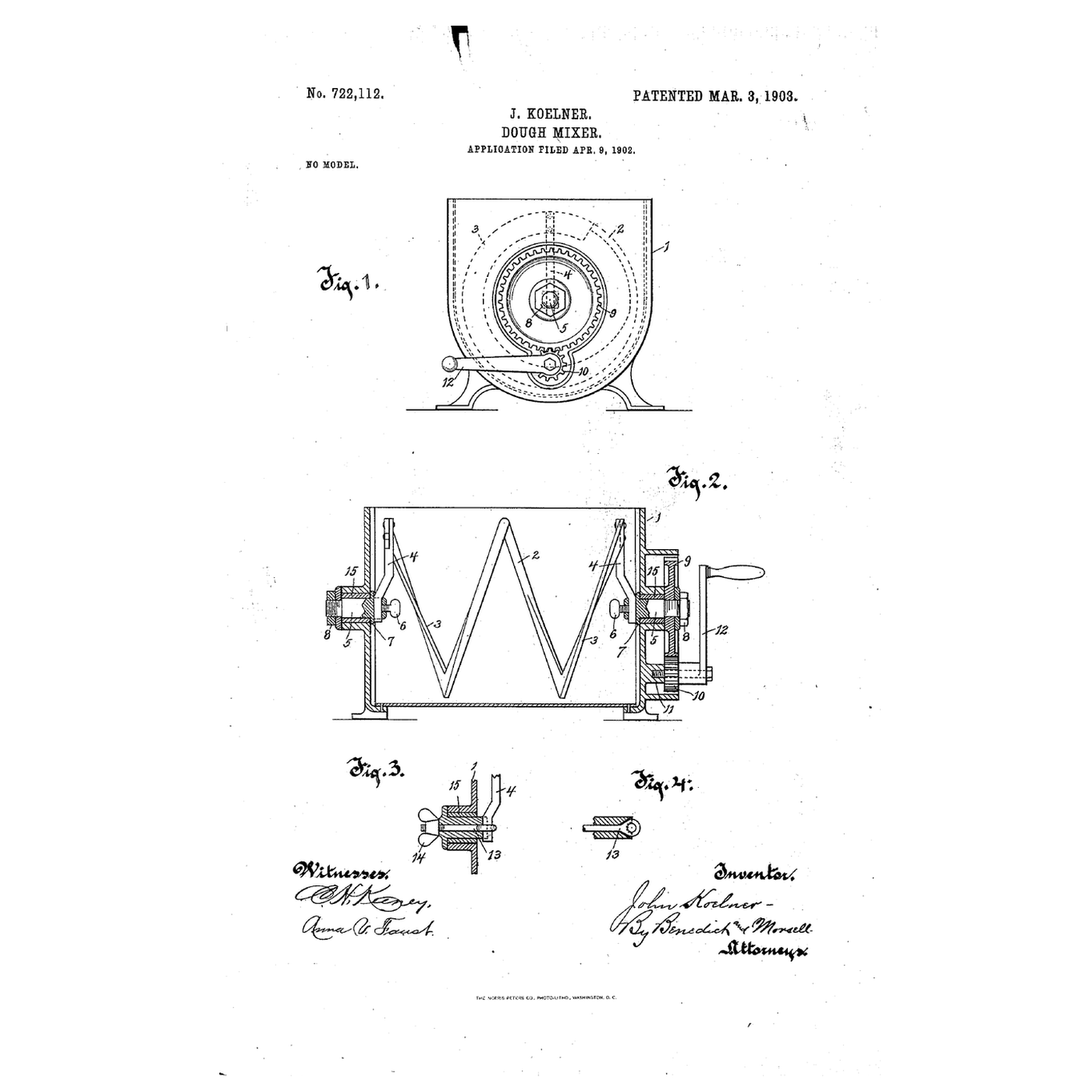


The Spiral Dough Mixer: Turn It Over, Press It Against the End
Kneading bread dough by hand takes time and a strong pair of arms. A crank and a shaped blade can do the folding and pressing instead.
John Koelner of Louisville, Kentucky, received US 722,112, dated 3 March 1903, for a dough-mixer in which a steel spiral of about two full turns, round in the middle and flattened at its ends, is cranked round in a trough with a half-round bottom. The spiral lifts out for cleaning.
This rung works out how often the spiral presses the dough against the trough's ends, then bends a spiral from stainless steel wire and mixes a bread dough with it.
Intermediate
About 3 hours
Instructions
1
1
Presses per minute
Presses per minute
Loading Jupyter Notebook...
2
2
A turning spiral carries
A turning spiral carries
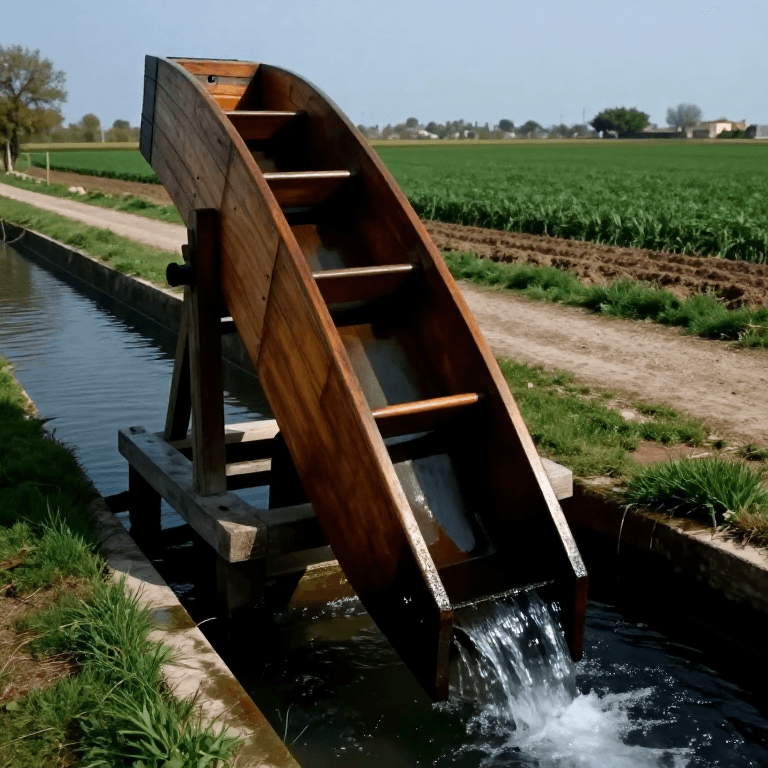
The embedded blueprint turns a spiral to carry water along and up. Koelner's spiral carries dough along the trough and presses it against the end.
3
3
Read US 722,112
Read US 722,112
"My invention relates to improvements in dough-mixers, whereby a construction is provided that is peculiarly well adapted for mixing dough successfully by movements that involve kneading and pressing the dough, and is so constructed that the parts can be readily removed, cleaned, and replaced properly in the mixer".
"It will be understood that when used dough is placed in the receptacle, and by the rotation of the spiral mixer the dough will be turned over and kneaded primarily by the medial round smooth portion 2 and by it and the blade-like parts 3 will be moved toward the end of the receptacle and will be pressed and kneaded against the end of the receptacle until the mass there falls back into the central portion of the receptacle, when the process will be again repeated until the dough shall have been thoroughly and sufficiently mixed."
4
4
Bend a spiral and mix a bread dough
Bend a spiral and mix a bread dough
Wrap stiff stainless steel wire two full turns round a jar a little narrower than the food container. Stretch the coil until it is as long as the container, less 4 cm. At each end, bend the wire in to the centre line as an arm, then out along the centre line as a short axle. Leave one axle long and bend it into a crank. Hammer the last quarter-turn at each end flat.
Drill a hole in the middle of each end of the container, halfway up, for the axles. Spring the spiral in and check it turns without scraping.
Put in 500 g of bread flour, 7 g of instant yeast, 10 g of salt and 330 mL of water. Crank steadily and count the turns for ten minutes. Stretch a small piece: when it thins to a see-through sheet without tearing, it is kneaded. Compare with the same dough kneaded by hand.
Materials for this step:
 Stainless Steel Wire1 piece
 Airtight Food Storage Container1 piece
 Bread Flour500 g
 Bread Yeast7 g
 Salt10 g
 Water330 ml
Tools needed:
 Dough Mixer
 Needle-Nose Pliers
 Bench Vise
 Hammer
 Cordless Drill
 Drill Bit Set
 Ruler
Ruler Digital Kitchen Scale
 Stopwatch
5
5
A mixer that jams, scrapes or leaves the dough unkneaded
A mixer that jams, scrapes or leaves the dough unkneaded
Spiral mixer troubleshooting.
Flow
Loading...
6
6
History and honest limits
History and honest limits
**John Koelner** of Louisville, Kentucky, filed US 722,112 on 9 April 1902; it is dated 3 March 1903. His crank turned the spiral through a pinion and a cog-wheel on one hub, and thumb-screws let the spiral be taken out for cleaning.
**Honest limits.** The notebook treats the dough as moving a fixed share of the pitch per turn; real dough sticks, stretches and slips. Sizes, speeds and slip are examples. Your turn count and the stretch test are the measurement.
Materials
6- 1 piecePlaceholder
- Placeholder
- 500 gPlaceholder
- 7 gPlaceholder
- 10 gPlaceholder
- 330 mlPlaceholder
Tools Required
9- Placeholder
- Placeholder
- Placeholder
- Placeholder
- 1 vendor sell this, none ship to you yetPlaceholder
- Placeholder
- Placeholder
- Placeholder
- Placeholder
Related Blueprints
These blueprints share knowledge with this one — techniques, materials, or principles that connect them in the learning graph.



CC0 Public Domain
This blueprint is released under CC0. You are free to copy, modify, distribute, and use this work for any purpose, without asking permission.
Support the Maker by purchasing products through their Blueprint where they earn a Maker Commission set by Vendors, or create a new iteration of this Blueprint and include it as a connection in your own Blueprint to share revenue.