ART
BEAUTY & WELLNESS
CRAFT
CULTURE & HISTORY
ENTERTAINMENT
ENVIRONMENT
FOOD & DRINKS
REVERSE ENGINEERING
SCIENCES
SPORTS
TECHNOLOGY
WEARABLES


The Spread Heddle Eye: Open the Ends of a Twisted-Wire Eye So the Warp Cannot Catch
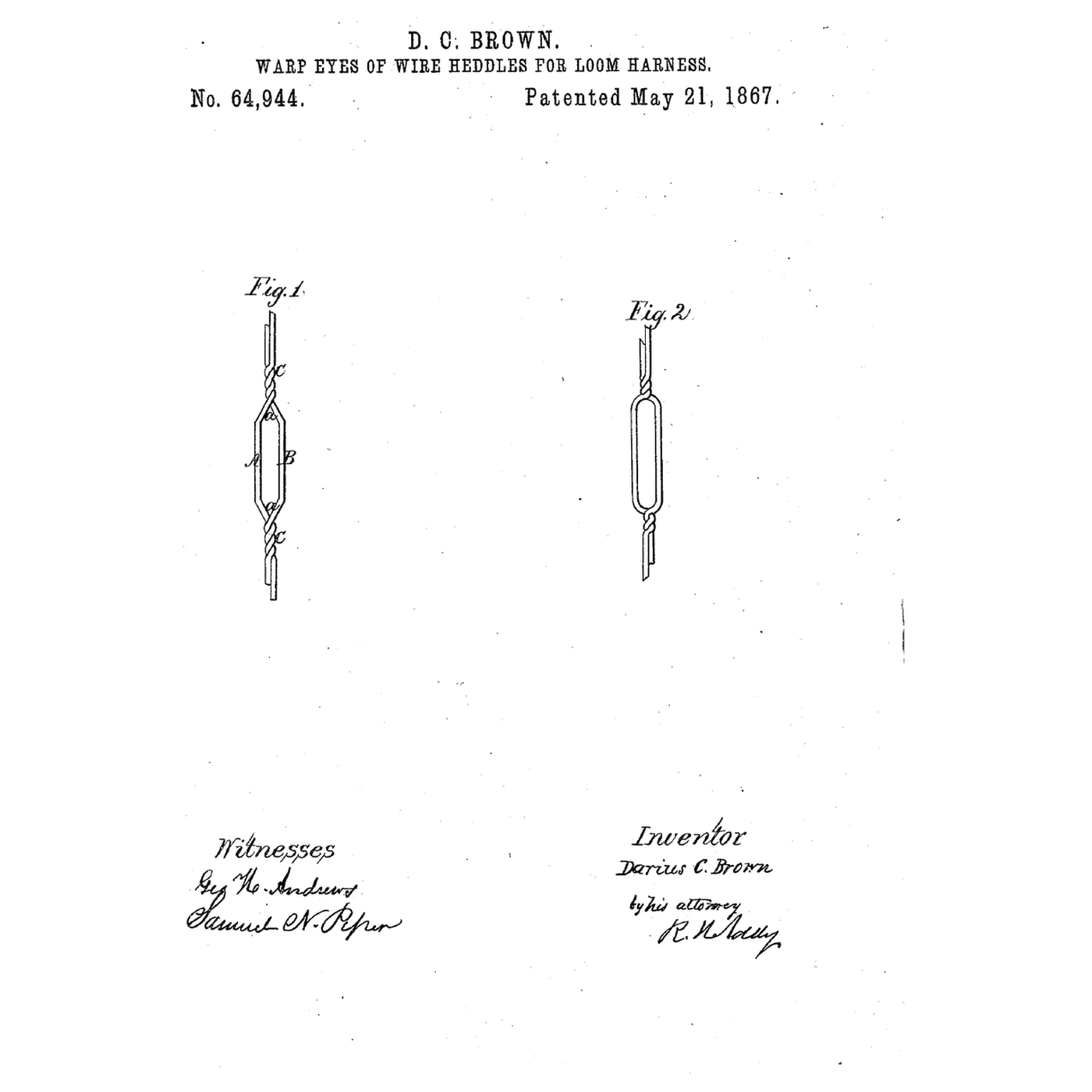
The eye of a wire heddle, formed by twisting two wires together, ends in a sharp angle where the warp yarn can catch in the twist and be chafed or broken.
Darius C. Brown of Lowell, Massachusetts, received US 64,944, dated 21 May 1867, for spreading the eye's wires "laterally at the angle or angles of junction, in manner substantially as set forth, so as to tighten the twist at either or both ends of the eye". After the eye is formed on a former, an instrument like a pair of pliers or a glove-stretcher is put into it and opened, which spreads the eye lengthwise, makes the angles at its ends greater, and draws the twist tighter, so "it will be found very difficult, if not impossible, for it to catch or injure a warp-thread or a knot thereof."
This rung works out how the angle at the eye's ends decides where a yarn wedges, then twists wire heddles, spreads half of them, and weaves a strip on a rigid heddle loom with both.
Beginner
About 3 hours
Instructions
1
1
The angle at the crotch
The angle at the crotch
Loading Jupyter Notebook...
2
2
The heddles it improves
The heddles it improves
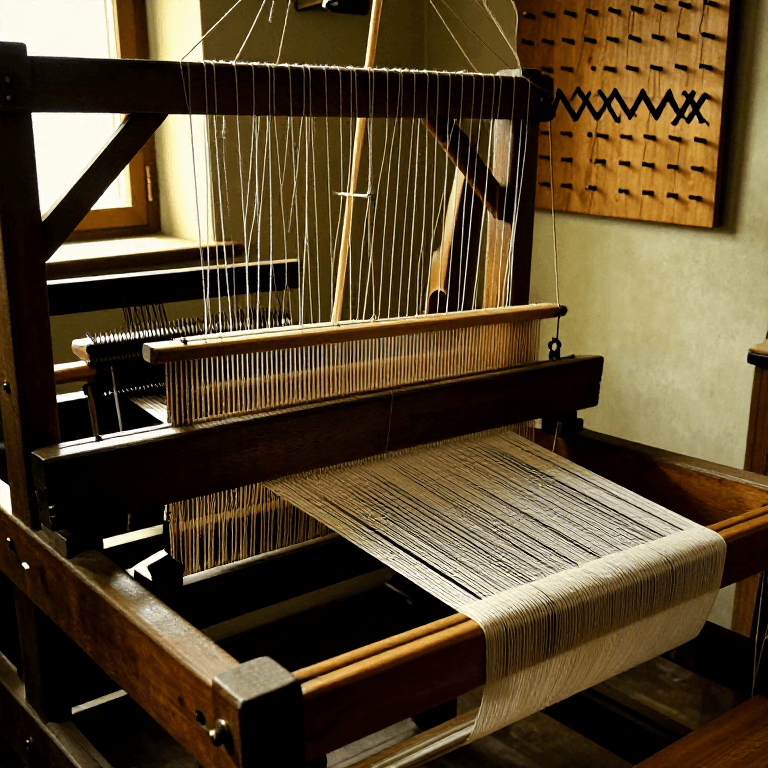
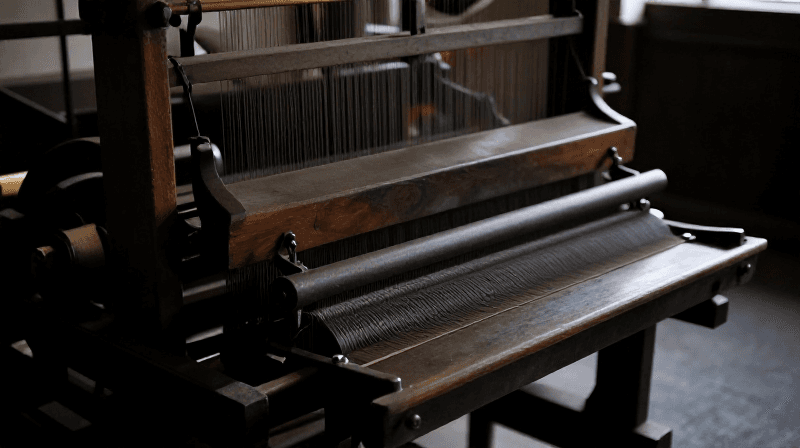
The embedded blueprint draws the warp through heddle eyes. Brown shapes those eyes so the warp cannot catch at their ends.
3
3
Read US 64,944
Read US 64,944
"The eyes as heretofore made of two wires or parts A B of a wire twisted together, as shown at C C, and upon a form, always, so far as I am aware, have their extremities or ends terminating in acute angles, as shown at a a in fig. 1."
"The object of my invention is to so form the eye at each extremity as to overcome the liability of the warp-yarn being caught in or injured by the twist of the wires, and I accomplish this by subsequently spreading the eye lengthwise, so as to impart to each end of it a semicircular form, or an approximation thereto, (see fig. 2,) that is, I spread the wires, where they form an acute angle at their junction, so as to make their angle greater, and at the same time elongate the eye and contract the twist."
4
4
Twist the heddles, spread them and weave
Twist the heddles, spread them and weave
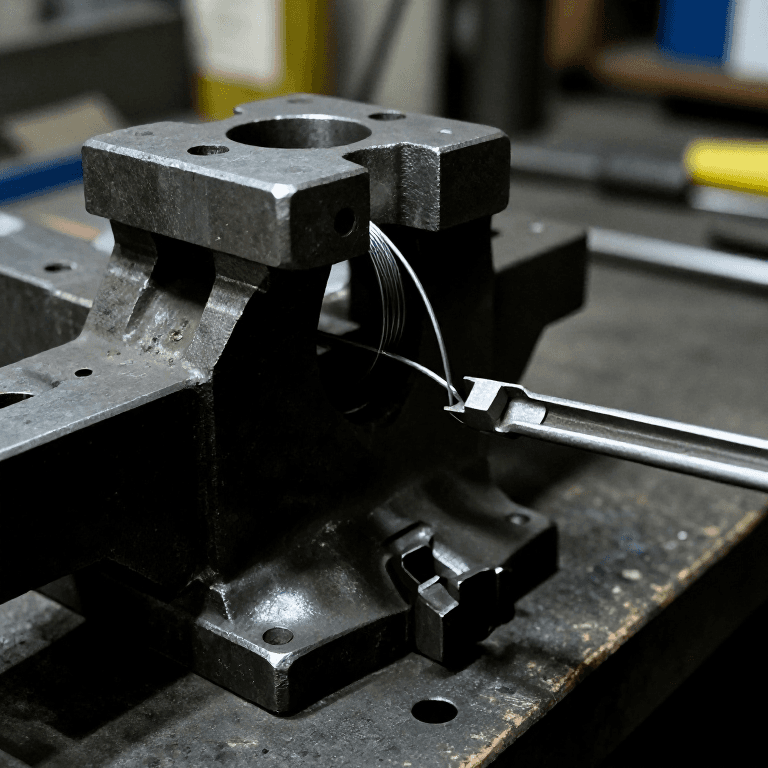
**Former.** File a flat steel strip to the eye's shape, about 6 × 2 mm, and hold it in the vice.
**Heddles.** For each heddle, fold 40 cm of stainless steel wire in half, lay the fold over the former, and twist the two legs together above and below it with pliers, forming the eye between the twists. Make a loop at each end. Make twelve.
**Spread.** Push the tips of round-nose pliers into six of the eyes and open them, stretching each eye lengthwise until its ends are nearly round and the twist beside them is drawn tight, as Brown did.
**Test.** Hang the heddles on the loom in place of six of its rigid heddle's holes, or on a string heddle bar, thread knotted yarn through them, and weave a strip, sliding the warp back and forth. Look at the yarn at the sharp-ended and the spread eyes for fraying and catching knots.
Materials for this step:
 Stainless Steel Wire5 meters
 Yarn1 piece
Tools needed:
 Bench Vise
 Files (Hand File)
 Round-nose Pliers
 Flat-Nose Pliers
 Wire Cutters
 Rigid Heddle Loom
 Digital Caliper 6-Inch
 Leather Work Gloves
5
5
Heddles that fray, twist loose or catch knots
Heddles that fray, twist loose or catch knots
Spread heddle eye troubleshooting.
Flow
Loading...
6
6
History and honest limits
History and honest limits
**Darius C. Brown** of Lowell, Middlesex County, Massachusetts, received US 64,944, dated 21 May 1867. It did not matter whether the former had round or square edges; he knew of twisted heddle-eyes with little angularity at their ends and did not claim those. His claim is the heddle eye of twisted wires afterwards spread laterally at the angles of junction so as to tighten the twist at either or both ends.
**Honest limits.** Hand-twisted stainless wire stands in for his machine-made heddles. The notebook treats the crotch as a straight wedge; its angles and yarns are examples. Your woven strip is the result.
Tools Required
8- Placeholder
- Placeholder
- Placeholder
- Placeholder
- Placeholder
- Placeholder
- Placeholder
- Placeholder
Related Blueprints
These blueprints share knowledge with this one — techniques, materials, or principles that connect them in the learning graph.

CC0 Public Domain
This blueprint is released under CC0. You are free to copy, modify, distribute, and use this work for any purpose, without asking permission.
Support the Maker by purchasing products through their Blueprint where they earn a Maker Commission set by Vendors, or create a new iteration of this Blueprint and include it as a connection in your own Blueprint to share revenue.