ART
BEAUTY & WELLNESS
CRAFT
CULTURE & HISTORY
ENTERTAINMENT
ENVIRONMENT
FOOD & DRINKS
REVERSE ENGINEERING
SCIENCES
SPORTS
TECHNOLOGY
WEARABLES

The Spring-Prong Looper: Two Springs That Take the Loop Off the Hook and Hold It Open for the Needle
In a chain-stitch machine for leather with a hooked needle rising from below, the loop must be taken off the hook and held open so the needle passes through it on the next stroke, and a slide over the hook frays the thread.
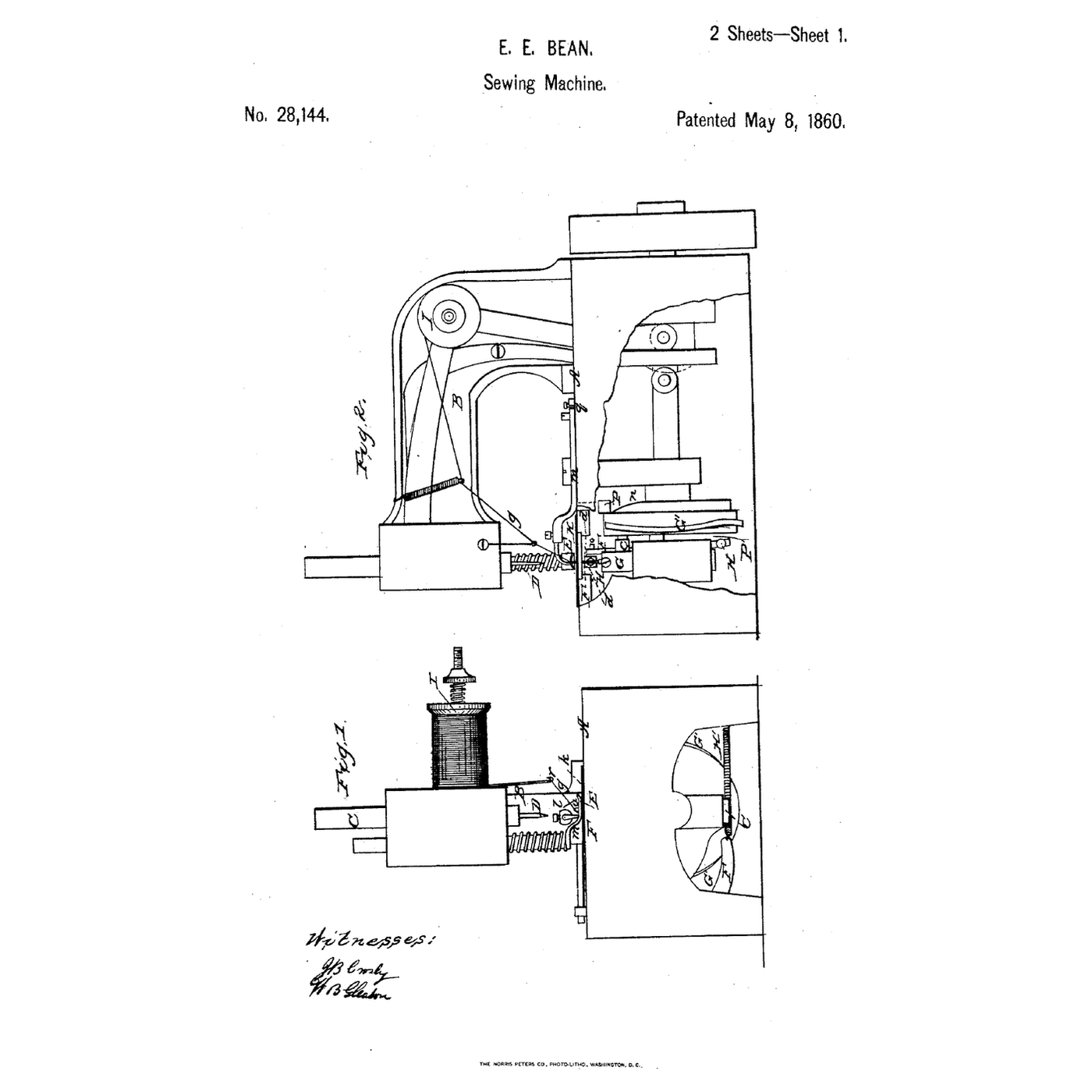
Edward E. Bean of Boston received US 28,144, dated 8 May 1860, for a looper that "consists of two flat springs, d d, and is seen particularly in Figs 9 and 10, the former of which represents the looper with its prongs sprung together, and the latter as it appears when opened by the needle." On a sliding bar below the table, it advances between the threads, rises to lift the loop from the hook, and carries it beyond the needle's path; on the next rise the needle forces the prongs apart and passes through the extended loop.
This rung works out the force the needle needs to spread the prongs, then makes a spring-prong looper on a slide, and forms a chain of loops with it and a crochet hook.
Intermediate
About 4 hours
Instructions
1
1
Spreading the prongs
Spreading the prongs
Loading Jupyter Notebook...
2
2
A looper drive before it
A looper drive before it
The embedded blueprint drives a curved needle or looper with a twisted shaft. Bean's looper is two springs on a slide that the needle itself spreads.
3
3
Read US 28,144
Read US 28,144
"The looper is shown at H. It consists of two flat springs, d d, and is seen particularly in Figs 9 and 10, the former of which represents the looper with its prongs sprung together, and the latter as it appears when opened by the needle. The springs approach at their front ends to each other, so as to form a looper point or beak, and at their opposite ends they are united to a horizontal sliding bar, e"
"Thus it will be seen that the looper-points operate to release the hook of or from its thread, and having so released it to carry it forward beyond the path of the needle in the form of a loop in such manner as that, when the needle next passes up to draw down or take another stitch, (above the table,) it shall pass through such loop"
4
4
Make the looper and form a chain
Make the looper and form a chain
**Prongs.** Cut two strips of thin spring steel 3 mm wide and 30 mm long. Rivet them together at one end to a hardwood slide, and bend their free ends toward each other so the tips touch in a point.
**Table and slide.** Fix a thin plywood plate over a box with a small hole for the hook, and run the slide in a groove under it so the looper's point passes just below the hole.
**Test.** Hold cloth on the plate. Push a crochet hook up through cloth and hole, catch the thread above, and draw it down as a loop. Advance the looper so its point enters the loop between the threads, lift it off the hook, and carry it past the hole. Push the hook up again between the prongs, spreading them, and through the held loop, catch the thread and draw it down. Repeat for a short chain, and compare with lifting the loop off the hook by hand.
Materials for this step:
 Spring Steel Strip0.1 meter
 Steel Rivets2 pieces
 Hardwood Block1 piece
 Plywood Sheet1 piece
 Wood Screws6 pieces
 Cotton Thread1 piece
 Cotton Fabric (Lightweight)1 piece
Tools needed:
 Tin Snips
 Files (Hand File)
 Needle File Set
 Rivet Set
 Cordless Drill
 Drill Bit Set
 Hand Saw
 Crochet Hook Set
 Round-nose Pliers
 Riveting Hammer
5
5
A looper that drops the loop, snags or will not open
A looper that drops the loop, snags or will not open
Spring-prong looper troubleshooting.
Flow
Loading...
6
6
History and honest limits
History and honest limits
**Edward E. Bean** of Boston, Suffolk County, Massachusetts, received US 28,144, dated 8 May 1860. His machine had an awl-feed for leather goods; the sliding bar e was worked by a lever F on a cam G′ and a spring H′; a thread-carrier l on a sliding bar m, moved by a cam n and a spring q, laid the thread against and partly round the needle. He noted a similar instrument by J. C. Seelye, applied for and rejected, worked differently. His claim is the crochet needle, thread-carrier and the looper of spring prongs operating together.
**Honest limits.** A hand-moved slide and a crochet hook stand in for his cam-driven machine, and the thread carrier is left out. The notebook treats the prongs as straight cantilevers; its sizes are examples. Your chain is the result.
Materials
7- 0.1 meterPlaceholder
- 2 piecesPlaceholder
- 1 piecePlaceholder
- 1 piecePlaceholder
- 6 piecesPlaceholder
- 1 piecePlaceholder
- 1 piecePlaceholder
Tools Required
10- Placeholder
- Placeholder
- Placeholder
- Placeholder
- 1 vendor sell this, none ship to you yetPlaceholder
- Placeholder
- Placeholder
- Placeholder
- Placeholder
- Placeholder
Related Blueprints
These blueprints share knowledge with this one — techniques, materials, or principles that connect them in the learning graph.

The Twisted-Shaft Needle Rocker: A Straight Push That Swings the Needle, Then Holds It Still
by Martin
Sewing
36
0
0
0
0
0
The Stationary-Hook Chain Stitcher: A Vibrating Needle Lays Its Loop Over a Fixed Hook
by Tex
Sewing
39
0
0
0
0
0
Crochet — The Chain Stitch and Single Crochet Foundation
by Tex
Textile & Leather
40
0
0
0
2
0
CC0 Public Domain
This blueprint is released under CC0. You are free to copy, modify, distribute, and use this work for any purpose, without asking permission.
Support the Maker by purchasing products through their Blueprint where they earn a Maker Commission set by Vendors, or create a new iteration of this Blueprint and include it as a connection in your own Blueprint to share revenue.