ART
BEAUTY & WELLNESS
CRAFT
CULTURE & HISTORY
ENTERTAINMENT
ENVIRONMENT
FOOD & DRINKS
REVERSE ENGINEERING
SCIENCES
SPORTS
TECHNOLOGY
WEARABLES
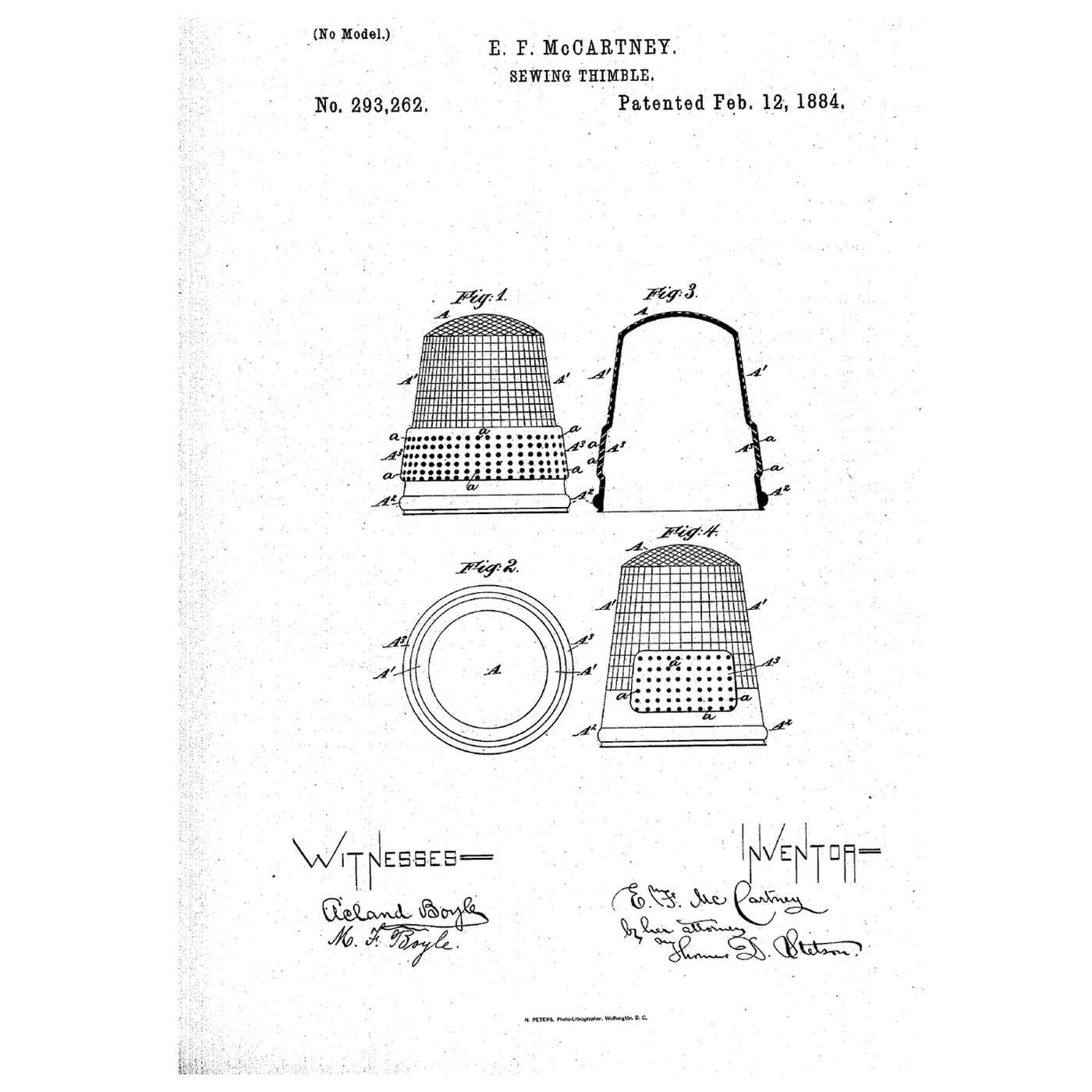


The Ventilated Thimble: A Raised Band That Spares the Nail
Anyone who sews all day with a thimble knows where it hurts: not the tip that pushes, but the root of the nail, where the rim presses hour after hour.
Elizabeth F. McCartney of Omaha, Nebraska, received US 293,262, dated 12 February 1884 (filed 3 September 1883), for a sewing-thimble meant "to more effectually relieve the root of the finger-nail from pressure, and to support the thimble in position by a sufficient bearing above and below, and also to ventilate the space thus provided, while thoroughly protecting it." A raised band stands clear of the nail root, perforated with small inclined holes the needle cannot enter.
This rung works out where the pressure lands and why the holes are safe, then compares pushing a needle through heavy cloth with and without a thimble.
Beginner
About 1 hour
Instructions
1
1
Pressure, area and safe holes
Pressure, area and safe holes
Loading Jupyter Notebook...
2
2
Sewing by hand
Sewing by hand
The embedded blueprint starts hand sewing; the thimble is what makes long seams bearable.
3
3
Read US 293,262
Read US 293,262
"The object of the invention is to more effectually relieve the root of the finger-nail from pressure, and to support the thimble in position by a sufficient bearing above and below, and also to ventilate the space thus provided, while thoroughly protecting it. The invention avoids the irritation due to pressure on the finger at and immediately adjacent to the base or root of the nail, and by sufficiently ventilating that portion of the thimble, avoids the tenderness and brittleness of the nail, which is sometimes experienced with long use of the ordinary unventilated thimbles."
"This part A3 is ventilated by holes a. These are profusely distributed over the entire area of the part A3, except the upper edge, and afford adequate ventilation. They are small and inclined, as shown. The needle will not, under any ordinary or extraordinary conditions, enter these perforations."
4
4
Push with and without
Push with and without
Stretch a piece of heavy denim or canvas in an embroidery hoop. Push a sewing needle through it twenty times with a bare fingertip against a folded cloth pad, and twenty times with a thimble, noting how it feels and how many pushes it takes.
Wear the thimble for a quarter of an hour of stitching and note where on the finger it presses. Measure the needle's eye end with a caliper and compare with the holes of any perforated thimble you have. Never push a needle with a bare fingertip hard enough to hurt.
Materials for this step:
 Sewing Thread1 piece
Tools needed:
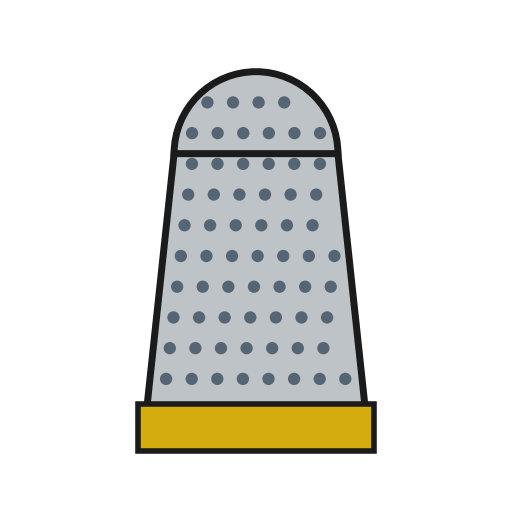 Thimble
 Sewing Needle
 Embroidery Hoop
 Digital Caliper 6-Inch
5
5
A thimble that hurts, slips or lets the needle through
A thimble that hurts, slips or lets the needle through
Thimble troubleshooting.
Flow
Loading...
6
6
History and honest limits
History and honest limits
**Elizabeth F. McCartney** of Omaha, Nebraska, filed US 293,262 on 3 September 1883; it is dated 12 February 1884. The raised band may go all the way round or only part way.
**Honest limits.** The patent gives no sizes. The push force, contact areas, needle and hole sizes in the notebook are examples.
Materials
1- 1 piecePlaceholder
Tools Required
4- Placeholder
- Placeholder
- Placeholder
- Placeholder
Related Blueprints
These blueprints share knowledge with this one — techniques, materials, or principles that connect them in the learning graph.

CC0 Public Domain
This blueprint is released under CC0. You are free to copy, modify, distribute, and use this work for any purpose, without asking permission.
Support the Maker by purchasing products through their Blueprint where they earn a Maker Commission set by Vendors, or create a new iteration of this Blueprint and include it as a connection in your own Blueprint to share revenue.