Collaboration
ART
BEAUTY & WELLNESS
CRAFT
CULTURE & HISTORY
ENTERTAINMENT
ENVIRONMENT
FOOD & DRINKS
REVERSE ENGINEERING
SCIENCES
SPORTS
TECHNOLOGY
WEARABLES
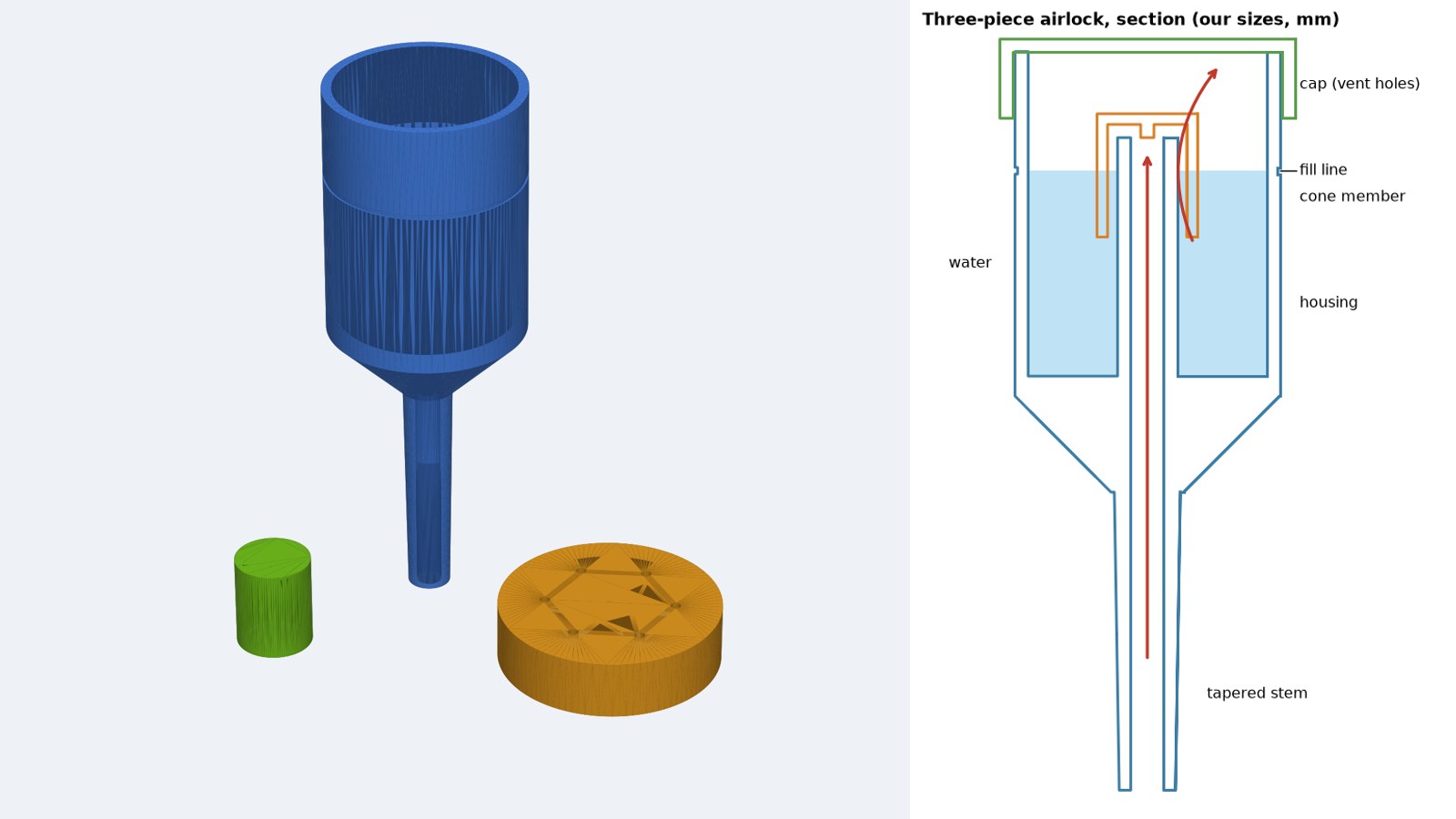


Three-Piece Airlock, 3D Printed in PETG
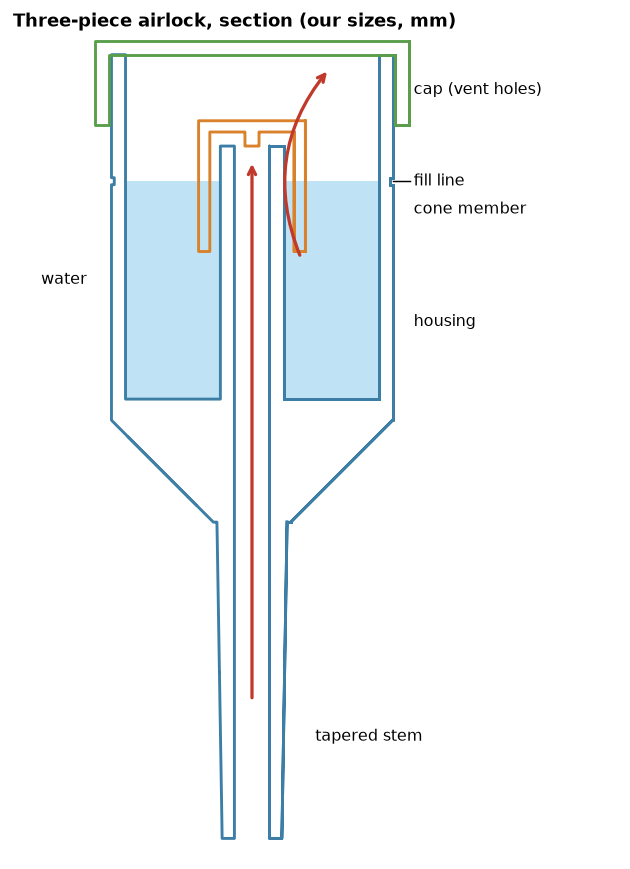
An airlock lets the carbon dioxide of a fermenting beer, wine or cider out through a little water, and keeps outside air out. This one has the four parts of the "standard type device" named in L. P. Beadle's 1980 US patent 4,218,964: a cap, a tapered stem, a housing two-thirds full of water, and a cone member. It prints in three pieces in PETG. All sizes are ours, and we have not printed or tested it yet: the leak test below comes first.
Beginner
About 5 hours, mostly printing
Instructions
1
1
Seal pressure and water back-flow
Seal pressure and water back-flow
Loading Jupyter Notebook...
2
2
Read US 4,218,964
Read US 4,218,964
"Housing 27 is filled two-thirds full with water, cone 28 is inserted and cap 25 is secured ... excess gas escapes by bubbling through the water in lock 14 so as to protect the beer ingredients within container 11 from contact with outside air." The picture is our section: gas goes up the stem, under the cone member's rim and out of the cap.
3
3
Print the housing and stem
Print the housing and stem
Stand it on the stem's tip with a 10 mm brim; the 45 degree cone under the floor needs no supports. PETG sold for food contact, a stainless steel nozzle (brass nozzles can contain lead), 0.2 mm layers, at least 4 walls so no water finds a path between the layers.
Materials for this step:
 PETG Filament15 g
Tools needed:
 FDM 3D Printer
 3D Printer Nozzle Set
4
4
Print the cone member
Print the cone member
Print it upside down, closed end on the bed. PETG sold for food contact, a stainless steel nozzle (brass nozzles can contain lead), 0.2 mm layers, at least 4 walls so no water finds a path between the layers.
Materials for this step:
PETG Filament3 gTools needed:
FDM 3D Printer3D Printer Nozzle Set5
5
Print the cap
Print the cap
Print it upside down, top on the bed. PETG sold for food contact, a stainless steel nozzle (brass nozzles can contain lead), 0.2 mm layers, at least 4 walls so no water finds a path between the layers.
Materials for this step:
PETG Filament3 gTools needed:
FDM 3D Printer3D Printer Nozzle Set6
6
Clean the parts
Clean the parts
Take off the brim. Turn a 5 mm drill bit through the stem by hand to clear any strings. Check the stem: 10.0 mm at the top, 8.5 mm at the tip.
Tools needed:
 Drill Bit Set
 Digital Caliper 6-Inch
7
7
Leak test
Leak test
Fill the housing with water to the groove. Stand it in a dry glass for an hour. Any drop on the outside or in the glass means a leak: print again.
Tools needed:
 Water
8
8
Sanitise
Sanitise
Soak all three parts in no-rinse sanitiser mixed as its label says. Do not boil them: PETG softens at about 80 °C.
Tools needed:
 SanitiserWater
9
9
Assemble and fill
Assemble and fill
Drop the cone member over the riser tube. Fill the housing to the groove with sanitiser solution, not plain water. Push the cap on.
Tools needed:
SanitiserWater10
10
Fit it to the fermenter
Fit it to the fermenter
Push the stem into the bored stopper or the lid's hole. The stem gets thinner towards the tip, so it wedges tight, as in Beadle's patent. Gas must bubble through the water, never round the stem.
Tools needed:
 Rubber Stoppers
11
11
Troubleshooting
Troubleshooting
Airlock problems and fixes.
Flow
Loading...
12
12
History and honest limits
History and honest limits
**Leigh P. Beadle**, US 4,218,964, "Lid construction for fermentation container", filed 21 May 1979, issued 26 August 1980, assigned to Specialty Products International Ltd. His invention was the lid; he calls the airlock "a standard type device" and names its parts: cap 25, tapered stem 26, housing 27 and cone member 28. He gives no sizes and no material for the lock. Ours: every size, the riser tube, the three ribs, the vent holes, the posts that stop the cone member lifting more than 3.4 mm, and PETG. Checked in CAD for fit; not yet printed or brewed with by us.
Tools Required
7- Placeholder
- Placeholder
- Placeholder
- Placeholder
- Placeholder
- Placeholder
- Placeholder
Design Files
3This blueprint makes

Related Blueprints
These blueprints share knowledge with this one — techniques, materials, or principles that connect them in the learning graph.

CC0 Public Domain
This blueprint is released under CC0. You are free to copy, modify, distribute, and use this work for any purpose, without asking permission.
Support the Maker by purchasing products through their Blueprint where they earn a Maker Commission set by Vendors, or create a new iteration of this Blueprint and include it as a connection in your own Blueprint to share revenue.