ART
BEAUTY & WELLNESS
CRAFT
CULTURE & HISTORY
ENTERTAINMENT
ENVIRONMENT
FOOD & DRINKS
REVERSE ENGINEERING
SCIENCES
SPORTS
TECHNOLOGY
WEARABLES
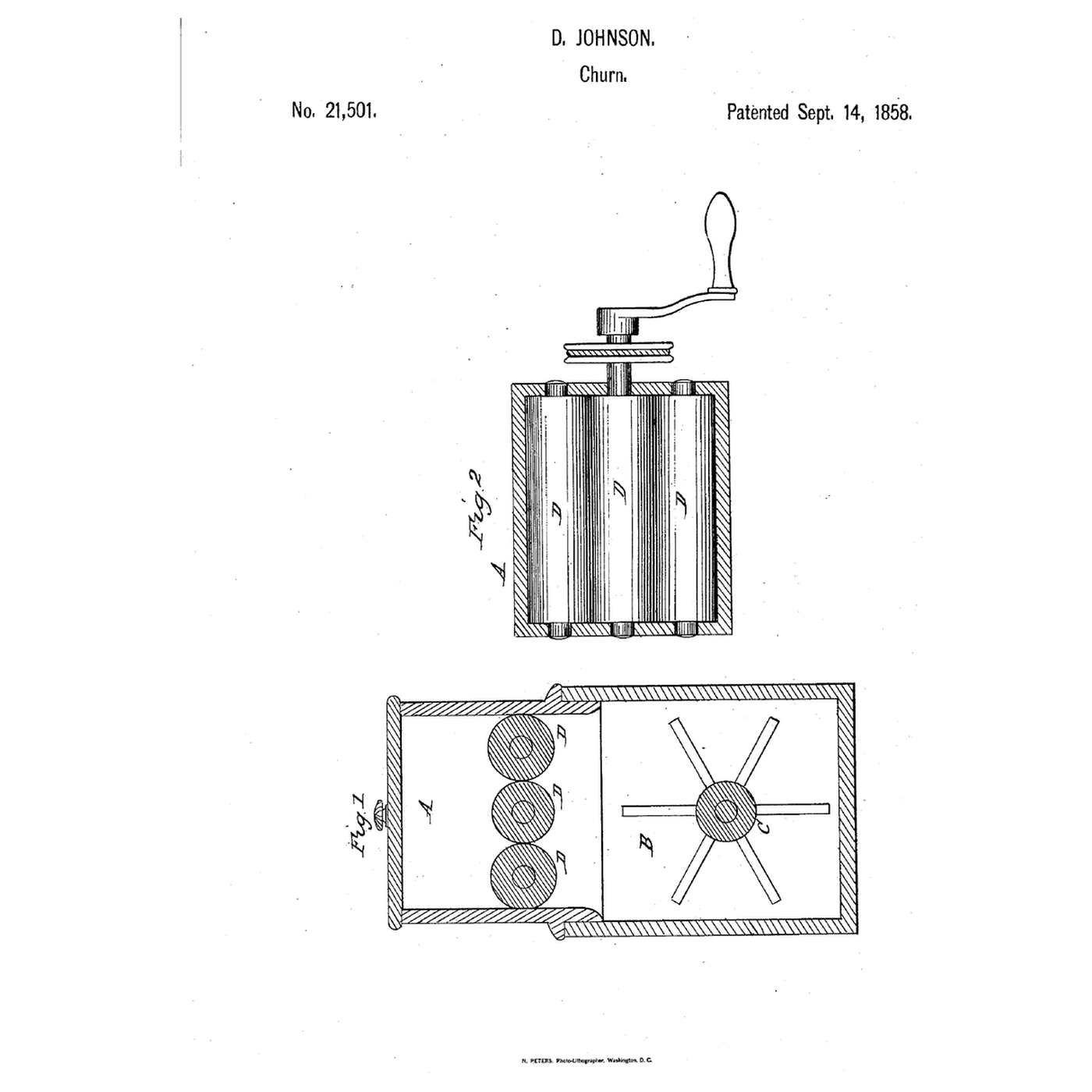


Three-Roller Pin-Agitator Churn: Cream Is Crushed Between Rollers, Then Beaten by Pins Below
Daniel Johnson of New York received US 21,501, dated 14 September 1858, for a churn in two parts: in the upper, three horizontal rollers bearing on one another crush the cream's globules as it is drawn between them; in the lower, a revolving agitator of square pins beats it the little more it needs.
This rung prints both boxes, the rollers, the pin agitator and a band drive at tabletop scale.
Advanced
About 4 hours, plus printing
Instructions
1
1
Rollers and agitator
Rollers and agitator
Loading Jupyter Notebook...
2
2
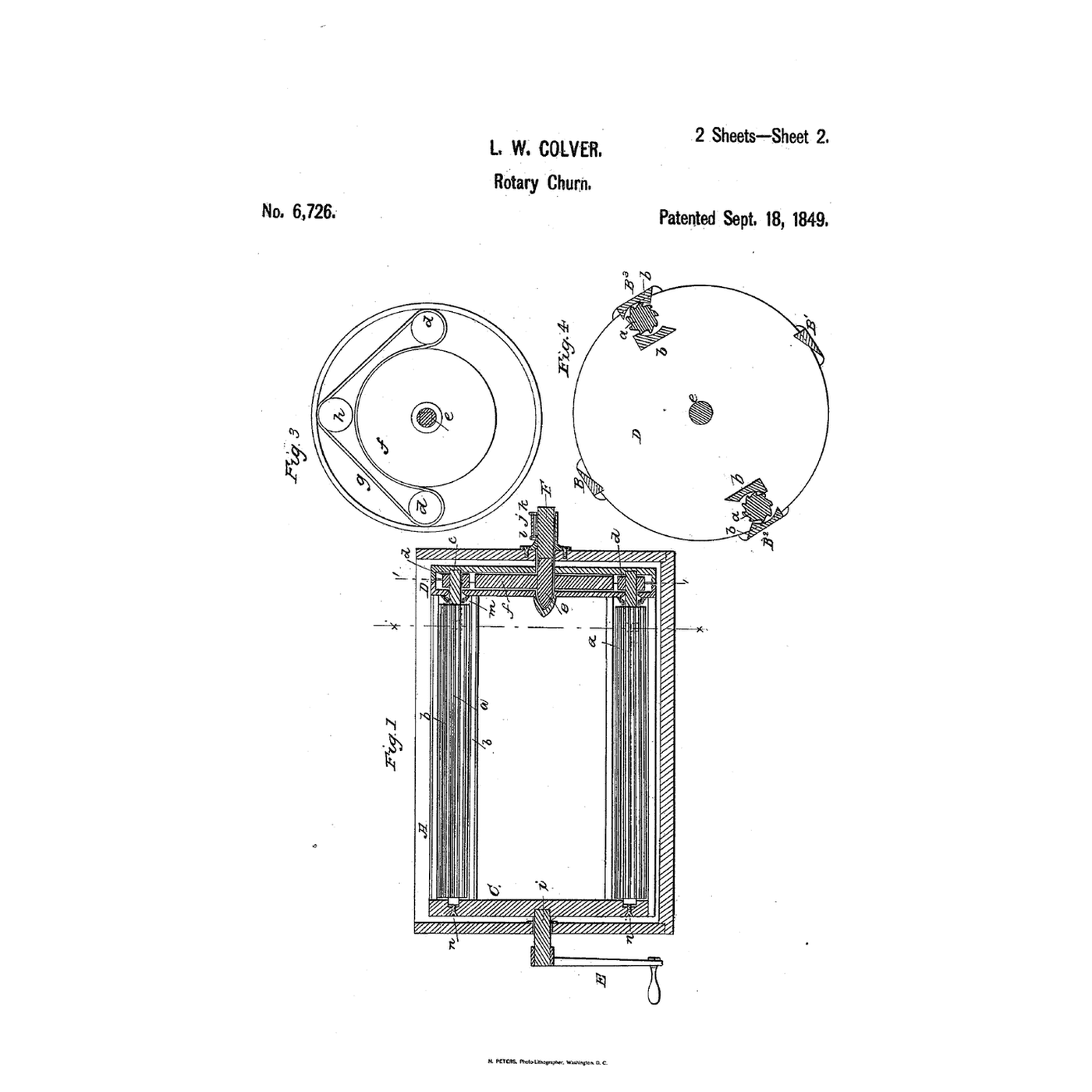
Churns with turning rollers, before it
Churns with turning rollers, before it
Those rollers worked inside the cream; Johnson's lie flat and the cream must pass between them.
3
3
Read US 21,501
Read US 21,501
"The rollers are then set in motion, the effect of which is to draw in between and compress the cream, passing it through them gradually and in detail, so that every particle is subjected to an equal action, and the globules before mentioned are instantly crushed…"
4
4
Print the parts
Print the parts
Print the lower box (/uploads/blueprints/three-roller-pin-agitator-churn-lower-box.stl), the upper box (/uploads/blueprints/three-roller-pin-agitator-churn-upper-box.stl), three rollers (/uploads/blueprints/three-roller-pin-agitator-churn-roller.stl) standing, the agitator (/uploads/blueprints/three-roller-pin-agitator-churn-agitator.stl), the large (/uploads/blueprints/three-roller-pin-agitator-churn-pulley-large.stl) and small (/uploads/blueprints/three-roller-pin-agitator-churn-pulley-small.stl) pulleys and the crank (/uploads/blueprints/three-roller-pin-agitator-churn-crank.stl). Print in PETG at 0.2 mm layers, 30 % infill, 4 walls; wash before first use.
Materials for this step:
 PETG Filament1 piece
Tools needed:
 FDM 3D Printer
5
5
Agitator and rollers
Agitator and rollers
Cut 10 mm dowels: 178 mm for the agitator, 196 mm for the middle roller and two of 162 mm for the side rollers; sand them. Pass the agitator's dowel through the lower box's end walls and the agitator, fixing it with an M3 screw drilled through. Pass each roller's dowel through the upper box's end walls and its roller, the long one in the middle, so the three rollers touch along their length.
Materials for this step:
 Hardwood Dowels1 piece
 Machine Screws1 piece
Tools needed:
 Hand Saw
 Sandpaper
 Hand Drill
 Screwdriver Set
6
6
Band and crank
Band and crank
Set the upper box on the lower. Fix the large pulley on the middle roller's dowel and the small one on the agitator's, both outside the same end, with M3 screws; tie a loop of cotton twine tightly round them as the band. Fix the crank on the middle roller's dowel outside the pulley.
Materials for this step:
Machine Screws1 piece Cotton Twine1 piece
Tools needed:
Hand DrillScrewdriver Set7
7
The build in 3D
The build in 3D
FreeCAD model of this build: the lower box with the pin agitator, the upper box with three touching rollers, the band pulleys and the crank; the near halves of the boxes are left off to show the inside.
8
8
Churn
Churn
Pour 1 litre of heavy cream at about 15 °C, checked with the thermometer, into the upper box: the touching rollers hold it. Turn the crank steadily and time it with the stopwatch: the rollers draw the cream down between them into the lower box, where the agitator beats it. When the butter comes, lift the upper box off, pour off the buttermilk, wash the butter in cold water until it runs clear, work in a pinch of salt and weigh it.
Materials for this step:
 Heavy Cream1 l
 Coarse Sea Salt1 piece
 Water1 piece
Tools needed:
 Leave-In Probe Thermometer
 Stopwatch
 Digital Kitchen Scale
 Stainless Steel Mixing Bowl (Large)
9
9
Troubleshooting
Troubleshooting
Roller churn troubleshooting.
Flow
Loading...
10
10
History and honest limits
History and honest limits
**Daniel Johnson** of New York, US 21,501, 14 September 1858. He set the rollers horizontal so the cream passes them once and is not heated by long friction, as it is between upright rollers. The tightness of his rollers could be set by placing the middle one a trifle above or below the others, and they could be geared instead of turned by friction; he allowed more rollers, more than one tier, and more or fewer beaters. He claimed two or more horizontal rollers touching or nearly touching, with a revolving dasher under them in the same box. Our rollers are fixed in place; our boxes, sizes and band are ours. FDM prints hold food in their layer lines, so wash well and replace when worn.
Materials
7- 1 piecePlaceholder
- 1 piecePlaceholder
- 2 piecesPlaceholder
- 1 piecePlaceholder
- 1 lPlaceholder
- 1 piecePlaceholder
- 1 piecePlaceholder
Tools Required
9- Placeholder
- Placeholder
- Placeholder
- Placeholder
- Placeholder
- Placeholder
- Placeholder
- Placeholder
- Placeholder
Design Files
1Related Blueprints
These blueprints share knowledge with this one — techniques, materials, or principles that connect them in the learning graph.

CC0 Public Domain
This blueprint is released under CC0. You are free to copy, modify, distribute, and use this work for any purpose, without asking permission.
Support the Maker by purchasing products through their Blueprint where they earn a Maker Commission set by Vendors, or create a new iteration of this Blueprint and include it as a connection in your own Blueprint to share revenue.