Collaboration
ART
BEAUTY & WELLNESS
CRAFT
CULTURE & HISTORY
ENTERTAINMENT
ENVIRONMENT
FOOD & DRINKS
REVERSE ENGINEERING
SCIENCES
SPORTS
TECHNOLOGY
WEARABLES
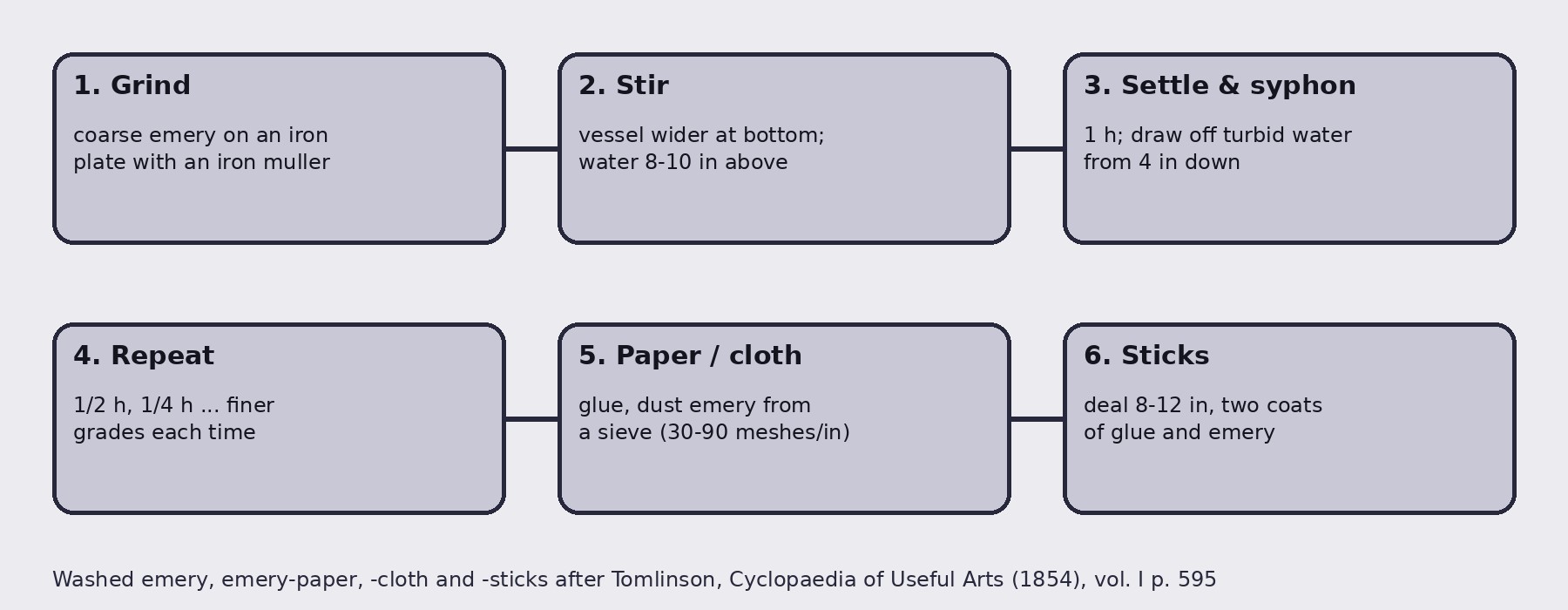


Washed Emery Graded by Settling Time, and Emery Paper, Cloth and Sticks (Tomlinson, 1854)
From Tomlinson's Cyclopaedia of Useful Arts (1854): emery ground on an iron plate and graded by how long it stays in suspension (Chezy's method: settle, syphon off, repeat for an hour, half an hour, a quarter...), then glued onto paper, thin cotton cloth or deal sticks to make emery-paper, emery-cloth and emery-sticks.
Intermediate
About 2 days
Instructions
1
1
Grades
Grades
Loading Jupyter Notebook...
2
2
Read the Cyclopaedia of Useful Arts
Read the Cyclopaedia of Useful Arts
"Mr. Chezy prepared very fine emery for optical purposes in the following manner."
3
3
Grind
Grind
Grind coarse emery well on an iron plate with an iron muller (break lumps first in a mortar).
Materials for this step:
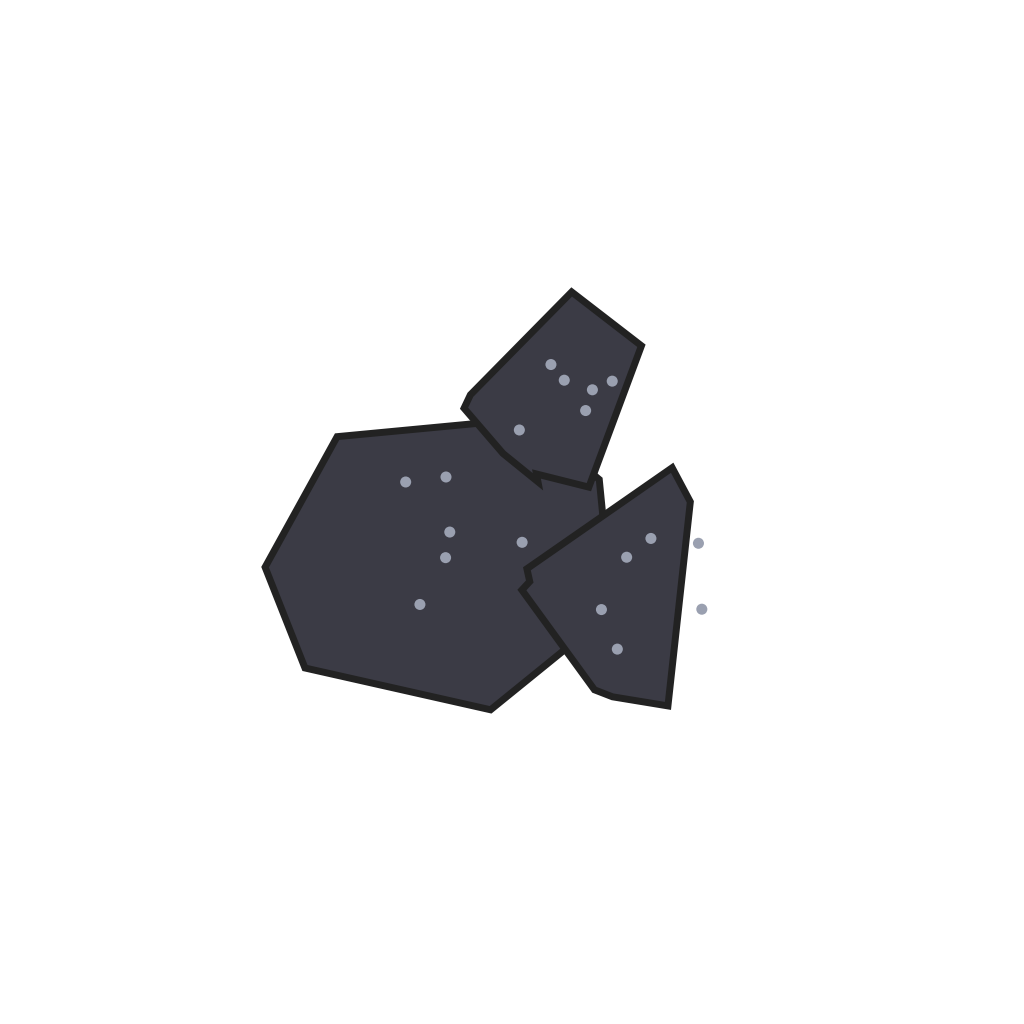 Emery Rock1 piece
Tools needed:
 Mortar and Pestle
 Iron Plate
 Muller
4
4
Wash by settling
Wash by settling
Put it in a vessel rather wider at the bottom than the top, fill with clear water to 8 or 10 in above the emery, stir hard with an iron spatula and let it settle an hour. Put the short branch of a syphon 4 in below the surface and draw the turbid water into another vessel without disturbing the first; refill, stir and repeat until the water runs clear. (That first powder is too fine for grinding glass.) Repeat with the remaining emery, drawing off after half an hour: the deposit in the second vessel is 'emery of half-an-hour'; then a quarter of an hour, and so on down to half or a quarter of a minute. Dry each grade.
Tools needed:
 20-Liter Bucket
 Siphon Tube
5
5
Emery-paper and emery-cloth
Emery-paper and emery-cloth
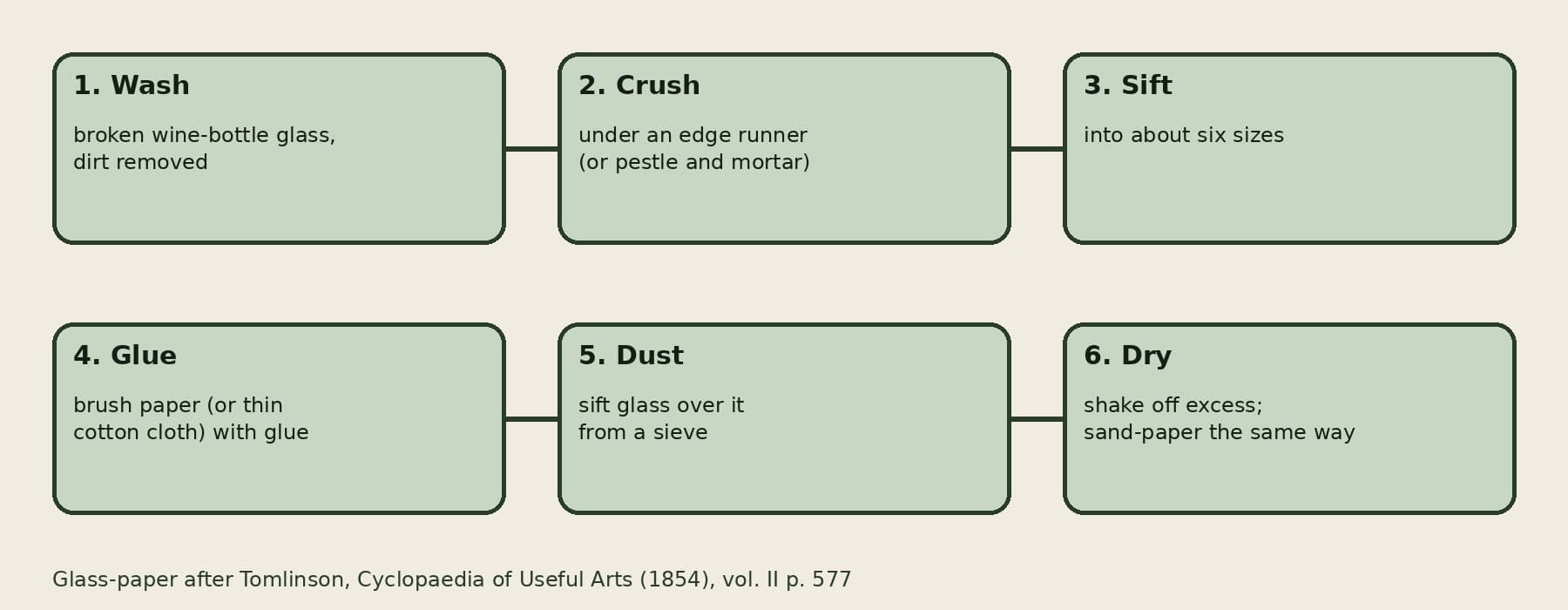
Brush paper over with thin glue and dust the emery over it from a sieve; there are about six degrees, sieves of 30 and 90 meshes per linear inch giving the coarsest and finest. Emery-cloth is the same on thin cotton cloth instead of paper (it lasts longer in the hand, though it does not wrap a file so readily).
Materials for this step:
 Kraft Paper Roll (Brown)1 piece
 Cotton Cloth1 piece
 Animal Glue1 piece
Tools needed:
 Glue Brush
 Sieve Set (Graded Mesh)
 Large Cooking Pot
6
6
Emery-sticks
Emery-sticks
Plane deal rods 8 to 12 in long, square or with one side rounded, drive a nail into each end as handles, brush with thin glue, dab all over in a heap of emery and knock on one end to shake off the excess. Give two coats.
Materials for this step:
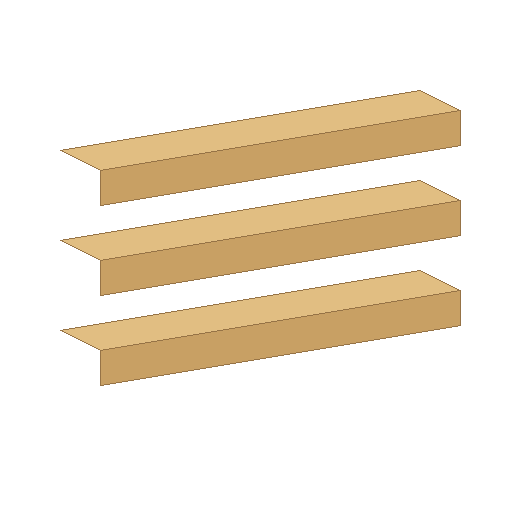 Softwood Batten1 pieceAnimal Glue1 piece
Tools needed:
 Hand Plane
 Hand SawGlue Brush
 Hammer
7
7
Troubleshooting
Troubleshooting
Emery troubleshooting.
Flow
Loading...
8
8
History and honest limits
History and honest limits
From Charles Tomlinson (ed.), **Cyclopaedia of Useful Arts** (1854), vol. I, "Emery" (checked on the archive.org scan cyclopaediaofuse01tomluoft, p. 595). The tools and the diagram are ours.
Materials
5- 1 piecePlaceholder
- 1 piecePlaceholder
- 1 piecePlaceholder
- 1 piecePlaceholder
- 1 piecePlaceholder
Tools Required
11- Placeholder
- Placeholder
- Placeholder
- Placeholder
- Placeholder
- Placeholder
- Placeholder
- Placeholder
- Placeholder
- Placeholder
- Placeholder
This blueprint makes


Related Blueprints
These blueprints share knowledge with this one — techniques, materials, or principles that connect them in the learning graph.
CC0 Public Domain
This blueprint is released under CC0. You are free to copy, modify, distribute, and use this work for any purpose, without asking permission.
Support the Maker by purchasing products through their Blueprint where they earn a Maker Commission set by Vendors, or create a new iteration of this Blueprint and include it as a connection in your own Blueprint to share revenue.