ART
BEAUTY & WELLNESS
CRAFT
CULTURE & HISTORY
ENTERTAINMENT
ENVIRONMENT
FOOD & DRINKS
REVERSE ENGINEERING
SCIENCES
SPORTS
TECHNOLOGY
WEARABLES
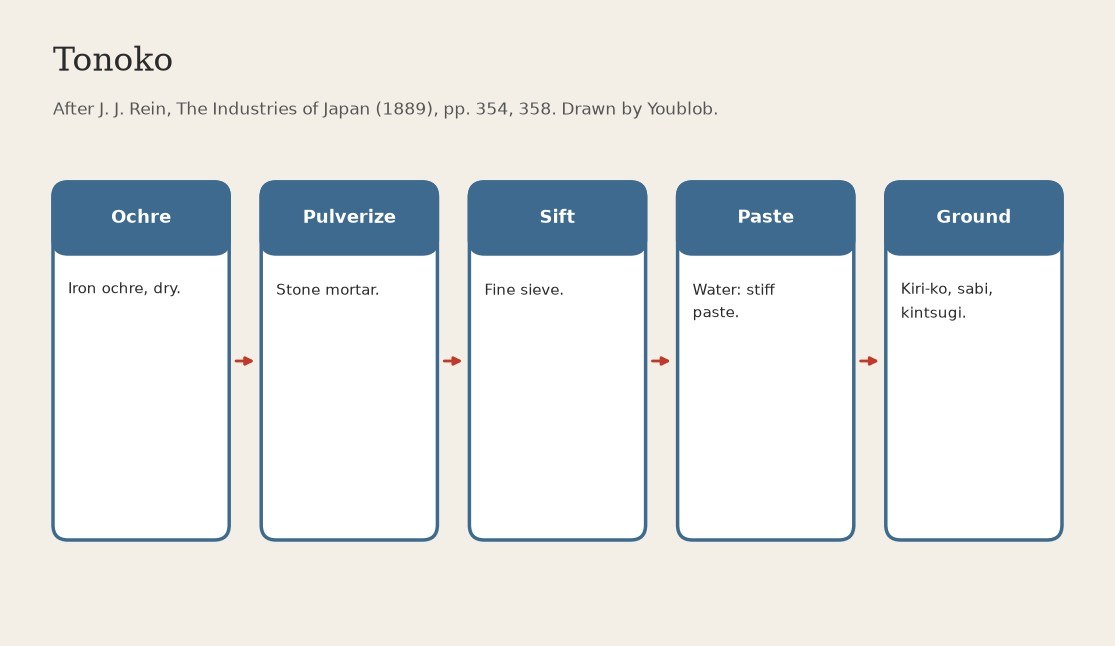


Tonoko: Iron Ochre Pulverized for Japanese Lacquer Groundwork (after Rein 1889)
Japanese lacquerers build a hard ground under the lacquer from a powder they call to-no-ko. Rein, who studied the workshops in the 1870s, names it plainly: iron ochre powder. Stirred with water to a stiff paste and tempered with raw lacquer, it becomes the kiri-ko and sabi grounds, and the sabi putty of kintsugi.
Result: tonoko, iron ochre ground to a fine powder.
Source: J. J. Rein, The Industries of Japan (1889), pp. 354 and 358. Rein says only 'pulverized'; mortar and sieve are ours. Picture drawn by Youblob.
Beginner
2 hours
Instructions
1
1
Pulverize the ochre
Pulverize the ochre
Crush and grind dry iron ochre in a stone mortar. Ours: until it is a fine, even powder.
Materials for this step:
 Raw Ochre1 as required
Tools needed:
 Stone Mortar and Pestle
2
2
Sift fine
Sift fine
Ours: pass the powder through a fine sieve and grind the coarse rest again. Keep it dry in a closed jar.
Tools needed:
 Fine Sieve
 Glass Jars with Lids
3
3
Check: a stiff paste
Check: a stiff paste
A little stirred with water should make a smooth, stiff paste, as for kiri-ko, where it is then tempered with raw lacquer, a little brick dust and paste.
Tools needed:
 Water
Tools Required
4- Placeholder
- Placeholder
- Placeholder
- Placeholder
This blueprint makes

CC0 Public Domain
This blueprint is released under CC0. You are free to copy, modify, distribute, and use this work for any purpose, without asking permission.
Support the Maker by purchasing products through their Blueprint where they earn a Maker Commission set by Vendors, or create a new iteration of this Blueprint and include it as a connection in your own Blueprint to share revenue.