ART
BEAUTY & WELLNESS
CRAFT
CULTURE & HISTORY
ENTERTAINMENT
ENVIRONMENT
FOOD & DRINKS
REVERSE ENGINEERING
SCIENCES
SPORTS
TECHNOLOGY
WEARABLES
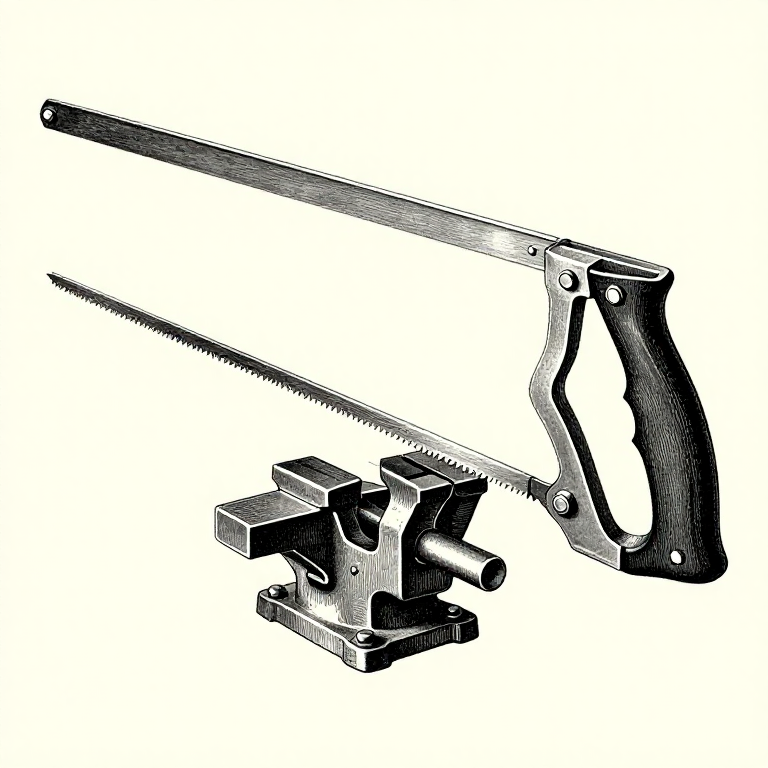


The Hacksaw: Blade Tension, TPI, and the Three-Tooth Rule
A hacksaw blade is a thin flexible strip that only works because the frame pulls it tight. Slack, it wanders and snaps; properly tensioned, it cuts straight and lasts.
The second thing that decides everything is the tooth pitch against the thickness of what you are cutting. At least three teeth must be in contact at all times, or the material drops between them, catches on one tooth, and strips it off. A coarse blade on thin tube destroys itself in seconds and it is not obvious why.
Those two rules cover almost every hacksaw failure, and both take five seconds to check.
Beginner
2 hours
Instructions
1
1
Fit the blade teeth-FORWARD, and tension it hard
Fit the blade teeth-FORWARD, and tension it hard
A hacksaw cuts on the PUSH stroke, so the teeth point away from the handle. Fitted backwards it will rub, heat up and cut almost nothing, and it is a surprisingly common mistake because the blade goes in just as easily either way.
Tighten the wing nut until the blade rings when you pluck it — genuinely tight, far tighter than feels reasonable. A hacksaw blade is designed to be tensioned to a high load and the frame is built for it.
A slack blade twists in the cut, so the kerf wanders, and the twisting is what snaps blades. If your cuts come out curved or your blades keep breaking, tension is the first thing to check and it is usually the answer.
Tools needed:
 Hacksaw Frame with Blades
 Hacksaw
 Clear Safety Glasses
2
2
The three-tooth rule
The three-tooth rule
Loading Jupyter Notebook...
Tools needed:
Hacksaw Frame with Blades Calculator
 Vernier Caliper
3
3
Long slow strokes, and the whole blade
Long slow strokes, and the whole blade
Aim for around fifty strokes a minute — slower than feels natural. A hacksaw blade is hardened and it loses its temper if it gets hot, so speed is genuinely counterproductive.
Use the full length of the blade. Working in the middle third wears out those teeth while the ends stay sharp, and once the middle is blunt the blade is useless even though most of it has never cut anything.
Press on the push stroke and lift slightly on the return, as with a file and for the same reason: the teeth cut one way only and dragging them back under load wears them for nothing. A little cutting oil on steel helps; aluminium prefers paraffin; do not oil a blade cutting cast iron.
Materials for this step:
 Mild Steel Bar1 piece
Tools needed:
Hacksaw Frame with Blades Heavy Bench ViceClear Safety Glasses
 Cutting Oil
4
4
Hold it close to the cut
Hold it close to the cut
Clamp the work in the vice so the cut line is within a centimetre or two of the jaws. Anything standing further out chatters, and chatter breaks teeth and wanders the cut.
For tube, use a piece of wood with a V cut in it, or wrap the tube in a scrap of sheet, so the vice does not crush it. A crushed tube is out of round permanently and often will not take its fitting.
Never finish a cut with the offcut unsupported. The last few strokes it hangs by a thread, snaps, and the ragged tear it leaves has to be filed off — and on a heavy piece it lands on your foot. Support it with your free hand or a block.
Materials for this step:
 Hardwood Board1 piece
 Mild Steel Plate1 piece
Tools needed:
Heavy Bench ViceHacksaw Frame with BladesClear Safety GlassesMaterials
3- 1 piecePlaceholder
- 1 piecePlaceholder
- 1 piecePlaceholder
Related Blueprints
These blueprints share knowledge with this one — techniques, materials, or principles that connect them in the learning graph.

CC0 Public Domain
This blueprint is released under CC0. You are free to copy, modify, distribute, and use this work for any purpose, without asking permission.
Support the Maker by purchasing products through their Blueprint where they earn a Maker Commission set by Vendors, or create a new iteration of this Blueprint and include it as a connection in your own Blueprint to share revenue.