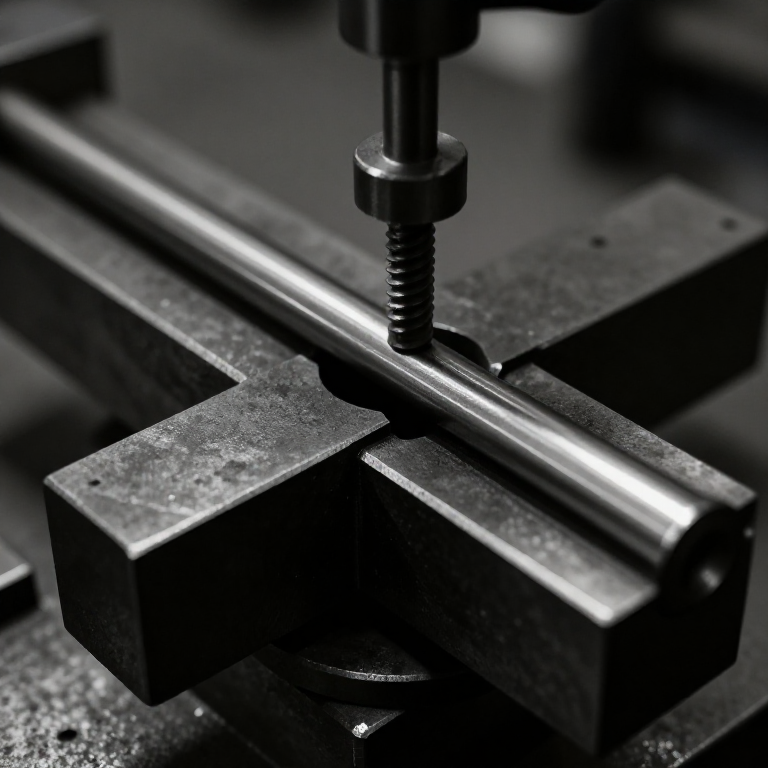


V-Block and Clamp
Instructions
Cut the V at exactly 90 degrees
Cut the V at exactly 90 degrees
The included angle is the one thing that must be right.
- Cut a block 100 × 70 × 18 mm from Baltic birch plywood.
- Mark the V on both ends: 45 degrees from vertical on each side, meeting on the centreline.
- Cut both faces, staying proud of the line.
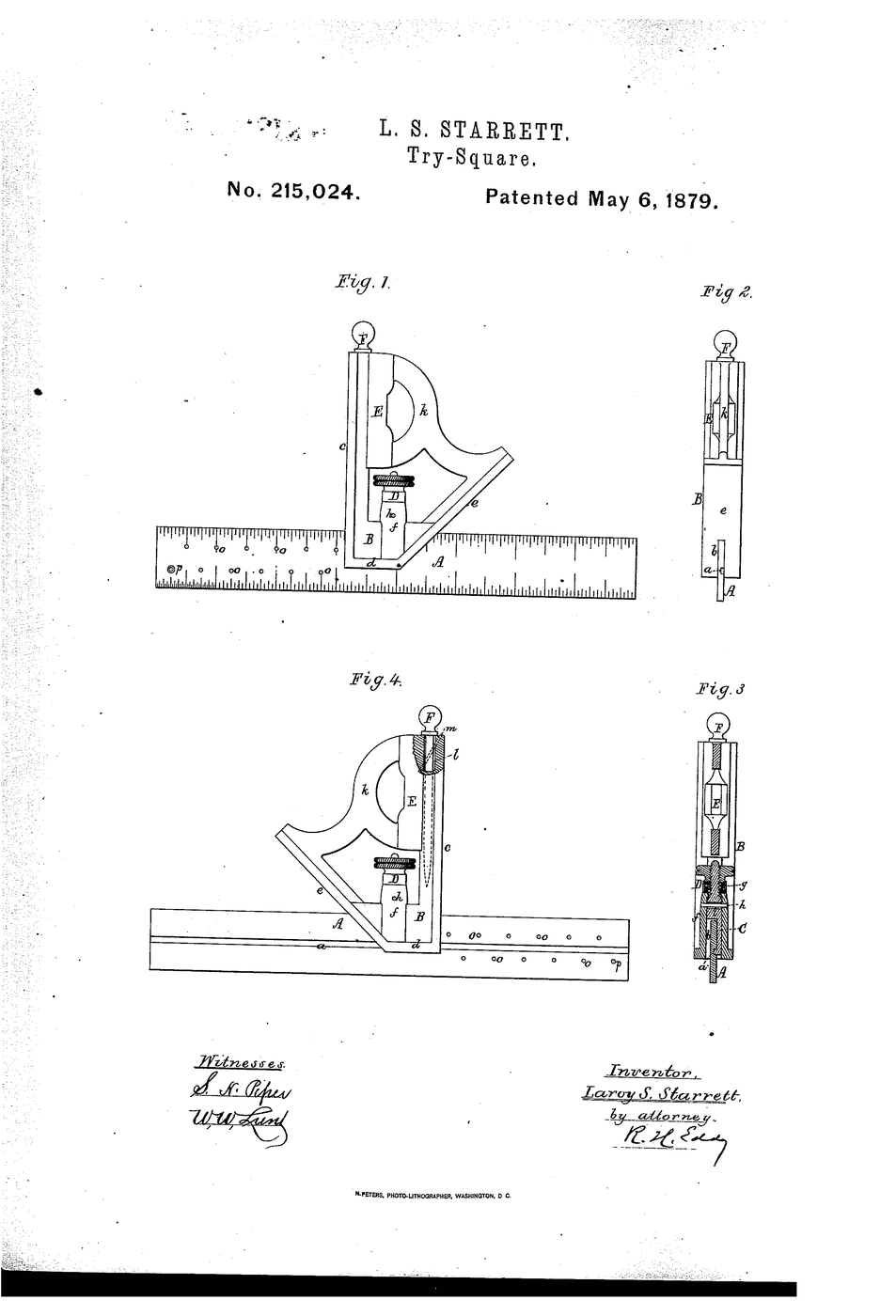
- File flat and check with the combination square's 45 degree face against each side in turn.
Why 90 degrees specifically. With a 90 degree V, the height of a bar's centre above the block's base changes with diameter in a simple, predictable way, and the bar sits on two contact lines exactly 45 degrees either side of vertical — so the clamping force from directly above passes symmetrically into both faces. Other angles work but lose that symmetry.
Check each face separately against the square rather than measuring the total 90. Two faces at 40 and 50 degrees also make 90, and the bar will then sit off the centreline.Materials for this step:
 Baltic Birch Plywood (3/4 inch, 24x30)1 sheet
Tools needed:
 Coping Saw
 File Set
 Combination Square
 Bench Vise
 Digital Caliper 6-Inch
Face the V with aluminium
Face the V with aluminium
Plywood crushes under a steel bar. Metal faces keep the geometry.
- Cut two strips of 6 mm aluminium flat bar to fit each V face, about 100 × 30 mm.
- Drill each for two countersunk fixings, 4.2 mm.
- Countersink so the screw heads sit BELOW the face — a proud head becomes the contact point and destroys the centring.
- Fix with M4 × 20 flat head machine screws × 4 and M4 hex nuts × 4.
- File the leading edges flush where the two plates meet at the bottom of the V.
Materials for this step:
 Aluminum Flat Bar (1x1/4 inch, 36-inch)1 piece
 M4 Flat Head Machine Screw4 pieces
 M4 Hex Nut4 pieces
Tools needed:
 Cordless Drill/Driver (20V)
 Drill Bit Set
 Countersink Drill Bit Set (5-Piece)
 Hacksaw Frame with Blades (10-Pack)File Set
 Allen/Hex Key Set
Make the U-clamp
Make the U-clamp
A yoke straddling the block, with one screw pressing down on the bar.
- Cut a U from 6 mm aluminium flat bar to straddle the block with 2 mm clearance each side.
- Drill and tap the centre of the U's top for M8, or drill 8.5 mm clear and fix an M8 hex nut above it as the thread.
- Fit an M8 × 60 hex bolt as the clamping screw with a swivelling pressure pad on its end.
- Slot the U's legs so it can slide up and down the block, retained by M5 × 30 socket head cap screws × 2, M5 flat washers × 4 and M5 hex nuts × 2.
The pressure pad matters. A bare screw end spins against the workpiece and marks it, and a rotating point contact walks the bar sideways as you tighten. A loose pad turns rotation into pure downward force.
M8 rather than M4 or M5 here because this fastener is doing real mechanical work rather than holding parts together — thread size follows the load, not the rest of the build.Materials for this step:
Aluminum Flat Bar (1x1/4 inch, 36-inch)1 piece M5 Flat Washer4 piecesM5 Hex Nut2 pieces
Tools needed:
Bench ViseCordless Drill/Driver (20V)Drill Bit SetHacksaw Frame with Blades (10-Pack)File SetAllen/Hex Key SetProve the centring property
Prove the centring property
The claim is that diameter does not matter. Test it.
- Clamp a 12 mm round bar in the V and scribe a line down its top using the surface of the block as reference.
- Roll the bar 180 degrees, scribe again. The two lines should coincide.
- Repeat with a 25 mm bar without changing anything else.
- Drill a small hole on the scribed line in each and check it emerges centred on the far side.
Materials for this step:
 Aluminum Round Bar1 piece
Tools needed:
 Center PunchCordless Drill/Driver (20V)Drill Bit SetCombination SquareDigital Caliper 6-Inch
Why it is shaped this way, and history
Why it is shaped this way, and history
The V-block is a fixture, not a tool — it holds nothing itself and cuts nothing. What it does is remove degrees of freedom. A round bar lying loose has five ways to move; the V takes away four of them and the clamp takes the fifth. Thinking about workholding as the systematic removal of freedoms is the idea behind every jig and fixture ever designed.
Why V-blocks come in matched pairs. A long shaft needs support at two points, and if the two blocks are not identical the shaft is held crooked. Commercial blocks are machined and ground as a pair from one setup and stamped with a matching number for that reason — the pair is the instrument, not the individual block.
What it does that its neighbours cannot: a bench vise holds flat work firmly but rolls round stock and centres nothing. A three-jaw chuck centres round stock beautifully but only on a rotating spindle. An angle plate presents a face at 90 degrees but cannot cradle a cylinder. Each removes a different set of freedoms, which is why a workshop needs all of them rather than the best one.
Its honest limits: the V-block centres in ONE plane only — the bar's height above the base still changes with diameter, so it does not set a centre HEIGHT. It handles a limited diameter range: too small and the bar sits at the bottom of the V where the faces are least accurate, too large and it rides on the block's top corners. And plywood faced with aluminium is a demonstration piece; sustained use wants hardened, ground steel.
Materials
7- 1 sheetPlaceholder
- Placeholder
- Placeholder
- 4 piecesPlaceholder
- 4 piecesPlaceholder
- 2 piecesPlaceholder
- 1 piecePlaceholder
Tools Required
11- Placeholder
- Placeholder
- Placeholder
- Placeholder
- Placeholder
- 1 vendor sell this, none ship to you yetPlaceholder
- Placeholder
- Placeholder
- Placeholder
- Placeholder
- Placeholder
This blueprint makes

Related Blueprints
These blueprints share knowledge with this one — techniques, materials, or principles that connect them in the learning graph.
CC0 Public Domain
This blueprint is released under CC0. You are free to copy, modify, distribute, and use this work for any purpose, without asking permission.
Support the Maker by purchasing products through their Blueprint where they earn a Maker Commission set by Vendors, or create a new iteration of this Blueprint and include it as a connection in your own Blueprint to share revenue.