ART
BEAUTY & WELLNESS
CRAFT
CULTURE & HISTORY
ENTERTAINMENT
ENVIRONMENT
FOOD & DRINKS
REVERSE ENGINEERING
SCIENCES
SPORTS
TECHNOLOGY
WEARABLES
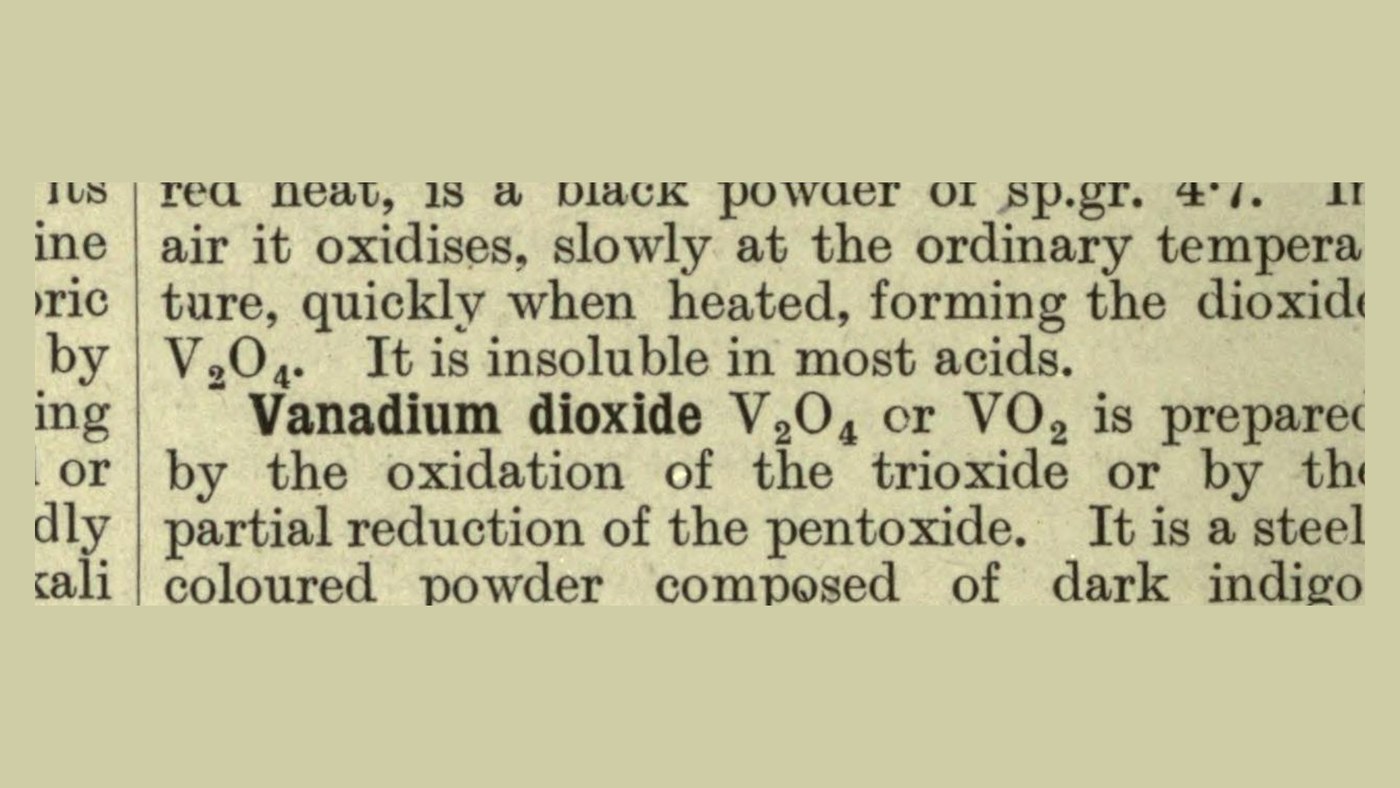


Vanadium Trioxide: the Pentoxide Reduced with Carbon at Red Heat (Thorpe, 1913)
Vanadium trioxide, a black powder, made by heating vanadium pentoxide with carbon to a red heat. It is the oxide Gin reduced with ferro-silicon to make ferro-vanadium.
Hot trioxide takes up oxygen quickly and turns back to the dioxide, so it is kept out of the air while hot.
Source: T. E. Thorpe, Dictionary of Applied Chemistry vol. V (1913), p. 610. Picture: the book's text.
Intermediate
Unknown
Instructions
1
1
Mix pentoxide and carbon
Mix pentoxide and carbon
Grind vanadium pentoxide with carbon. Proportions are not given.
Materials for this step:
 Vanadium Oxide1 piece
 Carbon1 piece
Tools needed:
 Mortar and Pestle
2
2
Reduce at red heat
Reduce at red heat
Heat the mixture in a crucible to a red heat; the pentoxide is reduced to the trioxide, a black powder.
Tools needed:
 Crucible
 Muffle Furnace
3
3
Cool out of air
Cool out of air
In air the trioxide oxidises slowly when cold and quickly when hot, forming the dioxide (Thorpe); so cool it with the crucible covered (our step).
Tools needed:
CrucibleConnected Blueprint Materials
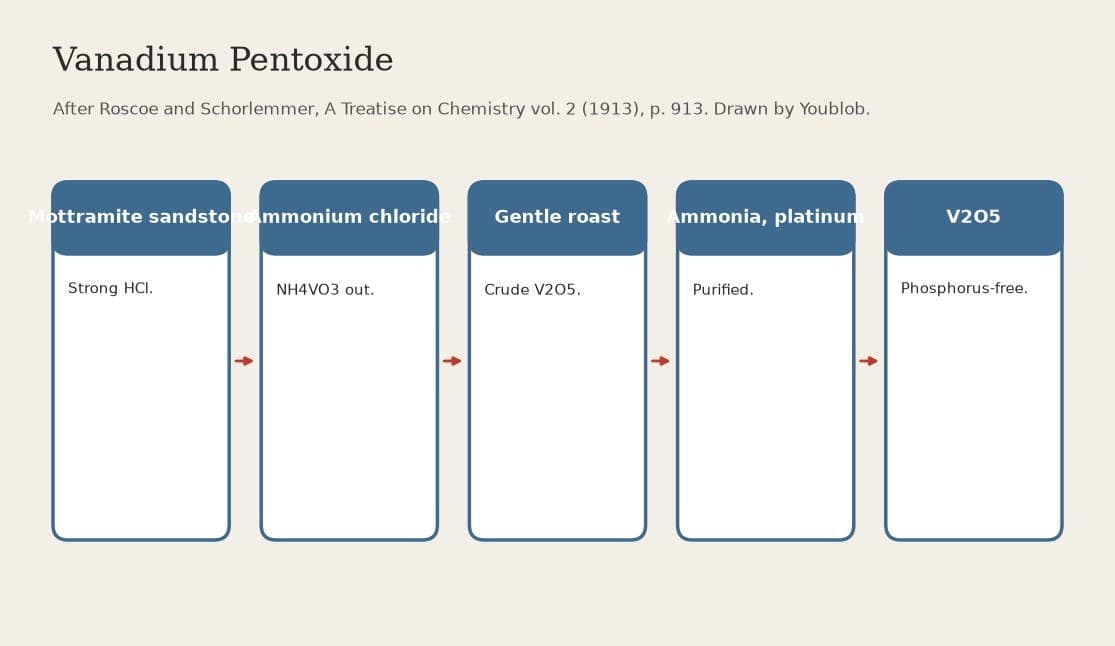
This blueprint makes

CC0 Public Domain
This blueprint is released under CC0. You are free to copy, modify, distribute, and use this work for any purpose, without asking permission.
Support the Maker by purchasing products through their Blueprint where they earn a Maker Commission set by Vendors, or create a new iteration of this Blueprint and include it as a connection in your own Blueprint to share revenue.