ART
BEAUTY & WELLNESS
CRAFT
CULTURE & HISTORY
ENTERTAINMENT
ENVIRONMENT
FOOD & DRINKS
REVERSE ENGINEERING
SCIENCES
SPORTS
TECHNOLOGY
WEARABLES
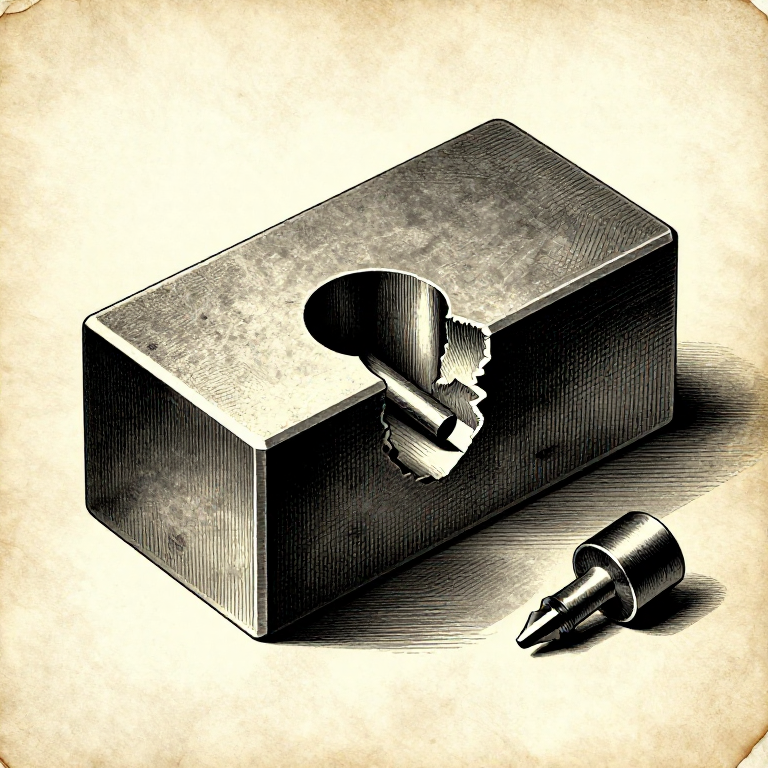


When a Tap Breaks: Getting It Out, and Not Doing It Again
A tap is glass-hard and completely brittle. It does not bend before it breaks, it gives no warning, and when it goes it leaves a piece of the hardest steel in the workshop jammed inside the part you have spent hours making.
A drill will not touch it, because the tap is harder than the drill. That is the whole difficulty, and it is why the honest answer to most broken taps is that the hole, and sometimes the part, is lost.
So this rung is two-thirds prevention. The removal methods are real and worth knowing, but every one of them is slower and less certain than the five seconds of care that would have avoided it.
Advanced
3 hours
Instructions
1
1
The five causes, in order of how often they do it
The five causes, in order of how often they do it
One: the tapping drill was too small, so the tap is being asked to cut far more metal than it was designed to. Two: the chip was never broken — no quarter-turn back — so it packed solid. Three: a blind hole bottomed out. Four: the tap was started crooked and then forced. Five: sideways pressure, usually from a spanner on the square instead of a tap wrench.
Every one of those is a decision made before the break, and four of them are made before the tap even enters the hole.
The small sizes break most. An M3 tap will snap under a force you would not notice applying, and below M4 the sensible approach is a tapping stand or a pillar drill used as a guide by hand, never a wrench swung freely.
Tools needed:
 Tap and Die Set
 Tap Wrench
 Drill Bit Set
2
2
If it is proud of the surface, you are in luck
If it is proud of the surface, you are in luck
A tap broken off above the work can often be gripped and wound out. Lock a pair of grips or a small pin vice onto the stub and turn it gently backwards — gently, because what is left in the hole is even easier to break again.
Flood the hole with penetrating oil first and leave it. The tap is jammed by packed chips more often than by the thread itself, and oil plus time does real work here.
If it will not turn backwards, try rocking it: a few degrees back, a few forward, gradually increasing. This breaks the chips loose the way the quarter-turn should have done, and it recovers far more taps than brute force does.
Materials for this step:
 Cutting Oil1 piece
Tools needed:
 Heavy Bench Vice
 Cotton Cloth
 Clear Safety Glasses
3
3
If it is flush or below — the methods, and their honest odds
If it is flush or below — the methods, and their honest odds
A TAP EXTRACTOR has fingers that slide down the tap's flutes and grip from inside. It works well on a clean break in a larger tap and poorly on a shattered small one — and its own fingers break.
SHATTERING works on hardened steel because it is brittle: a sharp centre punch and light taps can break the tap into pieces that pick out. It is genuinely effective and it can also crack the workpiece, so it is a decision, not a default.
ALUM SOLUTION dissolves hardened carbon steel and leaves aluminium and most workpiece metals alone. Hot saturated alum, several hours to a day, and the tap is gone. It is slow and completely non-destructive, which makes it the right answer for a valuable part — and the wrong answer for an HSS tap, which it barely touches. EDM will remove any tap from any part, and it means paying a specialist.
Tools needed:
 Center Punch
 HammerClear Safety Glasses
 Magnifying Loupe
4
4
Save the part instead of the hole
Save the part instead of the hole
When the tap will not come out, stop trying to save that hole and start thinking about the part. Drill the hole out to a larger size on the same centre — if you can get past the tap — and fit a threaded insert or a larger fastener.
Often the better answer is to abandon that hole entirely and put a new one a short distance away, or to fill it and re-drill. A part with an extra hole in it usually still works; a part destroyed by three hours of increasingly violent extraction does not.
Decide early. The damage in these situations is nearly always done in the attempt to fix the first mistake, not by the first mistake — and the same is true of most things in a workshop.
Materials for this step:
 Mild Steel Plate1 piece
Tools needed:
Drill Bit SetTap and Die SetTap WrenchMaterials
2- 1 piecePlaceholder
- 1 piecePlaceholder
Tools Required
9- Placeholder
- Placeholder
- Placeholder
- Placeholder
- Placeholder
- Placeholder
- Placeholder
- Placeholder
- Placeholder
Related Blueprints
These blueprints share knowledge with this one — techniques, materials, or principles that connect them in the learning graph.

CC0 Public Domain
This blueprint is released under CC0. You are free to copy, modify, distribute, and use this work for any purpose, without asking permission.
Support the Maker by purchasing products through their Blueprint where they earn a Maker Commission set by Vendors, or create a new iteration of this Blueprint and include it as a connection in your own Blueprint to share revenue.