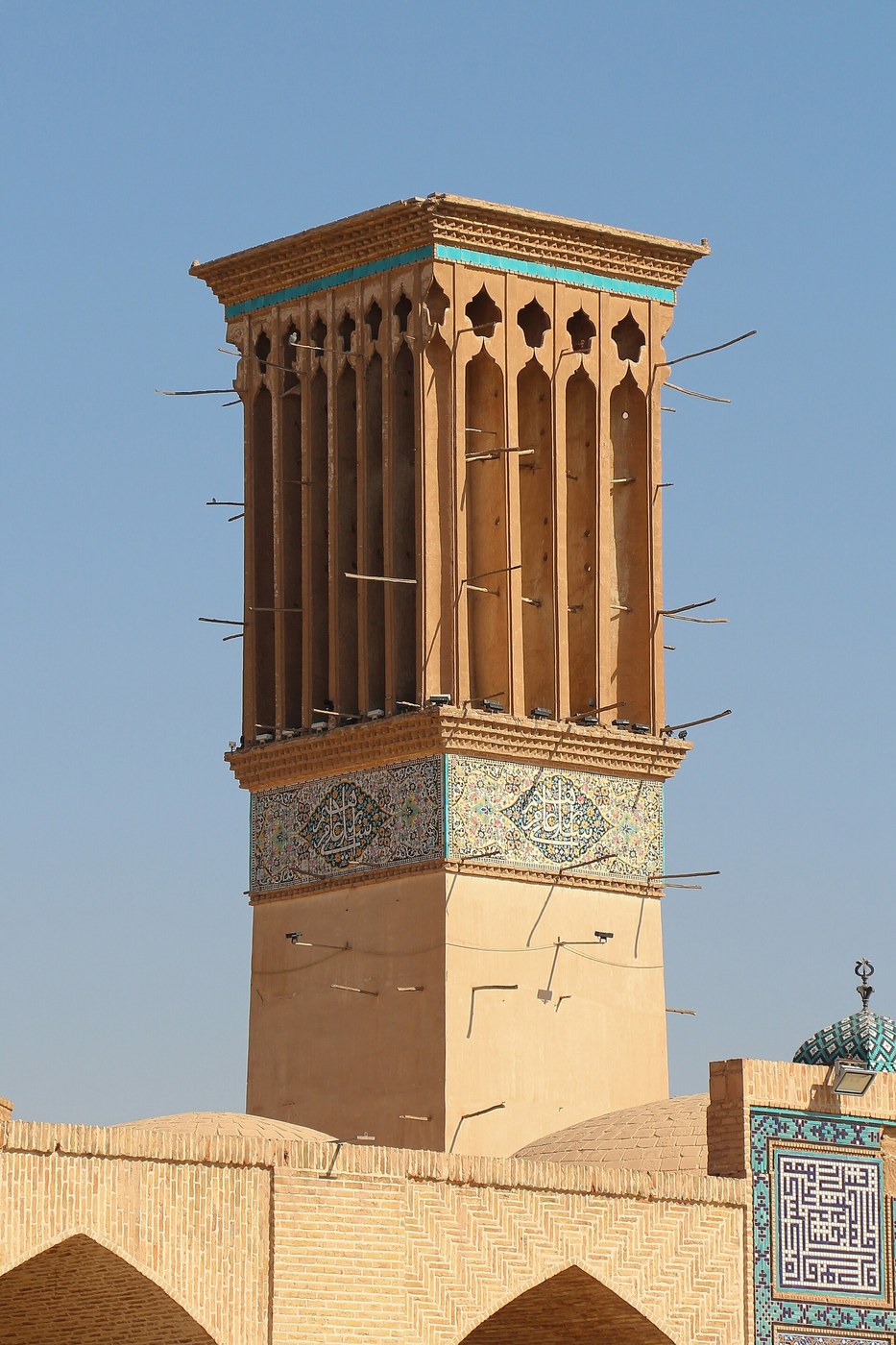


The Windcatcher
A fan moves air by spending energy. A windcatcher moves air by arranging a pressure difference and then getting out of the way.
It is a tower rising above a building, open on one or more faces. Wind striking an opening is brought to rest and its motion becomes pressure — positive on the windward side. On the leeward side the flow separates and leaves a region of negative pressure. Connect the two through the rooms below and air is pushed in at one face and sucked out at the other, continuously, with no moving part.
The second mechanism works when there is no wind at all. On a still night the tower's masonry has cooled; air inside it is denser than the outside air, so it sinks down the shaft and pushes room air out elsewhere. By day the tower's sunlit side heats, that column rises, and the flow reverses — a solar chimney in the same structure.
Add water at the bottom — a qanat channel, a wet mat, a pool — and the incoming air is chilled by evaporation before it reaches anyone.
The building becomes the machine. Height, orientation and openings do what a motor would otherwise be paid to do.
Instructions
Turn wind into a pressure difference you can measure
Turn wind into a pressure difference you can measure
Hold a tube with one end facing into the wind and the other end sheltered behind an obstacle, and connect the two ends to a simple water manometer — a U of clear tubing with coloured water in it.
Expect a steady difference in level, and expect it to grow sharply as the wind rises.
Note that the windward reading is positive and the leeward one is negative relative to still air — the sheltered side is actively sucking.
Both signs are useful. Most people design for the push and forget that the pull is often the larger and steadier of the two.
Materials for this step:
 Silicone Tubing (6mm ID)2 m
Tools needed:
 Measuring Tape 3m
Prove that one opening does almost nothing
Prove that one opening does almost nothing
Build a model room with a tower on top. First give it a single opening and measure the airflow through the room with a smoke source or a light streamer. Then open a second aperture on the opposite side.
Expect a single opening to produce almost no through-flow, and the second to start a strong steady current.
Air will not enter a sealed box. Ventilation is not a hole; it is a PAIR of holes at different pressures, and the flow is set by the weaker of the two.
Make it work with no wind at all
Make it work with no wind at all
On a still evening, chill the inside of your model tower — a bag of ice at the top, or simply test after the masonry has cooled overnight — and look for downward flow. Then warm one side in the sun and look again.
Expect downdraught when the shaft is cooler than outside and updraught when it is warmer.
Measure how the effect grows with tower height.
This is buoyancy, and it scales with the height of the column and the temperature difference. A tall shaft is a pump you do not have to buy, and it is why windcatchers are far taller than the openings need.
Chill the incoming air with water
Chill the incoming air with water
Run the intake air over a wet cloth or a shallow tray of water at the base of the shaft, and measure temperature before and after.
Expect a useful drop in dry air and almost nothing in humid air.
Then measure the humidity as well as the temperature, and note the trade being made: you are exchanging heat for moisture, and the lowest temperature you can reach is the wet-bulb temperature, not zero.
Evaporative cooling is free where air is dry and useless where it is not — which is why this technology maps almost exactly onto the world's desert belts.
Choose how many faces to open
Choose how many faces to open
Test three tower heads: one opening facing the prevailing wind, two facing opposite ways, and four open faces. Measure flow with the wind from several directions.
Expect the single opening to be best when the wind is right and useless when it is not, and the four-sided head to be never best but never hopeless.
That is a design choice, not a design error. Where a monsoon blows dependably from one quarter, build one-sided; where wind is fickle, accept a lower peak for a usable average.
Optimise for the worst case or the common case, and say which you chose.
History & Context
History & Context
They are ancient and geographically enormous. Wind towers appear across Iran, the Gulf, Egypt and Pakistan under many names — bâdgir, malqaf, barjeel — with the tradition running back thousands of years and the tall multi-sided Persian form well developed by the medieval period. Yazd's skyline is essentially a forest of them.
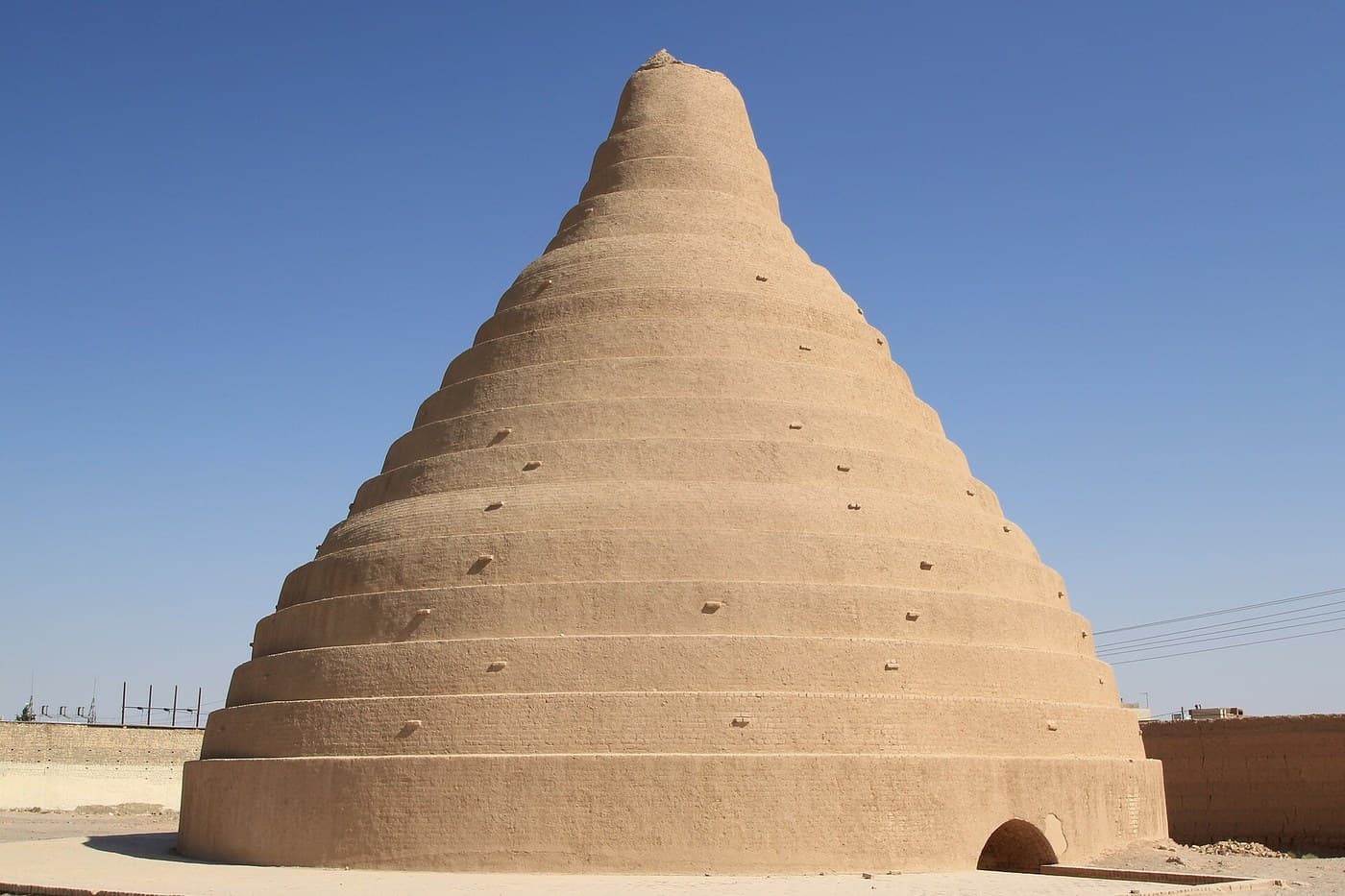
The best examples are coupled to the water system. A bâdgir drawing air across the surface of a qanat channel delivers air that has been shaded, then chilled by evaporation, then distributed — a three-stage conditioning plant with no moving parts and no fuel. Judge a vernacular technology as a system or you will underrate it, which is the same error as judging the yakhchāl's dome without its shade wall.
Air conditioning did not so much beat it as make it unnecessary. Cheap electricity and a compressor deliver cold air anywhere, in any humidity, on demand, controlled to a degree — none of which a wind tower can promise. Towers were abandoned across the Gulf within a generation. A technology that is free but conditional loses to one that is expensive and unconditional, until the price of the second changes.
It is being rebuilt, deliberately. Modern passive and mixed-mode buildings use wind towers, solar chimneys and night-purge ventilation, sometimes with a small fan to guarantee flow when physics will not. Masdar City's wind tower is the showpiece, but the same reasoning appears in ordinary schools and offices. The old design is not being copied for charm; it is being copied because the pressures it exploits are still free.
Honest limits. Flow depends on wind and on temperature difference, so it is variable and cannot be guaranteed. Evaporative pre-cooling only works in dry air. Open towers admit dust, insects, noise and rain, and need cleaning. They occupy roof space and considerable masonry. And they cannot dehumidify — which, as the air-conditioning blueprint at the end of this batch argues, turned out to be the thing that actually mattered.
Materials
1- Placeholder
Tools Required
1- 1 vendor sell this, none ship to you yetPlaceholder
Connected Blueprint Materials

CC0 Public Domain
This blueprint is released under CC0. You are free to copy, modify, distribute, and use this work for any purpose, without asking permission.
Support the Maker by purchasing products through their Blueprint where they earn a Maker Commission set by Vendors, or create a new iteration of this Blueprint and include it as a connection in your own Blueprint to share revenue.