Collaboration
ART
BEAUTY & WELLNESS
CRAFT
CULTURE & HISTORY
ENTERTAINMENT
ENVIRONMENT
FOOD & DRINKS
REVERSE ENGINEERING
SCIENCES
SPORTS
TECHNOLOGY
WEARABLES
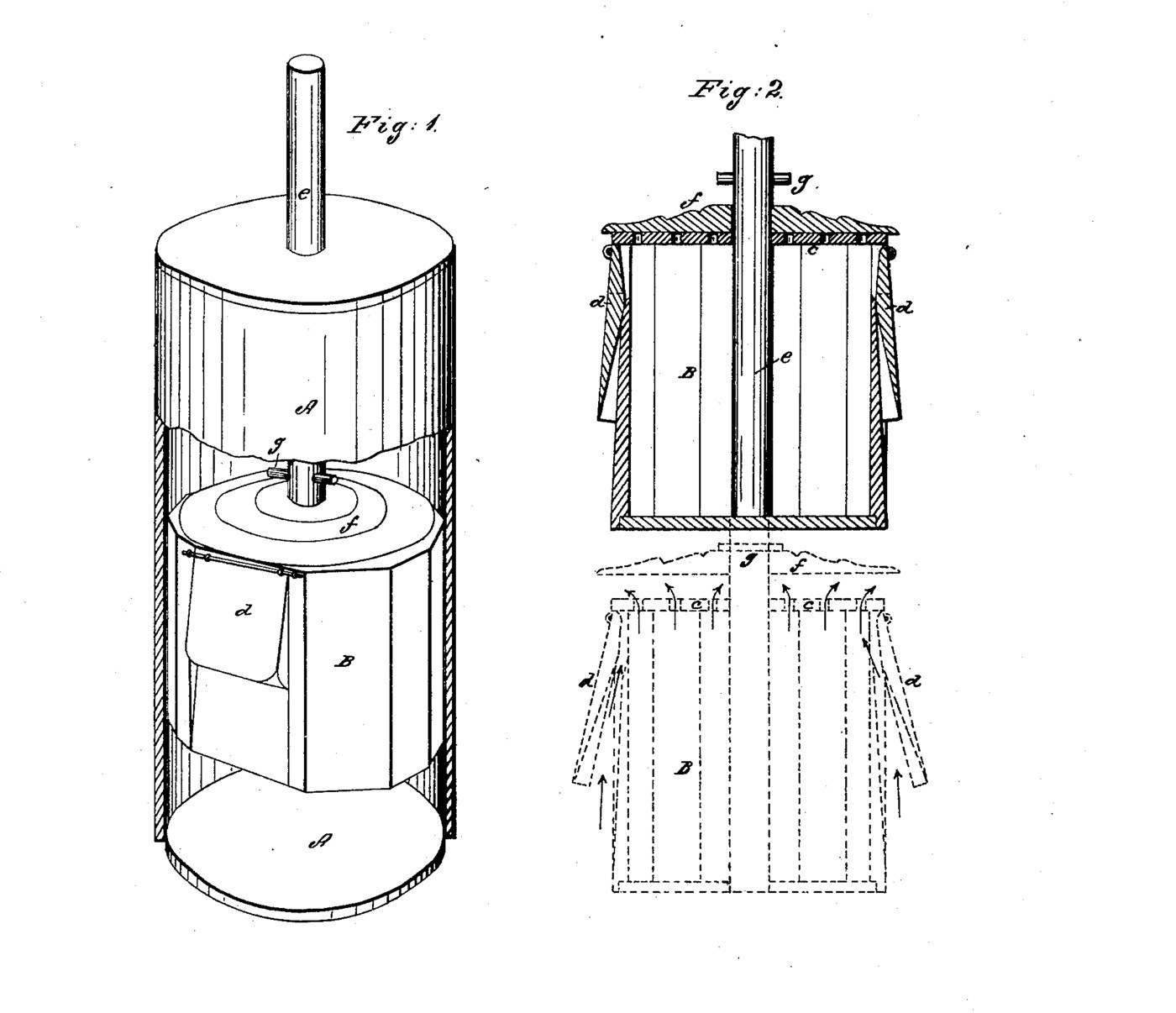


Valve-and-Cap Churn Dasher: Cream Driven Through Hinged Valves and Out of a Perforated Top Against a Sliding Cap
Parker Wineman of Loydsville, Ohio, received US 24,898, dated 26 July 1859, for a churn dasher that is itself a closed vessel. Pushed down, it takes cream in under hinged valves on its sides; the cream mingles with the air inside and is driven out through the holes of its perforated top against a cap that slides on the shaft up to a stop. The butter falls to the bottom of the dasher, and a segment of it is taken out to remove the butter.
This rung prints the dasher for a 20-litre bucket.
Intermediate
About 1 day, plus printing
Instructions
1
1
Where the cream stands
Where the cream stands
Loading Jupyter Notebook...
2
2
An up-and-down dasher, before it
An up-and-down dasher, before it
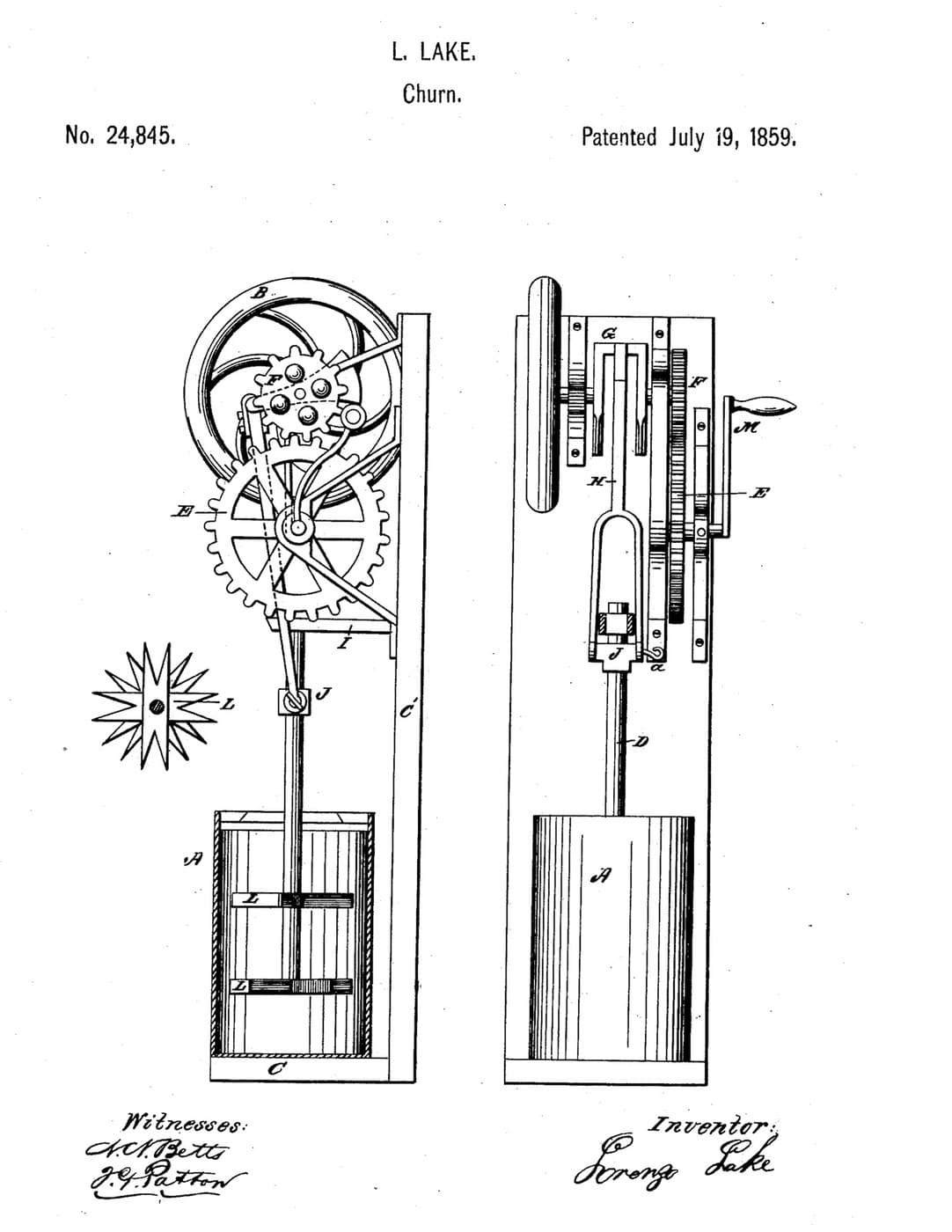
Lake's dashers cut the cream with notched boards. Wineman's dasher takes the cream inside it and drives it out against a cap.
3
3
Read US 24,898
Read US 24,898
"As the dasher is forced downward, the cream is forced under the valves (d) into the dasher, where it instantly mingles with the contained air, and is forced through the perforations (i) of the top of the dasher (c) against the cap with such violence as to burst the particles of cream or milk in which the butter is contained."
4
4
Print the dasher body
Print the dasher body
The octagonal dasher B, 160 mm across flats and 190 mm tall, closed at the floor, with two ports, the hinge lugs, the hub for the shaft and the opening for the side panel. Print it standing on its floor. PETG, 0.2 mm layers, 30 % infill, 4 walls.
5
5
Print the perforated top c
Print the perforated top c
The top c with 56 holes of 6 mm, a lip that drops into the body and a hub for the shaft. PETG, 0.2 mm layers, 30 % infill, 4 walls.
6
6
Print the valve flaps d
Print the valve flaps d
One flap, 50 x 100 mm with its hinge knuckle. Print two. PETG, 0.2 mm layers, 30 % infill, 4 walls.
7
7
Print the side panel
Print the side panel
The removable segment, a panel with a flange that sits on a lip at its foot. PETG, 0.2 mm layers, 30 % infill, 4 walls.
8
8
Print the cap f
Print the cap f
The cap, 168 mm across, a shallow cone with a 26 mm bore that slides on the shaft. PETG, 0.2 mm layers, 30 % infill, 4 walls.
9
9
Shaft, pins and handle
Shaft, pins and handle
Cut a 25 mm stainless tube 600 mm long for the shaft e. Drill 6 mm holes across it 10 mm and 185 mm from its foot for the pins that hold the body's hub and the top's hub, and one 233 mm from its foot for stop g. Cut 6 mm stainless pins 44 mm long and 3 mm pins 64 mm long, file their ends smooth, and make a hardwood T handle 200 mm wide bored for the tube's top.
Materials for this step:
 Stainless Steel Tube1 piece
 Stainless Steel Rod2 pieces
 Hardwood Board1 piece
 Wood Glue1 piece
Tools needed:
 Hacksaw
 Hand Saw
 Cordless Drill
 Drill Bit Set
 Spade Bit Set
 Files (Hand File)
 Sandpaper
 Tape Measure
10
10
Assemble the dasher
Assemble the dasher
Slide the body onto the shaft and pin its hub. Hang a flap over each port on a 3 mm pin through the lugs, and check it swings out freely and falls back shut. Press the top c into the body and pin its hub. Slide the cap f on above it and push the stop pin g through, so the cap can lift 20 mm. Set the side panel's foot on its lip and slide the 3 mm locking pin over its top. Put the handle on, and pass the shaft through a 28 mm hole in the bucket's lid.
Materials for this step:
 PETG Filament1 piece
 20-Liter Bucket1 piece
Tools needed:
 FDM 3D PrinterCordless DrillSpade Bit Set
11
11
The build in 3D
The build in 3D
FreeCAD model of this build, half the bucket and lid cut away: the octagonal dasher with its flaps swung open, the perforated top, the cap lifted to its stop, the shaft and handle. It was checked at three heights of the stroke with the flaps shut and open and the cap down and up.
12
12
Churn
Churn
Pour about 8 litres of heavy cream at about 15 °C into the bucket, checked with the thermometer, and put the lid on. Work the handle up and down about 100 mm, keeping the dasher's floor off the bucket's floor, and time it. When the butter has come, lift the dasher out, pull the panel's pin, take out the panel and scoop out the butter. Pour off the buttermilk, wash the butter in cold water until it runs clear, work in a pinch of salt and weigh it.
Materials for this step:
 Heavy Cream8 l
 Coarse Sea Salt1 piece
 Water1 piece
Tools needed:
 Leave-In Probe Thermometer
 Stopwatch
 Digital Kitchen Scale
 Stainless Steel Mixing Bowl (Large)
13
13
Troubleshooting
Troubleshooting
Valve-and-cap dasher troubleshooting.
Flow
Loading...
14
14
History and honest limits
History and honest limits
**Parker Wineman** of Loydsville, Belmont County, Ohio, US 24,898, 26 July 1859, "Churn-Dasher". He claimed the dasher with its perforated top, movable cap and hinged valves. He gives no sizes and says the valves may be arranged in various ways. Fig. 1 draws the dasher with flat sides, which we copy; our flaps hang over ports near the top as in Fig. 2. Every size is ours, and our printed build has not been churned with.
Materials
9- 1 piecePlaceholder
- 2 piecesPlaceholder
- 1 piecePlaceholder
- 1 piecePlaceholder
- 1 piecePlaceholder
- 1 piecePlaceholder
- 8 lPlaceholder
- 1 piecePlaceholder
- 1 piecePlaceholder
Tools Required
13- Placeholder
- Placeholder
- 1 vendor sell this, none ship to you yetPlaceholder
- Placeholder
- Placeholder
- Placeholder
- Placeholder
- 1 vendor sell this, none ship to you yetPlaceholder
- Placeholder
- Placeholder
- Placeholder
- Placeholder
- Placeholder
Design Files
6This blueprint makes

Related Blueprints
These blueprints share knowledge with this one — techniques, materials, or principles that connect them in the learning graph.



CC0 Public Domain
This blueprint is released under CC0. You are free to copy, modify, distribute, and use this work for any purpose, without asking permission.
Support the Maker by purchasing products through their Blueprint where they earn a Maker Commission set by Vendors, or create a new iteration of this Blueprint and include it as a connection in your own Blueprint to share revenue.