ART
BEAUTY & WELLNESS
CRAFT
CULTURE & HISTORY
ENTERTAINMENT
ENVIRONMENT
FOOD & DRINKS
REVERSE ENGINEERING
SCIENCES
SPORTS
TECHNOLOGY
WEARABLES
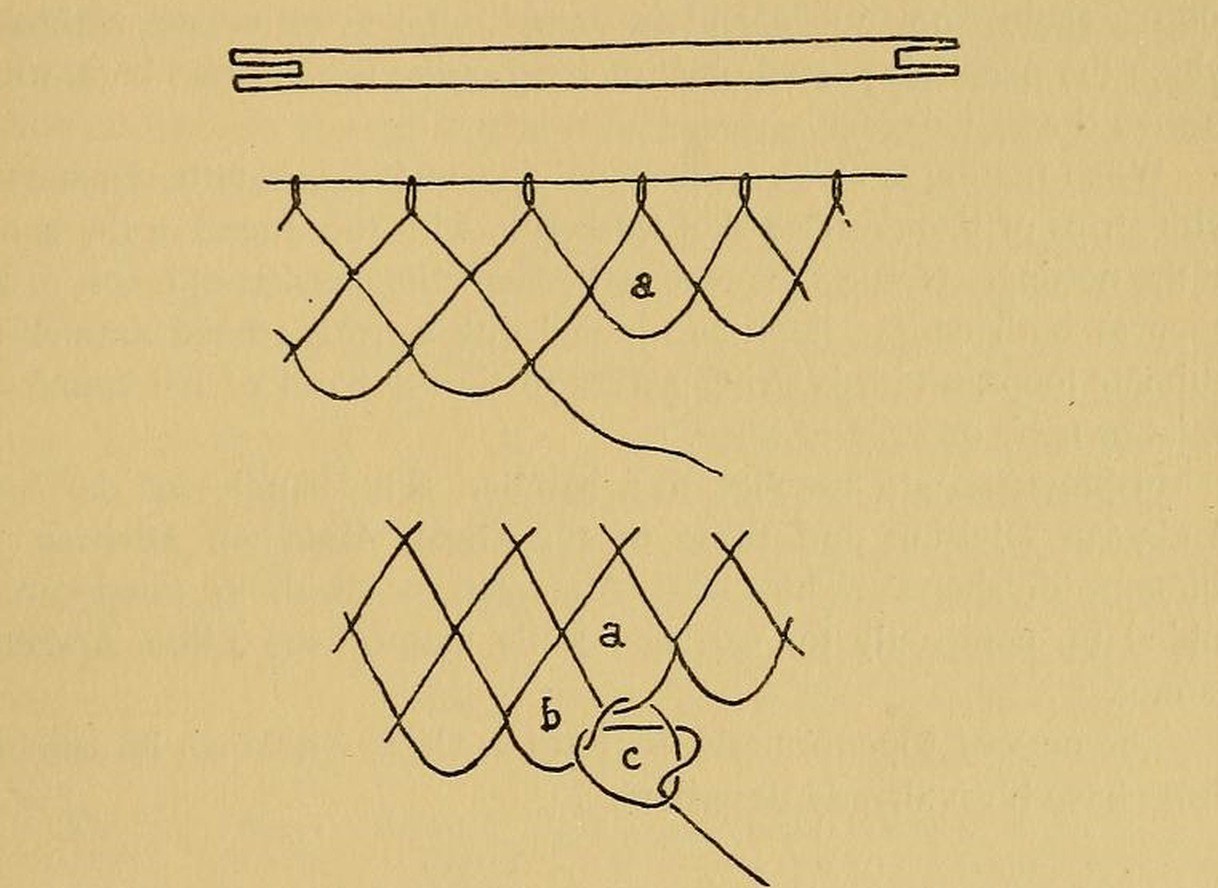


Wooden Netting Needle and Mesh Gauge
Hand nets are knotted with sheet bends from a netting needle holding the twine, round a gauge that keeps every mesh the same size. Carve a flat needle forked at both ends to wind the twine on, and a smooth gauge stick half as wide as the mesh.
The picture: a forked netting needle and the method of netting, from an old textbook figure.
Beginner
Two hours
Instructions
1
1
Cut the blanks
Cut the blanks
Saw a flat strip about 20–25 cm long for the needle, a little narrower than the gauge (step 4), and a second strip for the gauge.
Materials for this step:
 Hardwood Strip2 pieces
Tools needed:
 Tenon Saw
 Ruler
Ruler2
2
Fork the needle
Fork the needle
Saw a slot about 2 cm deep into each end and round the prongs with the knife, so twine wound lengthwise sits in the forks.
Tools needed:
 Bench Vise
 Coping Saw
 Sloyd Carving Knife
3
3
Smooth them
Smooth them
Rasp and sand both pieces smooth with rounded edges so the twine slides without catching. Rub in a little oil.
Materials for this step:
 Linseed Oil0.01 liter
Tools needed:
 Wood Rasp
 Sandpaper
4
4
Sizes
Sizes
Loading Jupyter Notebook...
Materials
2- 2 piecesPlaceholder
- 0.01 literPlaceholder
This blueprint makes


Related Blueprints
These blueprints share knowledge with this one — techniques, materials, or principles that connect them in the learning graph.

CC0 Public Domain
This blueprint is released under CC0. You are free to copy, modify, distribute, and use this work for any purpose, without asking permission.
Support the Maker by purchasing products through their Blueprint where they earn a Maker Commission set by Vendors, or create a new iteration of this Blueprint and include it as a connection in your own Blueprint to share revenue.