
Yak Hair Selection and Processing — Bhutan's Yak Hair Industry
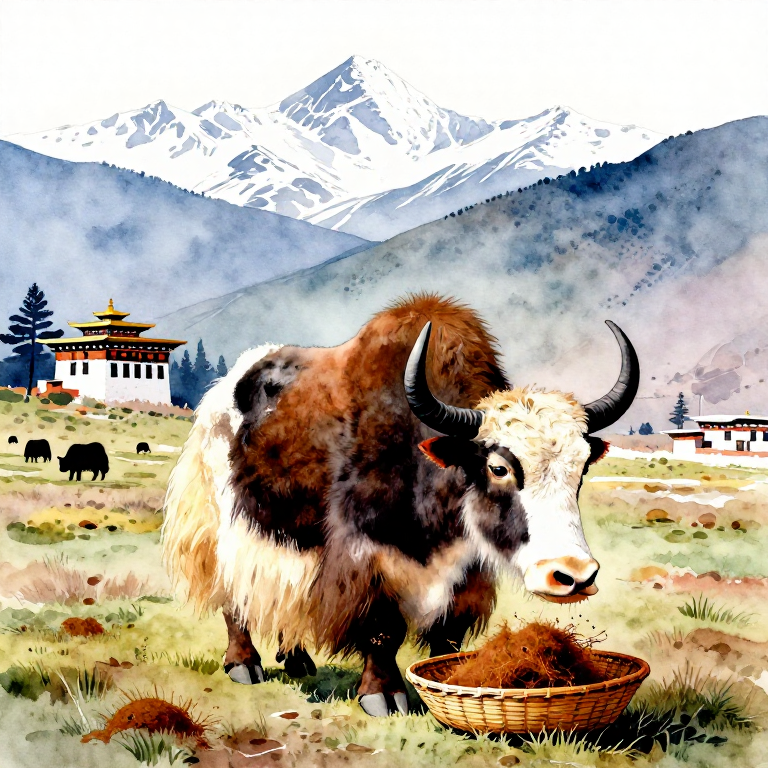
Detailed guidelines for processing yak hair (Bos grunniens) from the Kingdom of Bhutan. Yaks have three types of hair: outer guard hair (20-120 microns), middle hair, and inner fine fiber/down (16-20 microns). This inner fine fiber has a fineness similar to cashmere (cashmere). During the spring hair shedding season (spring months 3-5), herders must collect the hair. One yak produces 100-500 grams of hair per year.
Bhutan has 30,000-40,000 yaks. The northern regions (Bumthang, Wangdue, Chongsar) have the most. Yak herders (nomads) use yak hair for rope, yarn, and textile production. Yak fine hair is warmer than sheep wool, and if properly water-resistant treated, it does not shrink. The market price for processed yak fine fiber per kilogram per year is $80-150.
Instructions
Characteristics of Yak Hair
Characteristics of Yak Hair
The yak (Bos grunniens) is a wild animal that lives on high plateaus (3000-5500 meters). The yak has three types of hair: outer coarse hair (guard hair, diameter 20-120 microns), middle hair, and inner fine down fiber (diameter 16-20 microns). This inner fine down fiber has slight differences with cashmere (14-19 microns) in fineness. Yak fine down fiber is warmer than sheep wool, and when properly washed with water, it does not shrink. From one yak per year, 100-500 grams of fiber can be obtained.
Timing of hair shedding
Timing of hair shedding
Yak naturally sheds their winter coat during spring (March to May). As the weather warms, the thin inner coat emerges from under the outer hair. This is the best time for yak wool collection. If done too early, the yak will lose body heat protection. If done too late, some wool will be lost naturally. In Bhutan, the optimal period is from mid-April to May.
Preparation of combs and tools
Preparation of combs and tools
For yak hair selection, a wide-toothed comb is needed. The comb teeth should have rounded tips — sharp teeth will damage the yak's skin. If the comb teeth are spaced 3-5 millimeters apart, fine hair can be selected well. In particular, a collection bag (collection bag) is also needed. Collection bags of each color (white, black, brown, gray) are needed respectively.
Tools needed:
 Wide-Toothed Comb (Rounded Tips, 3-5mm spacing)
 Collection Bags (by color)
Yak holding/restraining
Yak holding/restraining
Yak holding/restraining is necessary. If you hold a calm and steady yak during milking, it is comfortable for both the yak and the person. Tie a rope around the yak's nose ring and fasten it to a wooden post. Do not let the rope become slack — if the yak becomes anxious, the quality of the milk decreases. Two people are needed — one to hold the yak, one to milk. Yak herders (herding people) can hold the yak very firmly by talking to it.
Tools needed:
 Soft Rope for Tethering
 Tethering Post
Like the direction of hair growth, shear
Like the direction of hair growth, shear
Shear with the grain of the goat's hair (with the grain) — if you go against the grain, the goat will feel pain. Place the blade close to the goat's skin and push outward. Place the fine comb on top of the sheared hair. The coarse guard hair will come out from the goat. Start from one side (side) of the goat — this side has the most hair. Go over one area 3-5 times while shearing to collect all the hair.
Tools needed:
Wide-Toothed Comb (Rounded Tips, 3-5mm spacing)Naturally Shed Fiber Collection
Naturally Shed Fiber Collection
When collecting fiber during the spring season, naturally shed fiber found on the yak's body is also collected. There is abundant naturally shed fiber in yak resting areas (resting area) and rubbing posts (rubbing posts). When these are collected, complete fiber yield is obtained. Fiber left on trees and forests is also collected. Yak herders (herders) regularly and continuously collect naturally shed fiber according to established guidelines.
Tools needed:
Collection Bags (by color)Coarse hair and fine undercoat separation
Coarse hair and fine undercoat separation
In the selected coat, there are both coarse hair (guard hair) and fine undercoat (down). Hand stripping process: coarse hair (diameter 20+ microns) is straight, glossy, and long (5-25 centimeters). Fine undercoat (16-20 microns) is soft, dense, and short (3-5 centimeters). Remove coarse hair by hand and leave fine undercoat. This takes some time, but properly prepares the undercoat texture.
Tools needed:
 Sorting Table
Color sorting
Color sorting
Yak wool comes in brown, black, grey, and white colors. White is very rare and commands the highest price — it is easier to dye, so colors are kept separate by type. Mixed color wool has lower value. The wool obtained is mostly of one color from each yak. Since black yaks are most common, black wool is most abundant.
Materials for this step:
 Cloth Sorting Bags (per color)4 pieces
Cold water wash
Cold water wash
Wash delicate wool in cold water (15-25°C) or lukewarm water. Never use hot water — hot water causes delicate wool to felt. Use mild soap (pH 7-8). Soak wool in water for 20-30 minutes. Wash gently by pressing — do not wring forcefully. Rinse 2-3 times with fresh cold water until all soap is removed. Rinse all the lanolin from the wool.
Materials for this step:
 Cold Water (15-25C)20 liters
 Mild Soap1 piece
Tools needed:
 Large Washing Basin
Dry in the shade
Dry in the shade
After washing the wool and squeezing out the excess water (not wringing — if wrung, it will stretch), spread it on a clean cloth and dry in the shade (shade). Do not place in direct sunlight — the wool's elasticity will be damaged. Dry for 1-2 days. The dried wool should be soft, fluffy, and dry. If wet wool is left, mold will develop.
Tools needed:
 Drying Rack
 Clean Cotton Cloth
Dehairing (Removing coarse hair)
Dehairing (Removing coarse hair)
There are some guard hairs remaining in the skin of dried fur. Remove guard hair by hand — spread the fur in a bright light area where the guard hair becomes very clear to see. Since guard hair is straight, shiny, and longer than fine hair, it can be plucked out by hand. For commercial purposes, using dehairing machines can obtain 95% fine hair. Manual labor obtains 80-90%.
Tools needed:
Sorting Table Bright Work Light
spread out after washing
spread out after washing
Fine wool from dried goat skin is washed. From one goat, 100-500 grams of fine wool is obtained (depending on type, age, and body size of the animal). Wool of different colors is kept in separate bundles. Each bundle is marked with weight, color, and date. Bhutanese goat wool is sold in the international market at a price of $80-150 per kilogram. White wool has the highest price.
Materials for this step:
 Paper Labels4 pieces
Tools needed:
 Kitchen Scale
Woolen fabric storage
Woolen fabric storage
Fine, dry woolen fabric. Store in a cool, breezy location. Temperature 15-20°C. Good if humidity is 50-60%. Use breathable cotton bag — if plastic bag is used, moisture gets trapped causing mildew. Do not press fabric — pressed fabric becomes creased. Put cedar ball in the bag to protect from moths (moth). If stored properly, woolen fabric maintains its quality for many years.
Materials for this step:
 Breathable Cotton Storage Bag4 pieces
 Cedar Moth Repellent Balls4 pieces
Materials
8- 4 piecesPlaceholder
- 20 litersPlaceholder
- 1 piecePlaceholder
- 4 piecesPlaceholder
- 4 piecesPlaceholder
- 4 piecesPlaceholder
- 20 litersPlaceholder
- 1 piecePlaceholder
Tools Required
10- Placeholder
- Placeholder
- Placeholder
- Placeholder
- Placeholder
- Placeholder
- Placeholder
- Placeholder
- Placeholder
CC0 Public Domain
This blueprint is released under CC0. You are free to copy, modify, distribute, and use this work for any purpose, without asking permission.
Support the Maker by purchasing products through their Blueprint where they earn a Maker Commission set by Vendors, or create a new iteration of this Blueprint and include it as a connection in your own Blueprint to share revenue.