ART
BEAUTY & WELLNESS
CRAFT
CULTURE & HISTORY
ENTERTAINMENT
ENVIRONMENT
FOOD & DRINKS
REVERSE ENGINEERING
SCIENCES
SPORTS
TECHNOLOGY
WEARABLES


Yoshino Tissue: Kozo Paper So Thin Fifty Sheets Weigh 35 Grams (Nibu, after Rein 1889)
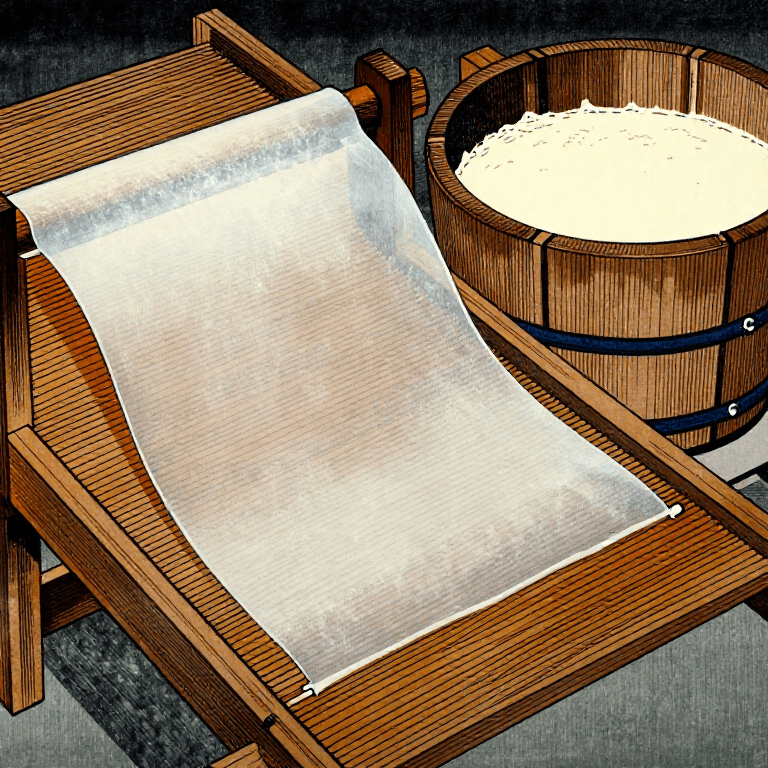
Yoshino-gami from Nibu in Yamato was the finest tissue of Japan: so thin that fifty sheets weigh 35 g, yet so strong that lacquer makers wrung thick lacquer through two or three layers and used them again. Light, tough tissue like this is what covers model wings.
Result: kozo tissue, sheets 48 x 25.5 cm, 50 sheets 35 g (about 5.7 g per square metre).
Source: J. J. Rein, The Industries of Japan (1889), pp. 399-405. Not given: amounts per vat, lye strength, beating time. Picture drawn by Youblob.
Advanced
3 days
Instructions
1
1
Clean the bast
Clean the bast
Take kozo bast freed of the dark outer skin and green parts, and cut out knot-holes and faulty spots.
Materials for this step:
 Kozo Bark1 as required
2
2
Boil in ash lye
Boil in ash lye
Boil the bast in an iron kettle with lye made from ashes, half an hour to three hours, until it is soft and crushes between the fingers.
Tools needed:
 Wood Ash Lye
 Iron Kettle
3
3
Wash clear
Wash clear
Wash the soft bast in a tub of fresh water, changing it four or five times until the water stays clear.
Materials for this step:
 Water1 as required
Tools needed:
 Wooden Tub
4
4
Beat to pulp
Beat to pulp
Lay the wet bast on a thick hardwood board and beat it with oak hammers of 1 to 2 lb, stirring and mixing in water often, until it is an even fibrous pulp. If the fibres are not yet apart, boil it again in plain water.
Tools needed:
 Flat Wooden Board
 Wooden MalletIron Kettle
5
5
Charge the vat
Charge the vat
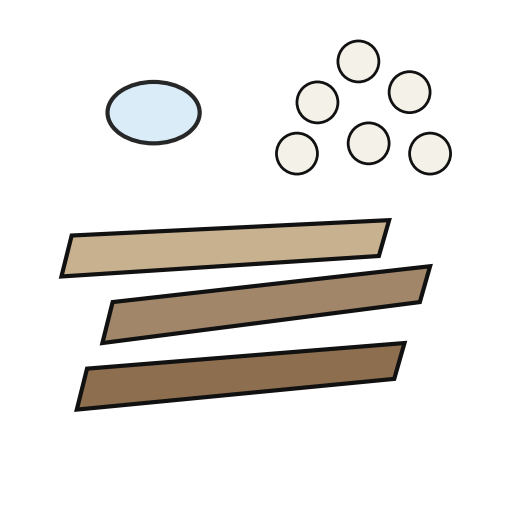
Put the pulp in the vat with water. Press out Nori-no-ki (Hydrangea paniculata) bark in water and add the slippery mucilage; it keeps the fibres floating apart. Ours: press the bark out in a linen bag.
Materials for this step:
 Nori-no-ki Bark (Hydrangea paniculata)1 as requiredWater1 as required
Tools needed:
 Vat
 Linen Bag
6
6
Scoop one thin layer
Scoop one thin layer
Dip a mould of fine bamboo sticks bound with silk thread and let the stuff flow toward you, so the fibres lie parallel. Fill it once only: a second, crossed filling makes a thicker paper.
Tools needed:
 SugetaVat
7
7
Pile and dry on boards
Pile and dry on boards
Pile the wet sheets on a mat with bamboo splints between them. When dry enough, brush each onto a smooth board and stand it slantwise in the sun; the dry sheet comes off by itself.
Tools needed:
 Bamboo Mat
 Wide BrushFlat Wooden Board
8
8
Check the tissue
Check the tissue
Sheets 48 x 25.5 cm; fifty of them should weigh about 35 g. The tissue is yellowish, silky and strong enough to be wrung without tearing.
Materials
3- 1 as requiredPlaceholder
- 2 as requiredPlaceholder
- 1 as requiredPlaceholder
This blueprint makes
Related Blueprints
These blueprints share knowledge with this one — techniques, materials, or principles that connect them in the learning graph.

CC0 Public Domain
This blueprint is released under CC0. You are free to copy, modify, distribute, and use this work for any purpose, without asking permission.
Support the Maker by purchasing products through their Blueprint where they earn a Maker Commission set by Vendors, or create a new iteration of this Blueprint and include it as a connection in your own Blueprint to share revenue.