ART
BEAUTY & WELLNESS
CRAFT
CULTURE & HISTORY
ENTERTAINMENT
ENVIRONMENT
FOOD & DRINKS
REVERSE ENGINEERING
SCIENCES
SPORTS
TECHNOLOGY
WEARABLES
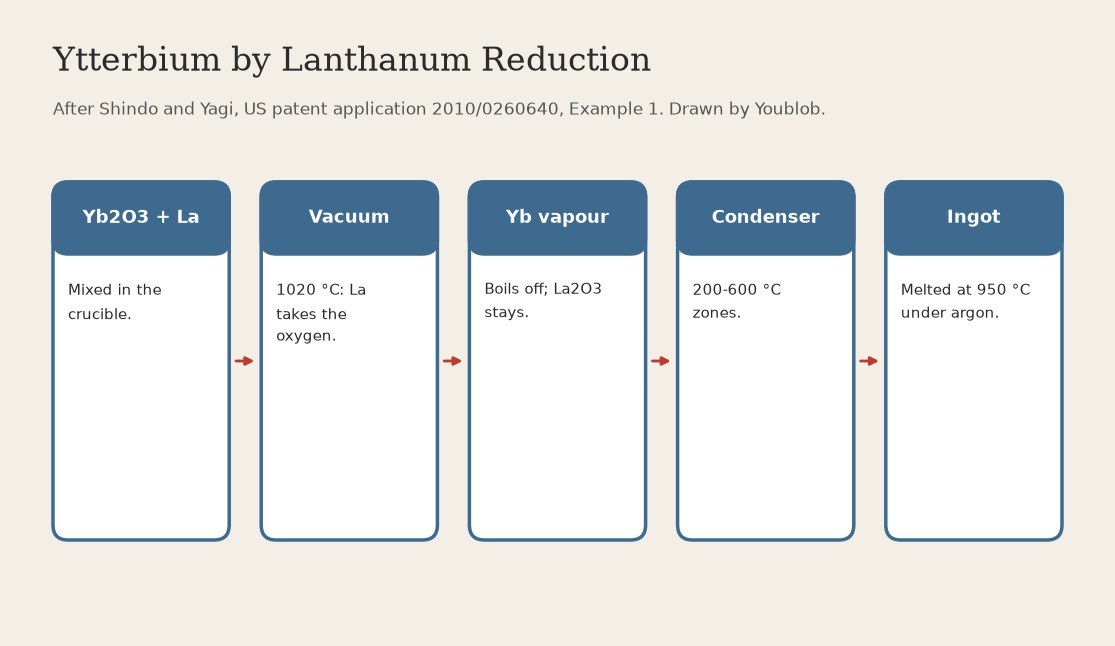

Ytterbium: Oxide Reduced by Lanthanum at 1020 °C in Vacuum, Metal Distilled Off (Shindo and Yagi, US 2010/0260640)
Ytterbium boils far more easily than lanthanum. Heated with lanthanum in a vacuum, ytterbium oxide gives up its oxygen to the lanthanum, and the freed ytterbium leaves as vapour and condenses in a cooler zone, while lanthanum oxide stays behind.
Result: ytterbium metal ingots; 20 kg of distillate in the patent's run, low in sodium, potassium and lithium.
Source: Y. Shindo and K. Yagi, US patent application 2010/0260640 (2010), Example 1. Not given: how much lanthanum, the vacuum, the time, crucible and condenser materials. Picture drawn by Youblob.
Advanced
1 day
Instructions
1
1
Mix the oxide with lanthanum
Mix the oxide with lanthanum
Mix ytterbium oxide with lanthanum metal as the reducing agent. Not given: the proportions.
Materials for this step:
 Ytterbium Oxide1 as required
Tools needed:
 Lanthanum
 Tantalum Crucible
2
2
Reduce in vacuum at 1020 °C
Reduce in vacuum at 1020 °C
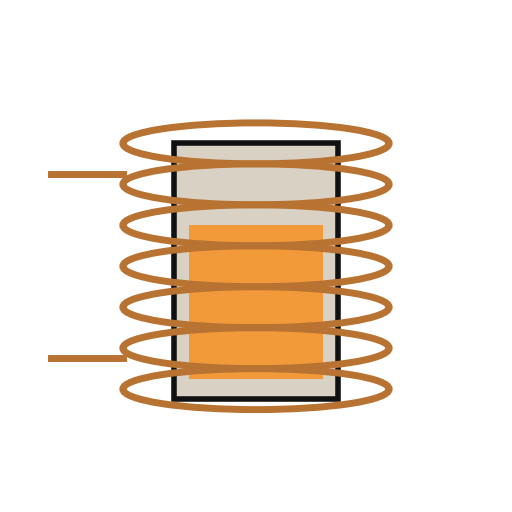
Heat the charge in a vacuum to 1020 °C: Yb2O3 + 2 La -> 2 Yb (vapour) + La2O3. Ours: a vacuum induction furnace; the vacuum level and time are not given.
Tools needed:
 Induction Furnace
 Vacuum PumpTantalum Crucible
3
3
Condense the ytterbium at 200-600 °C
Condense the ytterbium at 200-600 °C
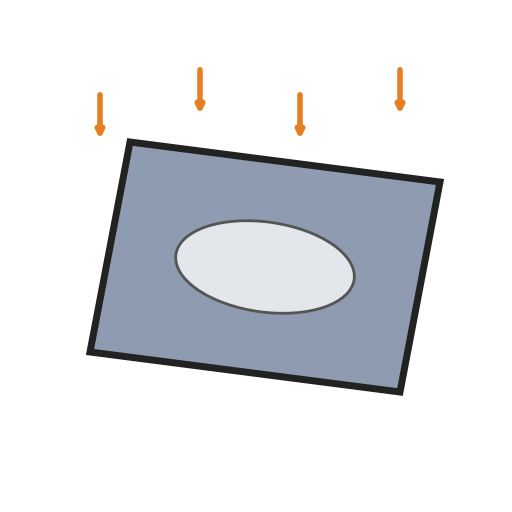
Catch the ytterbium vapour on a condenser held at 200-600 °C. Most of it settles in the 300-500 °C part; the 200-300 °C part carries the least sodium and lithium. Ours: a tantalum condenser plate.
Tools needed:
 Tantalum Condenser Plate
4
4
Melt into ingots under argon
Melt into ingots under argon
Take the distillate off the condenser, melt it in a crucible at 950 °C under a slight pressure of argon, and let it solidify into an ingot.
Tools needed:
Tantalum CrucibleInduction Furnace Argon
Materials
1- 1 as requiredPlaceholder
This blueprint makes

Related Blueprints
These blueprints share knowledge with this one — techniques, materials, or principles that connect them in the learning graph.
Hazardous
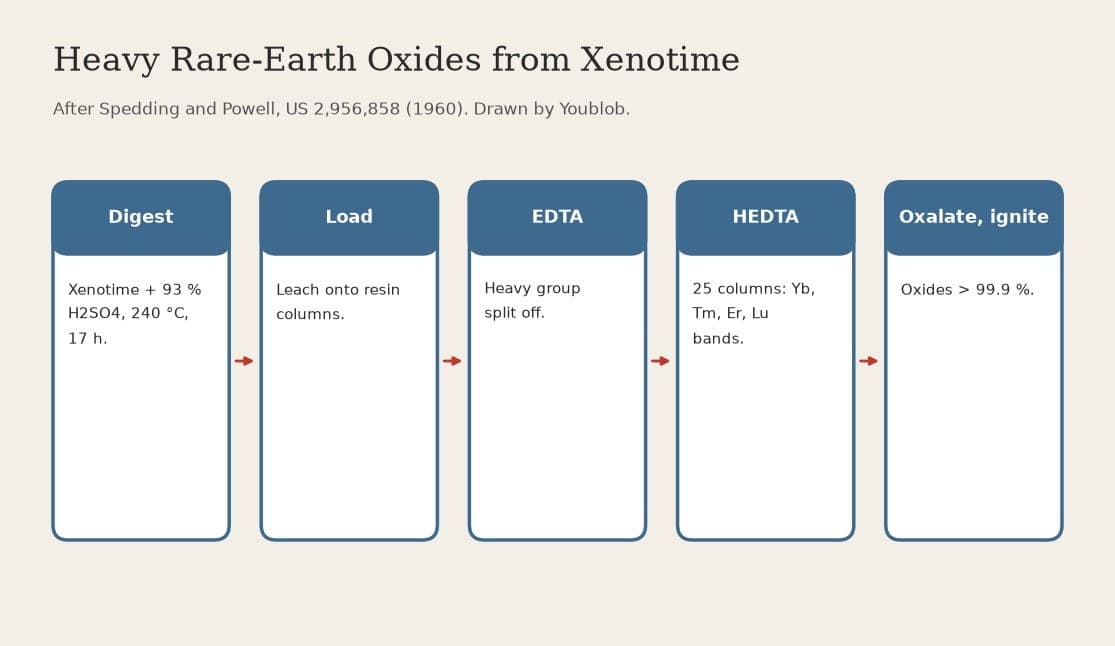
Erbium, Ytterbium, Thulium and Lutetium Oxides: Xenotime Separated on Ion Exchange Columns with EDTA and HEDTA (Spedding and Powell, US 2,956,858)
by Charlie
Inorganic
2
0
0
0
0
0
Hazardous
Lanthanum: Anhydrous Chloride Reduced with Calcium in a Tantalum Bomb under Argon, then Vacuum Cast (Daane, Ames 1950)
by Charlie
Inorganic
1
0
0
0
0
0
CC0 Public Domain
This blueprint is released under CC0. You are free to copy, modify, distribute, and use this work for any purpose, without asking permission.
Support the Maker by purchasing products through their Blueprint where they earn a Maker Commission set by Vendors, or create a new iteration of this Blueprint and include it as a connection in your own Blueprint to share revenue.